


"Here!" cried Alice, forgetting in her hurry how huge she had grown in the last few minutes. She jumped up so fast that the edge of her skirt tipped over the jury box, spilling all the jurors onto the heads of the crowd below, where they lay sprawling about like the goldfish from a bowl she had accidentally knocked over the week before.
"Oh, I beg your pardon!" she cried in alarm, and began picking them up as quickly as she could, with a confused idea from her goldfish accident that they must all be put back into the jury box at once or they would die.
"The trial cannot go on," said the King in a very serious voice, "until all the jurors are back in their proper places—all!" he repeated firmly, glaring hard at Alice.
Alice looked into the jury box and saw that in her rush she had put the Lizard in upside down, and the poor little fellow was waving his tail helplessly in the air, unable to move. She quickly pulled him out and set him right. "Not that it matters much," she thought to herself. "He would be just as useful in the trial one way up as the other."
As soon as the jurors had recovered from the shock and their slates and pencils had been returned to them, they set to work busily writing down the whole story of the accident—all except Bill the Lizard, who seemed too stunned to do anything except sit with his mouth open, staring up at the roof.
"What do you know about this business?" the King asked Alice.
"Nothing," said Alice.
"Nothing whatever?" insisted the King.
"Nothing whatever," said Alice.
"That's very important," the King said, turning to the jury. They were just starting to write that down when the White Rabbit interrupted. "Unimportant, your Majesty means, of course," he said respectfully, though he frowned and made faces at the King.
"Unimportant, of course I meant," the King said quickly, and then muttered to himself, "important—unimportant—unimportant—important—" as if testing which word sounded better. Some jurors wrote "important" and some wrote "unimportant." Alice saw this easily, being near enough to look over their slates, "but it doesn't matter a bit," she thought.
At that moment the King, who had been writing busily in his notebook, shouted, "Silence!" and read aloud, "Rule Forty-two. All persons more than a mile high to leave the court."
Everybody looked at Alice.
"I'm not a mile high," said Alice.
"You are," said the King.
"Nearly two miles high," added the Queen.
"Well, I won't go, anyway," said Alice. "Besides, that's not a regular rule—you invented it just now."
"It's the oldest rule in the book," said the King.
"Then it ought to be Number One," said Alice.
The King turned pale and snapped his notebook shut. "Consider your verdict," he told the jury in a low, shaking voice.
"There's more evidence to come yet, your Majesty," said the White Rabbit, jumping up excitedly. "This paper was just picked up."
"What's in it?" asked the Queen.
"I haven't opened it yet," said the White Rabbit, "but it seems to be a letter written by the prisoner to—to somebody."
"It must have been," said the King, "unless it was written to nobody, which isn't usual, you know."
"Who is it addressed to?" asked one of the jurors.
"It isn't addressed at all," said the White Rabbit, unfolding the sheet. "In fact, it isn't a letter after all—it's a set of verses."
"Are they in the prisoner's handwriting?" asked another juror.
"No, they're not," said the White Rabbit, "and that's the strangest thing about it." The whole jury looked puzzled.
"He must have copied somebody else's handwriting," said the King, and the jurors all brightened up again.
"Please, your Majesty," said the Knave, "I didn't write it, and they can't prove I did. There's no name signed at the end."
"If you didn't sign it," said the King, "that only makes matters worse. You must have planned some mischief, or else you would have signed your name like an honest man."
Everyone clapped at this; it was the first really clever thing the King had said all day.
"That proves his guilt!" said the Queen.
"It proves nothing of the sort!" said Alice. "Why, you don't even know what the verses are about!"
"Read them," ordered the King.
The White Rabbit put on his spectacles. "Where should I begin, your Majesty?"
"Begin at the beginning, and go on till you come to the end: then stop," the King said seriously.
So the White Rabbit read these verses:
"They told me you had been to her,
And mentioned me to him:
She gave me a good character,
But said I could not swim.
He sent them word I had not gone
(We know it to be true):
If she should push the matter on,
What would become of you?
I gave her one, they gave him two,
You gave us three or more;
They all returned from him to you,
Though they were mine before.
I always thought that you had been
(Before she had this fit)
An obstacle that came between
Him, and ourselves, and it."
"That's the most important piece of evidence we've heard yet," said the King, rubbing his hands. "So now let the jury—"
"If any one of them can explain it," said Alice—she had grown so big by now that she was not a bit afraid of interrupting him—"I'll give him sixpence. I don't believe there's a bit of meaning in it!"
The jurors all wrote on their slates, "She doesn't believe there's a bit of meaning in it," though not one of them tried to explain the poem.
"If there's no meaning in it," said the King, "that saves a world of trouble, since we don't need to look for any. And yet," he went on, spreading the paper on his knee and squinting at it, "I seem to see some meaning after all. 'Said I could not swim'—you can't swim, can you?" he asked the Knave.
The Knave shook his head sadly. "Do I look like it?" he asked—which he certainly did not, being made completely of cardboard.
"All right so far," said the King, muttering as he read down the page. "'We know it to be true'—that's the jury, of course. 'I gave her one, they gave him two'—why, that must be what he did with the tarts! 'They all returned from him to you'—why, there they are!" he cried proudly, pointing to the dish of tarts on the table. "Nothing could be clearer than that! Then again—'Before she had this fit'—you've never had fits, my dear, have you?" he asked the Queen.
"Never!" screamed the Queen furiously, throwing an ink bottle at Bill the Lizard as she spoke. Poor Bill had stopped writing with his finger once he saw it made no mark, so he quickly began again, using the ink dripping down his face for as long as it lasted.
"Then the words don't fit you," said the King, looking round the courtroom with a smile. There was dead silence. "It's a pun!" the King added in an offended tone, and everybody laughed. "Let the jury consider their verdict!" he said for about the twentieth time that day.
"No, no!" cried the Queen. "Sentence first—verdict afterwards."
"Stuff and nonsense!" cried Alice loudly. "The idea of having the sentence first!"
"Hold your tongue!" shouted the Queen, turning purple.
"I won't!" said Alice.
"Off with her head!" screamed the Queen at the top of her voice. Nobody moved.
"Who cares for you?" said Alice, who had grown back to her full size by now. "You're nothing but a pack of cards!"
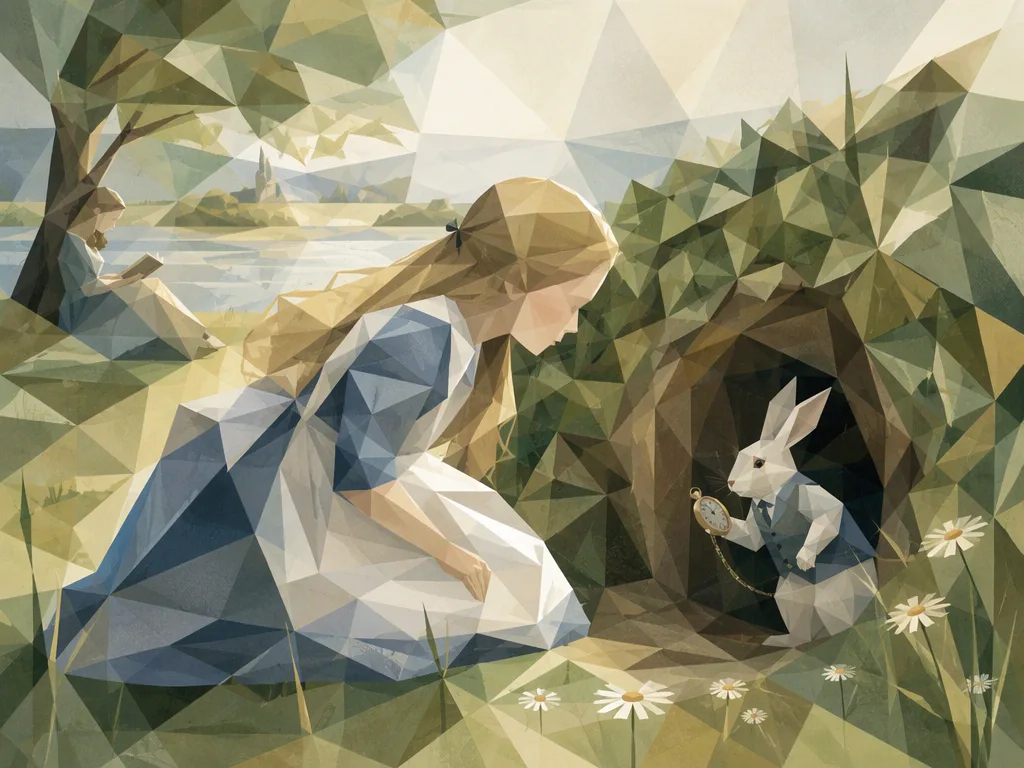
At those words the whole pack rose into the air and came flying down at her. She gave a little scream, half frightened and half angry, and tried to beat them off—and woke up lying on the riverbank with her head in her sister's lap, while her sister gently brushed away some dead leaves that had drifted down from the trees onto her face.
"Wake up, Alice dear!" said her sister. "Why, what a long sleep you've had!"
"Oh, I've had such a curious dream!" said Alice, and she told her sister, as well as she could remember them, all those strange adventures you have just been reading about. When she finished, her sister kissed her and said, "It was a curious dream, dear, certainly. Now run inside for your tea; it's getting late." So Alice got up and ran off, thinking as she ran what a wonderful dream it had been.
Her sister sat still where Alice had left her, leaning her head on her hand and watching the setting sun. She thought about little Alice and all her strange adventures until she too began half dreaming. First she dreamed of Alice herself: she felt the tiny hands clasped on her knee, saw the bright, eager eyes looking up into hers, heard the familiar voice, and pictured that quick little toss of the head to shake back the hair that always fell into her eyes. As she listened, the quiet riverbank seemed to come alive with the creatures of Alice's dream.
The long grass rustled at her feet as the White Rabbit hurried past, and the frightened Mouse splashed through the nearby pool. She seemed to hear the rattle of teacups at the March Hare's endless meal, and the shrill cries of the Queen ordering her guests' heads to be cut off. Once more the pig-baby sneezed on the Duchess's knee while plates and dishes crashed around it, and the Gryphon's cry, the squeaking of the Lizard's pencil, and the choking of the suppressed guinea pigs filled the air, mixed with the distant sobs of the unhappy Mock Turtle.
So she sat with closed eyes, half believing she was in Wonderland, though she knew she only had to open them and everything would turn back to ordinary life. The grass was only rustling in the wind, and the water was rippling among the reeds. The rattling teacups were really ringing sheep-bells, and the Queen's shrill cries were the calls of a shepherd boy. The baby's sneeze, the Gryphon's cry, and all the other strange sounds belonged to the busy farmyard nearby, while the distant mooing of cattle took the place of the Mock Turtle's heavy sobs.
At last she pictured how this same little sister of hers would grow up into a woman, yet keep the simple, loving heart of her childhood through all her years. She saw Alice gathering other children around her and making their eyes bright and eager with many a strange story—perhaps even this very dream of Wonderland from long ago—feeling their simple sorrows and sharing their simple joys, and remembering her own childhood and the happy summer days.