


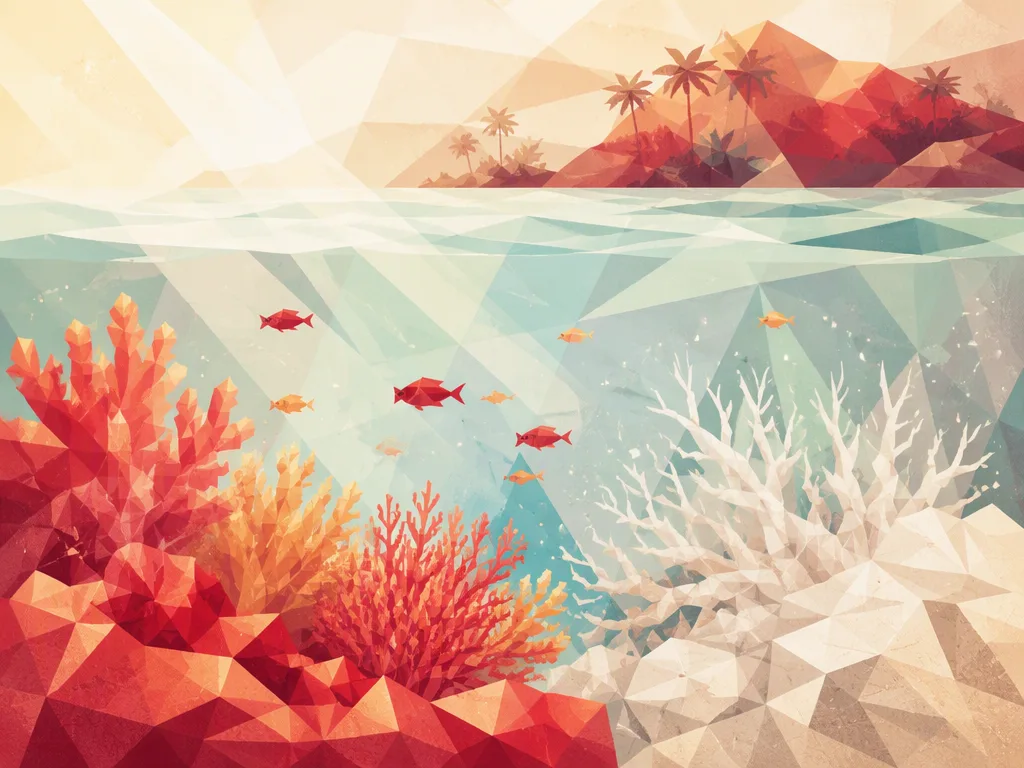
Natural Wonders Under Threat
Explore how environmental pressures affect famous natural places, from coral reefs to mountain forests, and discover how conservation can help.
Preview
Questions with solutions-
1. Chagua jibu sahihi.
Which pressure most directly triggers bleaching in this situation?
During marine heat waves, corals on the Great Barrier Reef may turn white after losing the tiny algae that live in their tissues.
- Sediment washing into the sea
- Unusually warm seawater
- Increasing ocean acidity
Show solution
- Unusually warm seawater
The algae supply much of a coral's food. A bleached coral is not necessarily dead, but prolonged heat stress can prevent recovery.
-
2. Chagua jibu sahihi.
What is the most direct threat to these animals?
Parts of the Amazon rainforest are cleared for cattle pasture. Animals that depend on the forest must then survive in a landscape with fewer trees.
- Loss of suitable forest habitat
- A shortage of open grassland
- Expansion of continuous forest cover
Show solution
- Loss of suitable forest habitat
Different forest species rely on the canopy, tree hollows, or shaded ground. A cattle pasture cannot replace all these habitats.
-
3. Chagua jibu sahihi.
What environmental problem does this illustrate?
Rats reached the Galápagos Islands on ships. On some islands, they now eat the eggs and chicks of native birds.
- Native predators returning after a decline
- Birds following a seasonal migration route
- Introduced animals disrupting an island ecosystem
Show solution
- Introduced animals disrupting an island ecosystem
Many island species evolved without certain predators. Animals introduced by people can therefore cause damage out of proportion to their size.
-
4. Chagua jibu sahihi.
What does this yearly imbalance mean?
A glacier gains ice from accumulated snow and loses ice through melting. Many glaciers in the Alps now lose more ice each year than they gain.
- The glacier's total volume gradually increases.
- The glacier's total volume gradually decreases.
- The glacier keeps the same total volume.
Show solution
- The glacier's total volume gradually decreases.
A snowy winter does not guarantee a healthy glacier. Snowfall must replace the ice lost over the whole year.
-
5. Chagua jibu sahihi.
Which change best addresses the damage caused by water diversion?
Fresh water once moved slowly through the Everglades, following seasonal patterns. Canals and other structures have diverted much of that water away from the wetlands.
- Restoring a more natural seasonal flow of fresh water
- Keeping every part of the wetland deeply flooded all year
- Draining wet areas more quickly after heavy rain
Show solution
- Restoring a more natural seasonal flow of fresh water
Wetland wildlife depends on the timing and depth of water, not simply on having as much water as possible.
-
6. Chagua jibu sahihi.
Which fire pattern poses the greatest threat to forest recovery?
Many Yellowstone plants are adapted to occasional fires. After a severe fire, however, young trees need time to grow and produce seeds.
- Occasional fires separated by long recovery periods
- Small fires that leave nearby seed-producing trees alive
- Severe fires returning before young trees can mature
Show solution
- Severe fires returning before young trees can mature
Being adapted to fire does not mean surviving every fire pattern. Repeated severe burns can interrupt the forest's natural renewal.
-
7. Chagua jibu sahihi.
How can excess nutrients threaten marine life?
Wastewater entering Ha Long Bay can carry nutrients that encourage algae to grow. Large blooms may eventually die and decay.
- Decaying algae release enough oxygen to support more fish.
- The breakdown of algae can use up oxygen that fish need.
- Extra nutrients prevent algae from growing, removing food for fish.
Show solution
- The breakdown of algae can use up oxygen that fish need.
Organisms that break down dead algae consume oxygen. Nutrients that support growth in small amounts can cause problems when excess amounts enter the water.
-
8. Chagua jibu sahihi.
Which plan best supports this seasonal movement?
In the Serengeti, migrating wildebeest move between areas as rainfall changes where grass grows. A fence can separate two otherwise healthy habitats.
- Protecting a route connecting seasonal feeding areas
- Protecting only the wet-season feeding area
- Fencing the dry-season feeding area on all sides
Show solution
- Protecting a route connecting seasonal feeding areas
Migrating animals need connected habitats. Protecting separate feeding areas is not enough if animals cannot travel between them.
-
9. Chagua jibu sahihi.
Which land-use decision would make this problem worse?
As sea levels rise, mangroves in the Sundarbans may need to spread inland. Embankments and settlements can block that movement.
- Leaving undeveloped space behind the mangrove forest
- Allowing tidal water to reach suitable inland areas
- Building more permanent barriers along the forest's inland edge
Show solution
- Building more permanent barriers along the forest's inland edge
This is called "coastal squeeze": rising water on one side and fixed barriers on the other leave less room for coastal habitats.
-
10. Chagua jibu sahihi.
What limitation must managers consider when planning these releases?
Dams above the Grand Canyon trap much of the sand that once entered the Colorado River. Managers sometimes release extra water to help rebuild downstream sandbars.
- Releasing extra water automatically restores the original sand supply.
- The flow needs enough available sand to deposit along the river.
- The strongest flow creates the largest lasting sandbars, regardless of sand supply.
Show solution
- The flow needs enough available sand to deposit along the river.
Water can move sand, but it cannot replace a missing supply. Strong flows may also carry existing sand farther downstream.
-
11. Chagua jibu sahihi.
Which action targets the immediate disease pathway?
In the mountain forests of Hawaii Volcanoes National Park, cool conditions have helped some native birds avoid disease-carrying mosquitoes. Warming allows these mosquitoes to survive farther uphill.
- Reducing mosquito populations near the remaining bird habitats
- Restoring vegetation without addressing disease carriers
- Reducing visitor noise while leaving mosquito populations unchanged
Show solution
- Reducing mosquito populations near the remaining bird habitats
Climate change can harm wildlife indirectly by changing where disease carriers can live. Cooler mountain habitats may no longer provide the same protection.
-
12. Chagua jibu sahihi.
Which approach addresses both local damage and ocean acidification?
Belize's Great Blue Hole lies within protected marine waters. Local rules can limit direct damage, but carbon dioxide from worldwide emissions still enters seawater and makes it more acidic.
- Relying on stronger local restrictions without addressing global emissions
- Focusing on global emissions instead of maintaining local protection
- Maintaining local protections while reducing global carbon emissions
Show solution
- Maintaining local protections while reducing global carbon emissions
Protected boundaries cannot keep out changes in ocean chemistry. Acidification makes building and maintaining shells or skeletons harder for many marine organisms.