


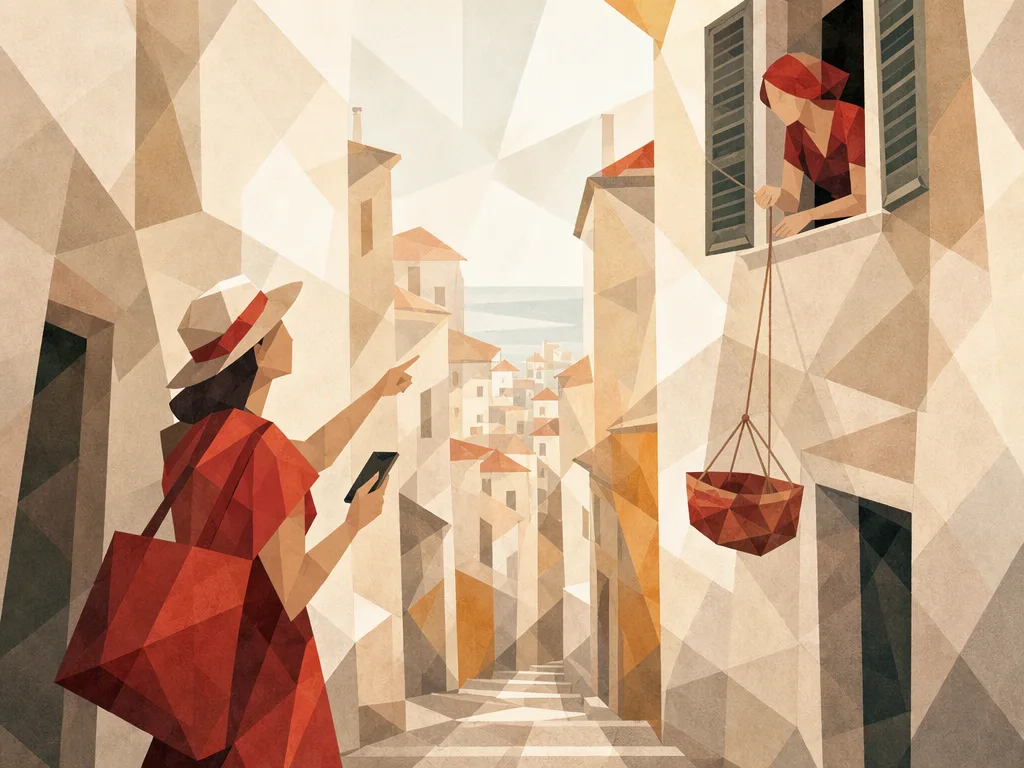
Senti or Senta? Instructions with tu and Lei
Practice giving and understanding instructions in Italian: directions in the street, polite requests in shops, warnings to friends and children. You'll switch between the informal tu (senti, dimmi, gira, non toccare) and the polite Lei (senta, mi dica, giri, non tocchi).
Preview
Questions with solutions-
1. Chagua jibu sahihi.
You want to get the attention of an older stranger in the street. What do you say?
- Senta, scusi!
- Senti, scusa!
- Senti, scusi!
- Sente, scusa!
With a stranger you use Lei, and both words should be in the same form.
Show solution
- Senta, scusi!
With Lei, 'sentire' becomes 'senta' and 'scusare' becomes 'scusi'. 'Senti, scusa!' is the tu version for friends. Don't mix the two forms.
-
2. Jaza pengo.
A shop assistant greets a customer and invites them to say what they want.
Buongiorno, mi ___!
- dica
- dici
- dice
- dire
The assistant speaks politely to the customer (Lei).
Show solution
Buongiorno, mi dica!
'Mi dica!' is the polite imperative of 'dire': literally 'tell me', meaning 'How can I help you?'. You hear it in shops, bars and offices.
-
3. Jaza pengo.
You're talking to your friend Marco.
Marco, ___ cosa è successo!
- dimmi
- mi dica
- dimi
- mi dimmi
With a friend you use tu. With tu, the pronoun attaches to the end of the verb.
Show solution
Marco, dimmi cosa è successo!
The tu imperative of 'dire' is 'di''. When you add 'mi', the m doubles: 'dimmi'. 'Mi dica' is the Lei form.
-
4. Chagua jibu sahihi.
A tourist asks you the way. You answer politely, using Lei. Which word completes the sentence?
Al semaforo ___ a destra.
- giri
- gira
- giro
- girare
For -are verbs, the Lei imperative ends in -i.
Show solution
- giri
For regular -are verbs, the Lei imperative ends in -i: girare → giri, parlare → parli, guardare → guardi. Compare: (tu) gira, (Lei) giri.
-
5. Andika jibu.
Now give directions to a friend, using tu. Type the missing verb (girare).
Al semaforo ___ a sinistra.
For -are verbs, the tu imperative looks like the 'lui/lei' form of the present tense.
Show solution
- gira
Tu imperative of -are verbs: girare → gira, parlare → parla, guardare → guarda.
-
6. Chagua jibu sahihi.
A child is about to touch the hot oven. What do you say?
Non ___ il forno, è caldissimo!
- toccare
- tocca
- tocchi
- toccato
Negative instructions with tu work differently: 'non' + one special form of the verb.
Show solution
- toccare
With tu, the negative imperative is 'non' + the infinitive: 'Non toccare!', 'Non parlare!', 'Non correre!'.
-
7. Jaza pengo.
You warn a lady you don't know about your dog, using Lei.
Signora, non ___ il cane, morde!
- tocchi
- toccare
- tocca
- tocco
With Lei, the negative imperative is simply 'non' + the normal Lei form.
Show solution
Signora, non tocchi il cane, morde!
With Lei, put 'non' before the normal form: 'tocchi' → 'non tocchi'. The h keeps the hard 'k' sound. 'Non toccare' is only for tu.
-
8. Panga maneno kwa mpangilio sahihi.
Give polite directions: 'Go straight on and then turn right.'
- a destra.
- sempre dritto
- e poi
- giri
- Vada
Show solution
Vada sempre dritto e poi giri a destra.
'Vada' (from andare) and 'giri' (from girare) are both Lei imperatives, the usual way to give directions to a stranger.
-
9. Panga maneno kwa mpangilio sahihi.
Tell a friend: 'Take the second street on the left.'
- la seconda
- a sinistra.
- Prendi
- strada
Show solution
Prendi la seconda strada a sinistra.
'Prendi' is the tu imperative of 'prendere'. With Lei you would say 'Prenda la seconda strada a sinistra.'
-
10. Jaza mapengo.
You give directions to a gentleman you don't know.
Signore, ___ la prima strada a destra e poi ___ dritto fino alla piazza.
- prenda
- vada
- prendi
- vai
- andare
'Signore' tells you to use Lei. For -ere and irregular verbs, the Lei form ends in -a.
Show solution
Signore, prenda la prima strada a destra e poi vada dritto fino alla piazza.
For -ere and -ire verbs, the Lei imperative ends in -a: prendere → prenda. 'Andare' is irregular: 'vada'. The tu forms are 'prendi' and 'vai' (or 'va'').
-
11. Jaza mapengo.
You ask your friend Luca to do two things.
Luca, ___ qui e ___ la porta, per favore!
- vieni
- chiudi
- venga
- chiuda
- chiude
Luca is a friend, so use tu.
Show solution
Luca, vieni qui e chiudi la porta, per favore!
Tu imperatives: venire → vieni, chiudere → chiudi. The Lei forms would be 'venga' and 'chiuda'.
-
12. Sikiliza kisha andika jibu.
Two tu imperatives: one from 'sentire', one from 'dire'.
Show solution
- Senti, dimmi la verità.
'Senti' and 'dimmi' are informal. To a stranger you would say 'Senta, mi dica la verità.'
-
13. Chagua jibu sahihi.
At the doctor's, you hear: "Non mangi troppo sale e beva molta acqua." What is the doctor telling you to do?
- Mangiare poco sale e bere tanta acqua.
- Mangiare più sale e bere poca acqua.
- Non bere acqua.
- Non mangiare niente.
'Beva' comes from 'bere' (to drink); 'non mangi' is a negative instruction.
Show solution
- Mangiare poco sale e bere tanta acqua.
The doctor uses Lei: 'non mangi' (don't eat) and 'beva' (drink, from 'bere'). So: little salt and lots of water.
-
14. Chagua jibu sahihi.
Your friend is nervous before an exam. How do you say 'Don't worry!'?
- Non preoccuparti!
- Non si preoccupi!
- Non ti preoccupi!
- Non preoccupati!
It's the tu negative: 'non' + infinitive, and the pronoun 'ti' can attach to the end.
Show solution
- Non preoccuparti!
'Non preoccuparti!' = non + preoccupare + ti (the final -e of the infinitive drops). 'Non si preoccupi!' is the polite Lei version.
-
15. Andika jibu.
Whisper to your friend not to speak loudly. Type the missing verb (parlare).
Shh, non ___ ad alta voce, il bambino dorme!
Negative instruction with tu: non + ...?
Show solution
- parlare
With tu, 'non' + infinitive: 'Non parlare!'. With Lei it would be 'Non parli!'.
-
16. Chagua jibu sahihi.
At the bakery, the assistant looks at you and says "Mi dica!". Which question means the same thing?
- Cosa desidera?
- Dove abita?
- Come si chiama?
- Quanto costa?
'Mi dica' literally means 'tell me'. What does a shop assistant want to know?
Show solution
- Cosa desidera?
'Mi dica!' invites you to say what you'd like, just like 'Cosa desidera?' (What would you like?).
-
17. Jaza pengo.
You warn a lady politely in a shop.
Signora, ___ attenzione, il pavimento è bagnato!
- faccia
- fai
- fa
- fare
'Fare' is irregular. Its Lei form is like 'dica' from 'dire'.
Show solution
Signora, faccia attenzione, il pavimento è bagnato!
'Faccia attenzione!' is the Lei form. To a friend you would say 'Fa' attenzione!' or 'Fai attenzione!'.