


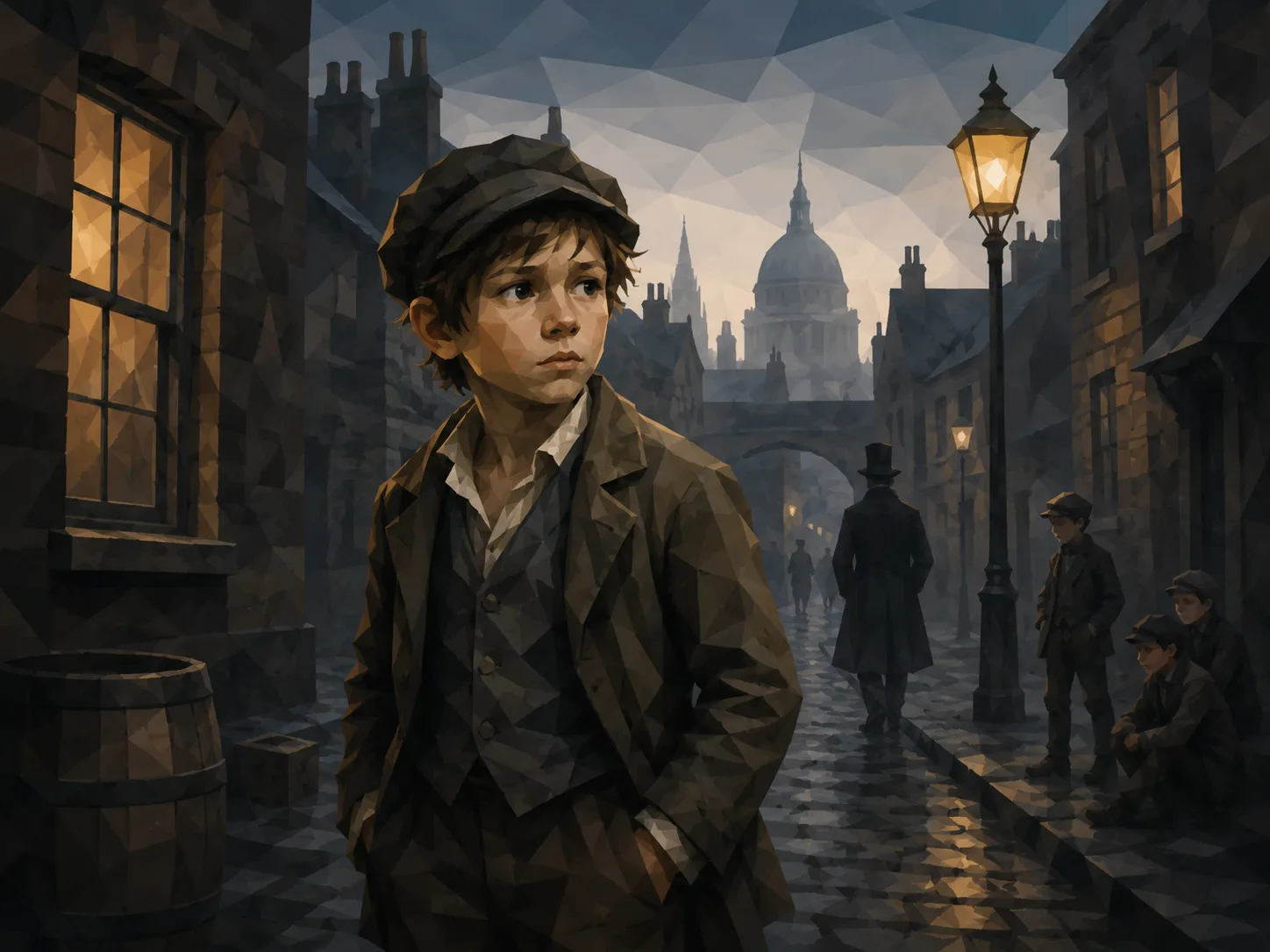
Twilight was beginning to fall when Mr. Brownlow’s carriage arrived at his front door. He knocked softly, and as soon as the door was opened, a robust man stepped out of the vehicle and took a position on one side of the steps. Another man, who had been sitting next to the driver, dismounted and stood on the other side. At a signal from Mr. Brownlow, they assisted a third man out of the carriage. Gripping him firmly between them, they hurried him into the house. This man was Monks.
They walked up the stairs in silence, following the same disciplined formation. Mr. Brownlow led the way into a back room. At the entrance to this apartment, Monks, who had climbed the stairs with obvious reluctance, came to a halt. The two guards looked at the old gentleman, awaiting his instructions.
“He is well aware of the alternative,” Mr. Brownlow stated firmly. “If he hesitates or moves even a finger against your orders, drag him into the street, call for the assistance of the police, and charge him with felony in my name.”
“How dare you say such things about me?” Monks demanded.
“How dare you force me to do so, young man?” Mr. Brownlow replied, confronting him with a steady, piercing gaze. “Are you foolish enough to try to leave this house? Release him. There, sir. You are free to go, and we are free to follow. But I warn you, by everything I hold sacred, that the moment you leave, I will have you apprehended on charges of fraud and robbery. I am resolute and will not change my mind. If you choose to be stubborn, you will be responsible for your own fate!”
“By what authority was I abducted in the street and brought here by these dogs?” Monks asked, glancing nervously from one guard to the other.
“By mine,” Mr. Brownlow replied. “I have taken full responsibility for these men’s actions. If you wish to complain about being deprived of your liberty, you had the opportunity to do so as we traveled here, yet you chose to remain quiet. I say again: if you want protection, appeal to the law. I will appeal to the law as well. However, once the process has gone too far to be stopped, do not beg me for mercy. By then, the power will be in other hands, and you will have no one to blame but yourself for your ruin.”
Monks was clearly unsettled and increasingly alarmed. He hesitated, shifting his weight.
“You must decide quickly,” Mr. Brownlow said with perfect composure. “If you wish for me to present my charges publicly and send you to a punishment whose severity I can foresee but not control, then go—you know the way out. If not, and you wish to appeal to my patience and the mercy of those you have deeply injured, then sit down in that chair. It has been waiting for you for two whole days.”
Monks muttered something unintelligible but continued to waver.
“Be prompt,” said Mr. Brownlow. “One word from me, and this opportunity will be gone forever.”
Still, the man hesitated.
“I have no desire to argue,” Mr. Brownlow added, “and since I am defending the vital interests of others, I do not even have the right to do so.”
“Is there no middle ground?” Monks asked, his voice faltering.
“None.”
Monks looked at the old gentleman, searching for any sign of weakness. Finding only severity and determination in Mr. Brownlow’s expression, he shrugged his shoulders and sat down.
“Lock the door from the outside,” Mr. Brownlow instructed the men, “and return when I ring the bell.”
The men obeyed, leaving the two of them alone.
“This is strange treatment, sir,” Monks remarked, throwing down his hat and cloak, “coming from my father’s oldest friend.”
“It is precisely because I was your father’s oldest friend,” Mr. Brownlow returned. “It is because my youth and happiness were tied to him and to his sister—that beautiful girl who died young and left me a lonely man. It is because he and I knelt together by her deathbed when he was still a boy, on the morning that should have made her my wife. I remained loyal to him through all his mistakes until the day he died. Even the sight of you brings back painful memories of him. It is because of these things that I am willing to treat you gently now—yes, Edward Leeford, even now—despite the fact that I am ashamed of your unworthiness.”
“What does that name have to do with anything?” Monks asked with a look of stubborn wonder. “What is that name to me?”
“Nothing to you, perhaps,” Mr. Brownlow replied. “But it was hers. Even after all this time, hearing it makes me feel the same emotion I felt as a young man. I am glad you changed it—truly.”
“This is all very dramatic,” Monks said after a long, tense silence. “But what do you want with me?”
“You have a brother,” Mr. Brownlow said, rousing himself. “A brother whose name I whispered in your ear in the street. That alone was enough to make you accompany me here in fear.”
“I have no brother,” Monks insisted. “You know I was an only child. Why talk to me of brothers? You know the truth as well as I do.”
“Listen to what I know, for there are things you may not realize,” Mr. Brownlow said. “I know that your father was forced into a miserable marriage by family pride and narrow ambition when he was only a boy. You were the only child of that unhappy union.”
“I don’t care about your insults,” Monks interrupted with a mocking laugh. “You know the facts, and that’s enough for me.”
“But I also know the slow torture of that marriage,” the old gentleman continued. “I know how that couple lived together in hatred until they finally separated, each carrying a bitter grudge that only death could end. Your mother moved on and forgot him quickly, but the pain stayed in your father’s heart for years.”
“So they separated,” Monks said. “What of it?”
“After they had been apart for some time,” Mr. Brownlow explained, “your father met new friends while living in the country. This much, at least, you already know.”
“I know nothing of the sort,” Monks said, turning away and tapping his foot, determined to deny everything.
“Your behavior proves that you have never forgotten it,” Mr. Brownlow retorted. “I am speaking of fifteen years ago. Your father was only thirty-one—he was still young because his father had forced him to marry so early. Must I continue with these details, or will you save your father’s memory and tell me the truth?”
“I have nothing to say,” Monks replied. “Keep talking if you must.”
“These new friends,” Mr. Brownlow said, ignoring the interruption, “were a retired naval officer and his two daughters. One was a beautiful young woman of nineteen, and the other was a small child. Your father fell in love with the elder daughter, and she with him.”
The old gentleman paused. Monks was biting his lips, his eyes fixed on the floor. Seeing this, Brownlow resumed:
“By the end of a year, they were solemnly engaged. But then, a wealthy relative died and left your father a large fortune. It was necessary for him to go to Rome immediately to settle the estate. While there, he became terminally ill. As soon as the news reached Paris, your mother traveled to Rome, taking you with her. He died the day after she arrived, leaving no will—or so it seemed. Consequently, the entire property went to her and you.”
Monks held his breath, listening with intense interest, though he avoided looking at the speaker. As Mr. Brownlow paused, Monks seemed to feel a sudden sense of relief and wiped his damp face.
“Before he went abroad,” Mr. Brownlow said slowly, fixing his eyes on Monks, “he came to see me in London.”
“I never heard of that,” Monks interrupted, sounding surprised and annoyed.
“He came to me and left a portrait he had painted of that poor girl. He was exhausted by anxiety and remorse. He spoke wildly of ruin and dishonor he had caused. He told me he intended to turn all his property into cash, provide for you and your mother, and then flee the country forever with the girl he loved. He promised to write and explain everything, but I never received a letter, and I never saw him again.”
After a short pause, Mr. Brownlow continued, “When it was all over, I went to find that family, hoping to offer the girl a home and compassion. However, they had left the area a week earlier, paying their debts and disappearing in the middle of the night. No one knew where they had gone.”
Monks smiled triumphantly.
“However,” Mr. Brownlow said, drawing closer, “when your brother—a weak, neglected child—was rescued by me from a life of crime—”
“What?” Monks cried.
“By me,” Mr. Brownlow repeated. “I see your associate, Fagin, suppressed my name. When the boy was recovering in my house, I was struck by his incredible resemblance to the portrait your father had left with me. Even when I first saw him in his rags, there was something in his face that reminded me of my old friend. But he was kidnapped before I could learn his history.”
“You can’t prove anything against me,” Monks stammered. “I defy you!”
“We shall see,” Mr. Brownlow replied. “I lost the boy, and since your mother was dead, I knew you were the only person who could solve the mystery. I traveled to the West Indies to find you, but you had already left. I returned to London and searched for you for months. It was only two hours ago that I finally found you.”
“And now that you have found me,” Monks said, standing up boldly, “what then? You talk of fraud based on a resemblance to an old painting! You don’t even know if a child was actually born.”
“I did not know,” Mr. Brownlow said, also rising, “but within the last two weeks, I have learned everything. You have a brother, and you know it. There was a will, which your mother destroyed, but she left the secret to you on her deathbed. You suspected the truth when you saw Oliver’s resemblance to your father. You went to his birthplace and destroyed the proofs of his identity. In your own words to the Jew, you said the proofs are at the bottom of the river and the old woman who held them is dead. You are a coward and a liar, Edward Leeford! Your plots have led to a violent murder. Do you still dare to defy me?”
“No, no!” Monks cried, overwhelmed by the weight of the accusations.
“Every word that passed between you and that villain Fagin is known to me,” Brownlow said. “Shadows on the wall heard your whispers. A murder has been committed, and you are morally responsible for it.”
“I knew nothing of the murder!” Monks pleaded. “I thought it was just a common quarrel.”
“It happened because your secrets were partially revealed,” Mr. Brownlow replied. “Will you now disclose the rest?”
“Yes, I will,” Monks promised.
“Will you sign a written statement and repeat it before witnesses?”
“I will.”
“And will you make restitution to this innocent child? You must carry out the provisions of the will regarding your brother. Do this, and then you may go wherever you like. You need never see him again.”
As Monks paced the room, torn between fear and hatred, the door was suddenly unlocked. Mr. Losberne entered, visibly agitated.
“The murderer will be caught!” he cried. “He will be taken tonight!”
“Sikes?” asked Mr. Brownlow.
“Yes. His dog has been seen, and there is no doubt he is hiding nearby. Spies are everywhere, and the government has offered a reward of a hundred pounds.”
“I will give fifty more,” said Mr. Brownlow. “Where is Harry Maylie?”
“He has gone to join the search,” the doctor replied.
“Fagin—what about him?”
“They haven't caught him yet, but they are certain to have him soon,” Losberne said.
Mr. Brownlow turned back to Monks. “Have you made up your mind?”
“Yes,” Monks replied in a low voice. “But you must keep my secret.”
“I will. Stay here until I return. It is your only chance for safety.”
The two gentlemen left the room and locked the door.
“What have you achieved?” the doctor whispered.
“Everything I hoped for,” Brownlow replied. “Between Nancy’s information and my own knowledge, Monks had no way to escape. The whole villainy is now clear. We must meet the others the evening after tomorrow at seven. My blood boils to see justice done for that poor murdered girl. Where is the police office?”
“Drive straight there, and you will be in time,” Mr. Losberne replied. “I will stay here.”
The two men separated quickly, both driven by an intense and uncontrollable excitement.