


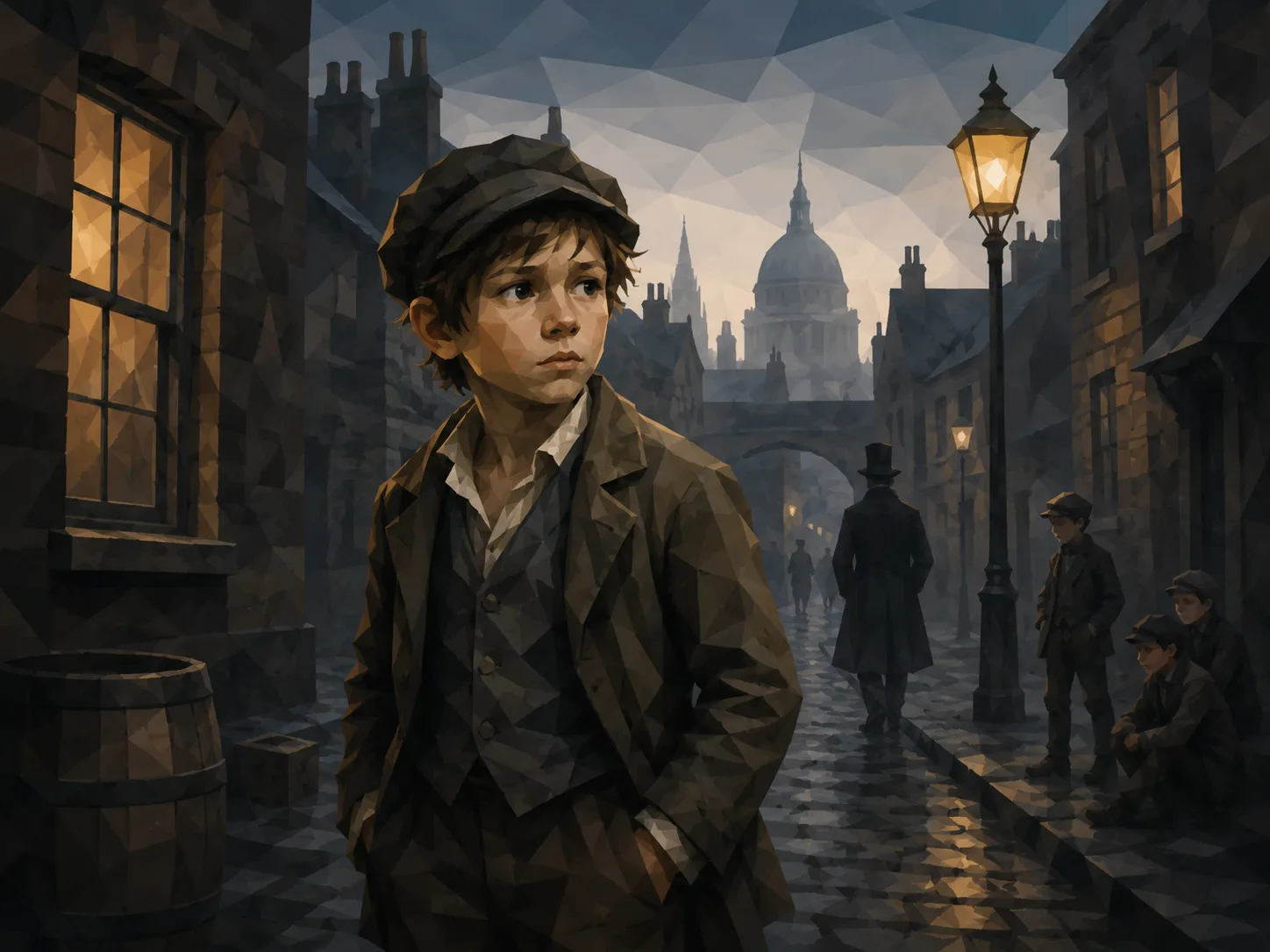
Only two days had passed since the events described in the previous chapter when Oliver found himself, at three o’clock in the afternoon, in a traveling carriage rolling swiftly toward his native town. Mrs. Maylie, Rose, Mrs. Bedwin, and the kind doctor were with him, while Mr. Brownlow followed in a separate carriage, accompanied by one other person whose name had not yet been mentioned.
They did not speak much during the journey. Oliver was in such a state of agitation and uncertainty that he was unable to collect his thoughts or even speak clearly. His companions seemed to be affected in much the same way, sharing his intense nervousness. Both he and the two ladies had been carefully informed by Mr. Brownlow about the admissions that had been forced from Monks. Although they knew that the purpose of this journey was to complete the work so successfully begun, the entire matter was still shrouded in enough doubt and mystery to keep them in a state of painful suspense.
Their kind friend, Mr. Brownlow, with the assistance of Mr. Losberne, had cautiously prevented any news of the dreadful occurrences that had recently taken place from reaching them. He argued that while they would have to learn the truth eventually, now was not the right time. Consequently, they traveled on in silence, each occupied with their own reflections on the purpose of their trip, and no one felt inclined to speak the thoughts that crowded their minds.
But if Oliver remained silent as they journeyed toward his birthplace along a road he had never seen, his memories raced back to earlier times. A flood of emotions woke in his heart when they turned onto the path he had once traveled on foot—a poor, homeless, wandering boy without a single friend to help him or a roof to shelter his head.
“Look! Over there!” Oliver cried eagerly, grasping Rose’s hand and pointing out of the carriage window. “That is the fence I climbed over! Those are the hedges I hid behind, fearing that someone would overtake me and force me back! There is the path across the fields leading to the old house where I lived as a small child! Oh, Dick, my dear old friend, if only I could see you now!”
“You will see him soon,” Rose replied gently, taking his hands in hers. “You shall tell him how happy you have become and how much your life has changed. You will tell him that your greatest joy is coming back to make him happy, too.”
“Yes, yes,” said Oliver. “And we will take him away from here. We will give him clothes and an education, and send him to a quiet place in the country where he can grow strong and healthy, won't we?”
Rose nodded, for the boy was smiling through tears of joy, and she found herself unable to speak.
“You will be kind to him, as you are to everyone,” Oliver continued. “It will make you cry to hear what he has to say, but don’t worry; it will all be over, and you will smile again when you think of how much his life has improved. You did the same for me. He said ‘God bless you’ to me when I ran away, and I will say the same to him now to show him how much I love him for it!”
As they approached the town and drove through its narrow streets, it became difficult for Oliver to contain his excitement. There was Sowerberry’s, the undertaker’s shop, looking exactly as it used to, though it seemed smaller and less grand than he remembered. There were all the familiar shops and houses, almost every one of which reminded him of some small incident from his past. He saw the very cart that Gamfield used to drive standing outside the old pub. There was the workhouse, the gloomy prison of his youth, with its depressing windows staring down at the street. He even saw the same thin porter standing at the gate; at the sight of him, Oliver instinctively shrank back, then laughed at his own foolishness, then cried, and laughed again. There were dozens of faces at the windows that he recognized perfectly. It felt as though he had left only yesterday and that his recent life had been nothing but a beautiful dream.
However, it was an earnest and joyful reality. They drove straight to the main hotel, which Oliver used to stare at with awe, thinking it was a magnificent palace. Now, somehow, it seemed to have lost its grandeur. Mr. Grimwig was there, ready to receive them. He greeted the ladies warmly, acting like the grandfather of the entire group. He was all smiles and kindness, and not once did he offer to "eat his head"—not even when he argued with an old driver about the quickest road to London, insisting he knew it best even though he had only traveled it once, and that time while fast asleep. Dinner was prepared, bedrooms were ready, and everything had been arranged as if by magic.
Despite these comforts, once the initial excitement of arrival had passed, the same silence and tension they had felt during the journey returned. Mr. Brownlow did not join them for dinner but remained in a separate room. The other two gentlemen hurried in and out with anxious expressions, whispering to each other during the brief moments they were present. At one point, Mrs. Maylie was called away; when she returned an hour later, her eyes were red from weeping. These events made Rose and Oliver, who were not yet aware of the latest secrets, feel extremely uncomfortable. They sat in silence, wondering what was happening, and if they spoke at all, they did so in whispers.
Finally, at nine o'clock, Mr. Losberne and Mr. Grimwig entered the room, followed by Mr. Brownlow and a man whom Oliver almost shrieked to see. They told him it was his brother—the same man he had encountered in the market town and seen looking through the window with Fagin. Monks cast a look of pure hatred at the astonished boy and sat down near the door. Mr. Brownlow, holding several papers, walked to a table near Rose and Oliver.
“This is a painful task,” he began, “but these statements, which were signed in London, must be repeated here. I would have preferred to spare you this shame, but we must hear the truth from your own lips before we finish, and you know why.”
“Go on,” Monks replied, turning his face away. “Hurry. I have done enough, I think. Don’t keep me here.”
“This child,” said Mr. Brownlow, drawing Oliver toward him and placing a hand on his head, “is your half-brother. He is the son of your father, my dear friend Edwin Leeford, and a young woman named Agnes Fleming, who died giving birth to him.”
“Yes,” said Monks, scowling at the trembling boy. “That is the child.”
“The way you speak of him,” Mr. Brownlow said sternly, “is a disgrace only to you. Let us continue. He was born in this town.”
“In the workhouse of this town,” Monks replied sullenly. “You have the whole story in those papers.” He pointed impatiently at the documents.
“I must hear it from you as well,” Mr. Brownlow insisted, looking around at the listeners.
“Listen then!” Monks shouted. “When his father became ill in Rome, he was joined by his wife—my mother—from whom he had been separated for a long time. She traveled from Paris and took me with her, mainly to look after his property, for neither of them felt any affection for the other. He didn't even know we were there; he was unconscious and died the next day. In his desk, we found two papers written on the night he fell ill. They were addressed to you, Mr. Brownlow, with a note saying they shouldn't be delivered until after his death. One was a letter to this girl, Agnes; the other was a will.”
“What did the letter say?” asked Mr. Brownlow.
“It was a long confession,” Monks replied. “He was filled with regret and prayed for God to help her. He had lied to the girl, telling her that some mystery prevented them from marrying immediately. She had trusted him, but she lost her reputation and her social standing. At that time, she was pregnant. In the letter, he explained what he would have done to protect her if he had lived. He reminded her of the locket and the ring he had given her—the ring with her name engraved on it and a blank space for the surname he hoped to give her one day. He begged her to keep it and wear it next to her heart. He wrote wildly, as if he had lost his mind. I believe he had.”
“And the will?” Mr. Brownlow asked, as Oliver wept.
Monks remained silent, so Mr. Brownlow spoke for him.
“The will reflected the same feelings as the letter. He wrote about the misery his wife had caused him and the malicious, rebellious nature of his only son—you—who had been taught to hate him. He left you and your mother a small yearly income, but the majority of his wealth was divided into two equal parts: one for Agnes Fleming and the other for their child, if it should be born alive. If the child were a girl, she would inherit the money without any conditions. However, if it were a boy, he would only inherit the wealth if he reached adulthood without ever having stained his name with any act of dishonesty, cowardice, or wrong. He did this to show his faith in the mother’s gentle nature, believing the child would inherit her goodness. If he were disappointed and the boy turned out to be dishonest, the money was to go to you. Only then would he recognize your claim to his money—for you certainly had no claim to his heart.”
“My mother,” Monks said, raising his voice, “did what any woman would do. She burnt the will. The letter never reached Agnes, but my mother kept it and other proofs in case anyone ever tried to reveal the truth. She found Agnes's father and told him the story with all the hatred she could manage. Driven by shame, the father fled with his two daughters to a remote part of Wales. He even changed his name so his friends would never find him. Not long after, he was found dead in his bed. Agnes had left home secretly weeks before; her father had searched for her everywhere on foot. He died of a broken heart on the night he returned home, convinced that his daughter had killed herself to hide their shame.”
There was a brief silence before Mr. Brownlow continued the narrative.
“Years later, Edward Leeford’s mother came to me. He had left her when he was only eighteen, after stealing her jewels and money. He had gambled, wasted his fortune, and fled to London, where he lived among criminals. She was dying and wanted to find him before she passed away. We searched for a long time and finally found him. He returned with her to France.”
“There she died,” said Monks. “On her deathbed, she told me these secrets and passed on her deadly hatred for everyone involved. She refused to believe the girl had killed herself. She was convinced that a boy had been born and was still alive. I swore to her that if I ever found him, I would hunt him down and destroy him. I wanted to turn his life into a misery and drag him to the gallows if I could. She was right—he did cross my path eventually. I began my plan well, and if it weren't for those who talked too much, I would have finished it!”
As Monks folded his arms and muttered curses, Mr. Brownlow turned to the group and explained that Fagin had been promised a large reward for keeping Oliver in a life of crime. A dispute over this payment had led to their visit to the country house to identify the boy.
“The locket and the ring?” Mr. Brownlow asked Monks.
“I bought them from the Bumbles, who stole them from the nurse, who had stolen them from the corpse,” Monks answered without looking up. “You already know what happened to them—I threw them into the river.”
Mr. Brownlow signaled to Mr. Grimwig, who left the room and quickly returned, pushing Mrs. Bumble inside and dragging her husband behind him.
“Do my eyes deceive me!” Mr. Bumble cried with fake enthusiasm. “Is that little Oliver? Oh, Oliver, if you only knew how much I have grieved for you—”
“Be quiet, you fool,” Mrs. Bumble whispered.
“Isn’t nature a wonderful thing, Mrs. Bumble?” the workhouse master continued. “Shouldn't I feel emotion—I, who brought him up—when I see him sitting here among such polite ladies and gentlemen? I always loved that boy as if he were my own relative. Master Oliver, do you remember the gentleman in the white waistcoat? He passed away last week, Oliver.”
“Come now, sir,” Mr. Grimwig said sharply. “Control your feelings.”
“I will try, sir,” Mr. Bumble replied. “How do you do, sir? I hope you are well.” This was addressed to Mr. Brownlow, who stepped toward the couple and pointed at Monks.
“Do you know this man?” he asked.
“No,” Mrs. Bumble replied flatly.
“Perhaps you do?” Mr. Brownlow asked her husband.
“I have never seen him in my life,” Mr. Bumble insisted.
“And you never sold him anything?”
“No,” said Mrs. Bumble.
“You never had a certain gold locket and ring?” Mr. Brownlow inquired.
“Certainly not,” the woman replied. “Why are we being asked such nonsense?”
Mr. Brownlow signaled to Mr. Grimwig again, who soon returned with two old, frail women from the workhouse.
“You shut the door the night old Sally died,” the first woman said, raising a trembling hand. “But you couldn't shut out the sound or stop the cracks in the wall.”
“We heard her tell you what she had done, and we saw you take a paper from her hand,” the second woman added. “The next day, we followed you to the pawnbroker’s shop. It was a locket and a gold ring. We saw it all.”
“And we know more,” the first one continued. “Sally told us long ago that the young mother intended to die near the grave of the child’s father.”
“Would you like to see the pawnbroker himself?” Mr. Grimwig asked, moving toward the door.
“No,” Mrs. Bumble replied. “If that man has been coward enough to confess, I have nothing more to say. I did sell them, and you will never get them back. What of it?”
“Nothing,” Mr. Brownlow replied, “except that we will ensure that neither of you ever holds a position of trust again. You may leave.”
“I hope,” Mr. Bumble said anxiously, “that this little misunderstanding will not cost me my job at the workhouse?”
“It certainly will,” Mr. Brownlow replied. “You should consider yourself lucky that it is the only consequence.”
“It was all my wife’s fault. She insisted on it,” Mr. Bumble argued, after checking that she had left the room.
“That is no excuse,” Mr. Brownlow said. “You were present when those items were destroyed. In the eyes of the law, you are even more responsible, as the law assumes a wife acts under her husband’s direction.”
“If the law assumes that,” Mr. Bumble said, clutching his hat, “then the law is an ass—an idiot. If that is the eye of the law, then the law must be a bachelor; and my only wish for the law is that his eye may be opened by experience!”
With that, Mr. Bumble put on his hat and followed his wife downstairs.
“Young lady,” Mr. Brownlow said, turning to Rose. “Give me your hand. Do not be afraid of what I have left to say.”
“If it has anything to do with me,” Rose said, “please tell me some other time. I don't have the strength right now.”
“On the contrary,” the old gentleman said, “I am sure you have the courage. Do you know this young lady, sir?”
“Yes,” Monks replied.
“I have never seen you before,” Rose said faintly.
“I have seen you often,” Monks returned.
“The father of Agnes Fleming had two daughters,” Mr. Brownlow explained. “What happened to the younger child?”
“When the father died in Wales under a false name,” Monks replied, “leaving no clues to his true identity, the child was taken in by some poor villagers who raised her as their own.”
“Continue,” said Mr. Brownlow, signaling to Mrs. Maylie.
“My mother found her after a year of searching,” Monks said. “She didn't take the child, but she left her with the poor family, giving them a small amount of money and promising more that she never intended to send. She told them the child came from ‘bad blood’ and was illegitimate, hoping to make her life miserable. The child lived in poverty until a widow lady living in Chester saw her by chance, felt sorry for her, and took her home. Despite all our efforts, she remained there and was happy. I lost sight of her until a few months ago.”
“And do you see her now?”
“Yes. She is leaning on your arm.”
“But she is still my niece!” Mrs. Maylie cried, catching the fainting girl in her arms. “She is still my dearest child, and I would not lose her for all the treasures in the world!”
“The only friend I ever had,” Rose cried, clinging to her. “I cannot bear all this.”
“You have been the best and gentlest creature I have ever known,” Mrs. Maylie said tenderly. “Look, Rose—look who is waiting to embrace you!”
“Not aunt!” Oliver cried, throwing his arms around her neck. “I will never call her aunt—she is my sister! My own dear sister whom my heart loved from the very beginning! Rose, darling Rose!”
The tears that fell and the words they exchanged during that long embrace are sacred. In that single moment, they felt as if they had gained and lost a father, mother, and sister all at once. Joy and grief were mixed, but there were no bitter tears, for even the sadness was softened by tender memories.
They were left alone for a long time. Eventually, a soft knock at the door announced another visitor. Oliver opened it and made way for Harry Maylie.
“I know everything,” Harry said, sitting beside Rose. “Dear Rose, I know it all.” He added after a silence, “I haven't just heard this tonight; I found out yesterday. Do you realize why I have come?”
“Wait,” Rose said. “You really do know everything about my birth?”
“Everything. You told me I could speak to you again about this within a year.”
“I did.”
“I am not here to force you to change your mind,” the young man continued. “I was to offer you whatever status or fortune I had. If you still refused, I promised not to try to change your decision.”
“The same reasons I had then still influence me now,” Rose said firmly. “I owe a duty to the woman who saved me from a life of suffering. I cannot change my mind.”
“The news of tonight—” Harry began.
“The news of tonight,” Rose interrupted softly, “leaves me in the same position as before.”
“You are being too hard on yourself, Rose,” her lover urged.
“Oh, Harry,” she said, bursting into tears. “I wish I could spare us both this pain.”
“Then why cause it?” Harry asked, taking her hand. “Think of what you have heard tonight. Your father was not a criminal; he was a man overcome by grief and shame.”
“My hopes and prospects have changed,” the young man continued. “I am no longer seeking a life of high status or public ambition. I am not offering you a place in a world of gossip and malice. Instead, I offer you a home and a heart—and that is all I have.”
“What do you mean?” she whispered.
“I mean that when I left you last, I was determined to remove the barriers between us. I decided that if you could not join my world, I would join yours. I have turned away from the pride of my birth and the influence of my wealthy relatives. They look coldly at me now, but I don't care. In a beautiful part of the country, by a village church—my own church—there is a simple house. You can make me prouder of that home than of all the high positions I have given up. This is my life now, and I offer it to you.”
“Waiting for lovers to finish their conversation is a difficult way to spend an evening,” Mr. Grimwig remarked, waking up and removing his handkerchief from his head.
To tell the truth, supper had been waiting for a very long time. Neither Mrs. Maylie, nor Harry, nor Rose could find an excuse for their delay.
“I seriously thought about eating my head tonight,” Mr. Grimwig said, “because I thought I would get nothing else to eat. Now, if you'll allow me, I’d like to congratulate the future bride.”
Mr. Grimwig kissed the blushing girl, and his example was followed by the doctor and Mr. Brownlow. Some people claimed Harry Maylie had already done the same in the next room, but as he was a clergyman, most people considered that to be gossip.
“Oliver, my child,” said Mrs. Maylie, “where have you been, and why do you look so sad? There are tears on your face. What is the matter?”
The world is often full of disappointment, even for our most cherished hopes.
Poor Dick was dead.