


Social Norms in Different Situations
Explore everyday expectations in homes, workplaces, and public spaces—and how they change with the situation.
Preview
Questions with solutions-
1. درست جواب منتخب کریں۔
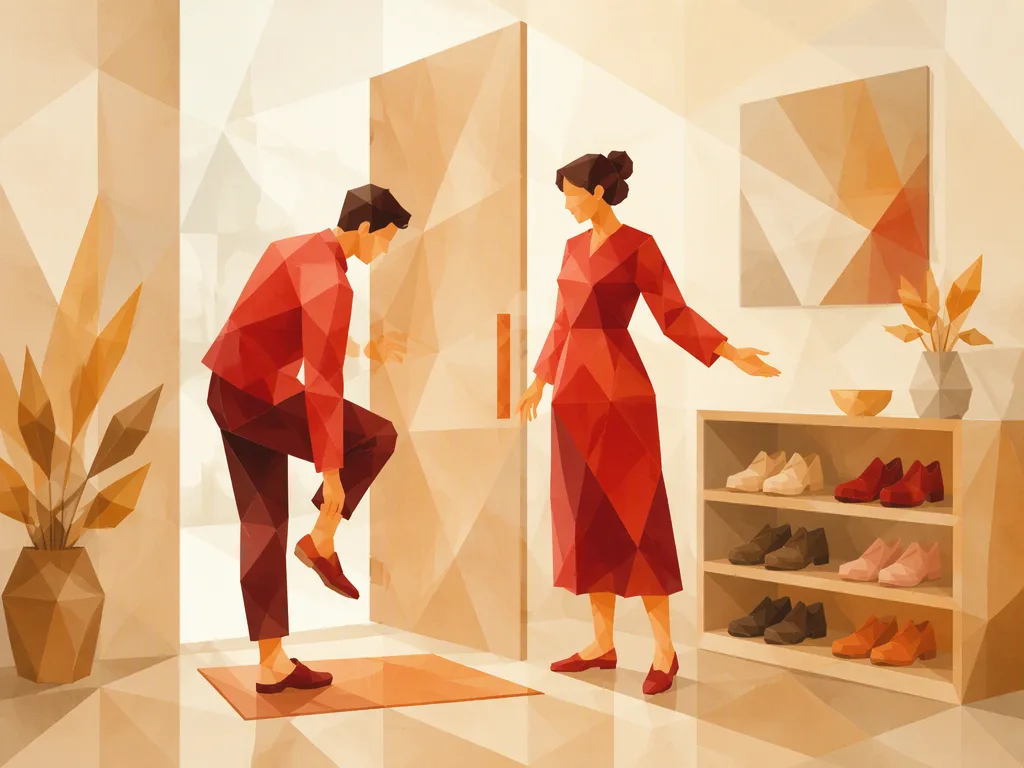
What does the host expect the guest to do?
Host: Welcome! We leave outdoor shoes by the door. There are slippers here if you'd like a pair.
- Remove their outdoor shoes at the entrance.
- Keep their outdoor shoes on until they reach the living room.
- Wear the slippers over their outdoor shoes.
Notice the difference between the household practice and the optional offer.
Show solution
- Remove their outdoor shoes at the entrance.
The host describes this household's practice. The slippers are optional, but the outdoor shoes stay by the door.
-
2. خالی جگہ پُر کریں۔
The guest politely declines another serving without criticizing the food.
Host: Would you like some more?
Guest: It was delicious, but I'm full. I'll ___, thank you.- insist
- pass
- indulge
The guest wants to say no, not ask for more.
Show solution
Host: Would you like some more?
Guest: It was delicious, but I'm full. I'll pass, thank you.“I'll pass, thank you” is a natural way to decline an offer. Praising the food makes clear that fullness is the reason.
-
3. درست جواب منتخب کریں۔
Why does the customer ask before joining the line?
Customer: Excuse me, are you waiting in line?
Person near the counter: No, I'm just looking at the menu. The line starts behind the person in green.- To ask someone to save a place while they leave.
- To find out which meal the person recommends.
- To check whether the person is already waiting to order.
Standing near a counter does not always mean someone is in line.
Show solution
- To check whether the person is already waiting to order.
A quick question helps avoid accidentally stepping ahead of someone when the line is unclear.
-
4. درست جواب منتخب کریں۔
What has the host given permission for?
Guest: Can I share this photo from tonight?
Host: In our group chat, yes. Please don't tag me or post it publicly.- Posting the photo publicly without tagging the host.
- Sharing the photo in the group chat without tagging the host.
- Sharing the photo in the group chat and tagging the host.
- Posting the photo publicly if only friends can comment.
There is a limit on both the audience and the use of tags.
Show solution
- Sharing the photo in the group chat without tagging the host.
Permission to share a photo can have conditions. Approval for one audience does not automatically cover another.
-
5. خالی جگہ پُر کریں۔
A colleague interrupts a presentation because an urgent warning cannot wait.
Presenter: Our next topic is the sales forecast.
Colleague: Sorry to ___, but the building alarm is going off. We need to leave now.- carry on
- hold off
- cut in
The colleague speaks before the presenter has finished.
Show solution
Presenter: Our next topic is the sales forecast.
Colleague: Sorry to cut in, but the building alarm is going off. We need to leave now.“Cut in” means interrupt. An urgent safety warning can justify interrupting even when normal meeting etiquette favors waiting.
-
6. درست جواب منتخب کریں۔
Why does lowering their voice not solve the traveler's problem?
Traveler: I'll speak very quietly on the phone.
Train attendant: This is the quiet car. The rule here is no phone calls, even whispered ones.- The rule limits the activity itself, not just its volume.
- The rule allows calls only when the train is moving.
- The rule applies only to calls made without headphones.
- The rule requires travelers to whisper during every call.
Notice what is prohibited, rather than how loudly it happens.
Show solution
- The rule limits the activity itself, not just its volume.
Some spaces restrict particular activities. Making an activity less noticeable does not necessarily make it permitted.
-
7. خالی جگہ پُر کریں۔
The reply recognizes that the request can wait.
Coworker: Could you review this when you have a moment? No rush—tomorrow is fine.
You: Got it. Since it isn't ___, I'll review it tomorrow.- confidential
- urgent
- formal
- optional
“No rush” tells you about timing, not whether the work is necessary.
Show solution
Coworker: Could you review this when you have a moment? No rush—tomorrow is fine.
You: Got it. Since it isn't urgent, I'll review it tomorrow.A request can still matter without needing an immediate response. “No rush” lowers its time pressure.
-
8. درست جواب منتخب کریں۔
What is the speaker trying to avoid?
Coworker: Do you have a minute after the meeting? There's a point I'd like to discuss without putting you on the spot in front of everyone.
- Giving you any opportunity to respond.
- Letting you know which meeting to attend.
- Making you respond to an issue in front of the group.
- Discussing the issue anywhere outside the meeting room.
“On the spot” involves pressure to react immediately.
Show solution
- Making you respond to an issue in front of the group.
A private conversation can reduce social pressure and give someone more space to respond thoughtfully.
-
9. درست جواب منتخب کریں۔
What preference does the host's reply suggest?
Guest: I left my coat in your bedroom. Should I get it?
Host: I'll bring it out for you. I'm sorting through some personal things in there.- The host would like help sorting the personal things.
- The host would prefer the guest not to enter the bedroom.
- The host wants the guest to leave the coat overnight.
- The host is asking the guest to search for the coat.
The host offers an alternative instead of directly saying no.
Show solution
- The host would prefer the guest not to enter the bedroom.
People sometimes express a privacy boundary indirectly. Offering to bring the coat out keeps the exchange friendly while protecting personal space.
-
10. درست جواب منتخب کریں۔
Which arrangement follows the organizer's instructions?
Organizer: You can move the chairs for a better view, but keep the ramp completely clear. It's the only wheelchair-accessible entrance.
- Place chairs on the ramp and move them whenever someone needs access.
- Use the edge of the ramp for chairs, leaving a narrow gap.
- Move the chairs to a better viewing position without blocking the ramp.
The permission to rearrange chairs has a firm limit.
Show solution
- Move the chairs to a better viewing position without blocking the ramp.
Keeping an accessible route clear means keeping it usable throughout the event, not clearing it only when someone asks.
-
11. خالی جگہیں پُر کریں۔
The summary preserves both the coworker's permission and the confidentiality limit.
Coworker: Feel free to tell other departments about the revised deadline. The client's budget figures must stay within our project team.
Summary: Sharing the revised deadline with other departments is ___; sharing the budget figures with them is ___.- prohibited
- required
- permitted
One detail may be shared, but the other must remain within a specific group.
Show solution
Coworker: Feel free to tell other departments about the revised deadline. The client's budget figures must stay within our project team.
Summary: Sharing the revised deadline with other departments is permitted; sharing the budget figures with them is prohibited.“Feel free” gives permission rather than creating a duty. Confidentiality can apply to one part of an update without covering all of it.
-
12. درست جواب منتخب کریں۔
What should the newcomer understand about participation in the two meetings?
Newcomer: People seem comfortable jumping in during our team check-ins. Is tomorrow's client review the same?
Teammate: Not quite. In check-ins, we speak as ideas come up. At the client review, Maya will invite questions after each section.- Both meetings allow questions at any moment without waiting.
- Both meetings reserve all questions for the very end.
- Check-ins have scheduled question breaks, while the client review allows spontaneous interruptions.
- Check-ins allow spontaneous contributions, while the client review has set breaks for questions.
The teammate describes different speaking arrangements, not one rule for every meeting.
Show solution
- Check-ins allow spontaneous contributions, while the client review has set breaks for questions.
Meeting habits can change with the audience and purpose. Familiar team routines do not automatically apply in another setting.