


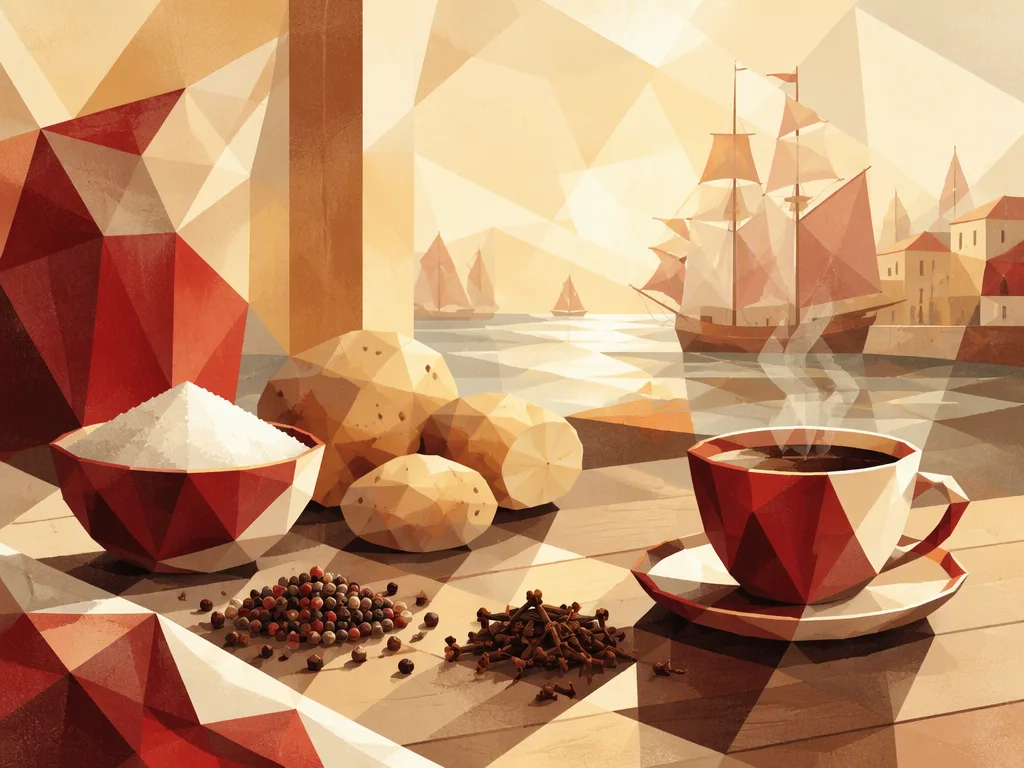
Food That Changed History
Discover how spices, potatoes, sugar, and coffee reshaped trade, daily life, and power.
Preview
Questions with solutions-
1. יש לבחור את התשובה הנכונה
Which goods were a major commercial incentive for these voyages?
Portuguese navigators sought a sea route around Africa to Asian trading ports, hoping to reduce their reliance on established trading networks.
- Potatoes and other crops from the Andes
- Pepper and other valuable Asian spices
- Sugar from Caribbean plantations
The destination matters: these voyages sought access to Asian markets.
Show solution
- Pepper and other valuable Asian spices
Strong European demand for Asian spices helped make costly and dangerous sea voyages commercially attractive.
-
2. יש לבחור את התשובה הנכונה
Which historical process brought potatoes to Europe?
Potatoes were cultivated in the Andes long before they became a staple food in European households.
- The Columbian Exchange between the Americas and the rest of the world
- Medieval trade along the Silk Road between Asia and Europe
- Ancient Roman trade across the Mediterranean
Think about the connections that followed European voyages to the Americas.
Show solution
- The Columbian Exchange between the Americas and the rest of the world
The Columbian Exchange moved animals and diseases as well as crops, transforming societies on both sides of the Atlantic.
-
3. יש לבחור את התשובה הנכונה
Which labor system predominated on these plantations?
In the eighteenth-century Caribbean, large sugar plantations supplied European markets with a product whose growing popularity depended on an intensely exploitative system of production.
- Paid employment by freely hired European migrants
- Independent family farming on small plots
- Forced labor by enslaved Africans
Consider the connection between plantation agriculture and the transatlantic slave trade.
Show solution
- Forced labor by enslaved Africans
Sugar cultivation and processing required exhausting work, which plantation owners imposed through slavery and violent coercion.
-
4. יש לבחור את התשובה הנכונה
Which business developed from this setting?
London's seventeenth-century coffeehouses supplied merchants with shipping news. At Edward Lloyd's establishment, shipowners met people willing to accept financial risk in return for payment.
- Merchant shipbuilding
- Marine insurance
- The collection of import duties
The key service concerned possible losses, not the construction or taxation of ships.
Show solution
- Marine insurance
Lloyd's developed from this coffeehouse network into an insurance market, rather than a single insurance company.
-
5. יש לבחור את התשובה הנכונה
How could adopting potatoes help households with little land?
On suitable European farmland, potatoes could provide more food energy per acre than many traditional grains.
- They could support more people from the same amount of land.
- They would need larger farms to maintain the same food supply.
- They would have to abandon food production and grow export crops.
Consider the relationship between crop yields and the area available to a family.
Show solution
- They could support more people from the same amount of land.
The potato helped support population growth in parts of Europe without requiring an equivalent expansion of farmland.
-
6. יש לבחור את התשובה הנכונה
Which change in consumption does this illustrate?
In Britain, sugar was once a costly luxury. As production and trade expanded, it became affordable to far more households and increasingly appeared in everyday tea.
- An imported ingredient becoming a locally grown staple
- An everyday necessity becoming an exclusive luxury
- A luxury import becoming a mass-consumption commodity
The important change concerns who could regularly afford the product.
Show solution
- A luxury import becoming a mass-consumption commodity
Sweetened tea connected ordinary household routines to distant plantations and international trading networks.
-
7. יש לבחור את התשובה הנכונה
Which property of spices helps explain this investment?
Before modern transport, moving goods between Asia and Europe was slow and expensive. Nevertheless, merchants repeatedly financed voyages carrying pepper, cloves, and nutmeg.
- High market value relative to their weight and volume
- Low market value combined with bulky cargoes
- Nearly identical purchase and sale prices across distant markets
A cargo had to earn enough to justify the expense of transporting it.
Show solution
- High market value relative to their weight and volume
A relatively small spice cargo could generate substantial revenue, helping offset shipping costs and the risk of losses.
-
8. יש לבחור את התשובה הנכונה
How should their contribution to public life be understood?
European coffeehouses circulated newspapers and hosted lively discussions. However, participation was often shaped by gender, social standing, and local customs.
- They established universal political equality through open debate.
- They widened public discussion without making participation equal.
- They restricted public conversation to official government announcements.
Broader discussion and universal inclusion are not the same thing.
Show solution
- They widened public discussion without making participation equal.
Coffeehouse conversations linked printed news to face-to-face debate, helping information circulate beyond private households.
-
9. יש לבחור את התשובה הנכונה
What commercial purpose did these restrictions serve?
In parts of the Moluccas, Dutch colonial authorities restricted clove cultivation and destroyed trees outside permitted areas.
- To lower prices by maximizing the total clove harvest
- To increase competition by spreading production among independent growers
- To protect monopoly profits by controlling the supply of cloves
Consider how deliberately reducing supply can affect a valuable commodity's price.
Show solution
- To protect monopoly profits by controlling the supply of cloves
Colonial control could be used to create artificial scarcity: commercial power depended on restricting production, not simply expanding it.
-
10. יש לבחור את התשובה הנכונה
What best explains why the potato failure became a human catastrophe?
In nineteenth-century Ireland, many poor households depended heavily on potatoes, while other crops were grown for sale. Blight devastated potato harvests; poverty and limited access to alternative food intensified the crisis.
- Dependence on a vulnerable staple combined with barriers to obtaining other food
- A disease that destroyed every food crop rather than mainly affecting potatoes
- A collapse in demand that left healthy potato harvests unsold
Food being produced somewhere does not mean everyone can obtain it.
Show solution
- Dependence on a vulnerable staple combined with barriers to obtaining other food
Food security depends on access as well as production: the presence of crops for sale does not ensure that poor households can afford them.