


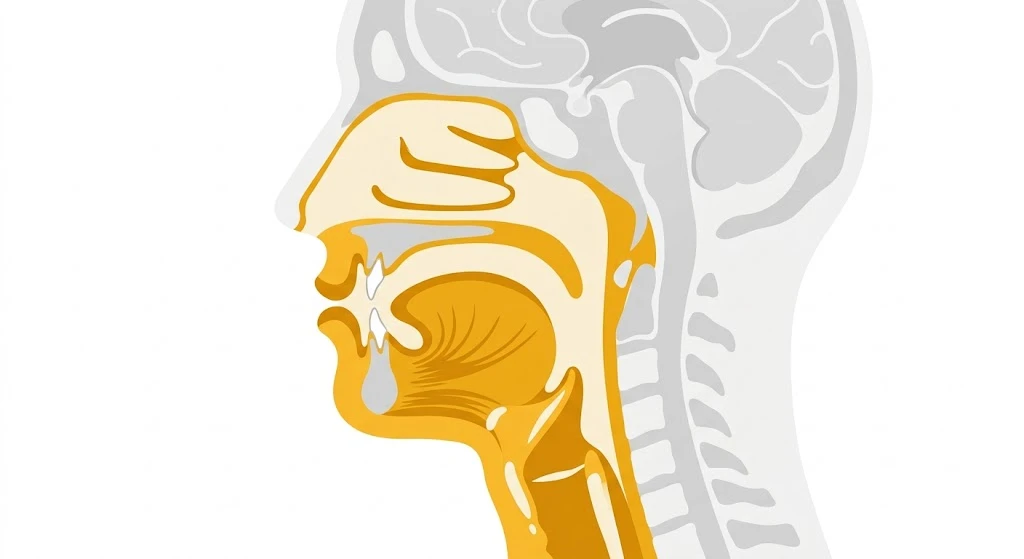
Vocal anatomy
Learn about the anatomy used to produce IPA sounds.
Stop (Plosive)
Blocked then released (stop)
The airflow is completely stopped for a moment and then suddenly released.
Nasal
Air through the nose
Air is blocked in the mouth and flows out entirely through the nose.
Trill
Rolling / vibrating
The air makes the tongue tip or uvula vibrate rapidly.
Tap / Flap
Quick tap
The tongue makes a single, very quick flick or tap against the roof of the mouth.
Fricative
Narrow airflow (friction)
Air is forced through a very narrow gap, creating a continuous hissing or buzzing friction.
Affricate
Stop plus friction
The sound starts with a full block and then releases slowly with friction.
Approximant
Smooth airflow
The mouth parts get close but leave enough space for smooth, silent airflow.
Lateral Approximant
Air down the sides
The tongue blocks the middle of the mouth, so air flows down the sides.
Bilabial
Both lips
The sound is made by bringing both lips together.
Labiodental
Lower lip & upper teeth
The sound is made with the lower lip touching the upper teeth.
Dental
Teeth
The tongue tip touches the back or bottom of the upper front teeth.
Alveolar
Gum ridge
The tongue tip touches the hard ridge just behind the upper front teeth.
Post-alveolar
Behind gum ridge
The tongue is placed just further back from the gum ridge.
Retroflex
Curled back tongue
The tip of the tongue is curled up and backward toward the hard palate.
Palatal
Hard palate
The middle of the tongue raises toward the hard roof of the mouth.
Velar
Soft palate
The back of the tongue raises toward the soft part at the back of the mouth.
Uvular
Uvula
The very back of the tongue reaches the uvula (the small fleshy dangling part in the back).
Pharyngeal
Throat cavity
The root of the tongue moves backward deep into the throat.
Glottal
Vocal cords
The sound is controlled by the vocal cords far down in the windpipe.
Voiceless
Voice off
The vocal cords do not vibrate. Only air is used.
Voiced
Voice on
The vocal cords vibrate to produce a tone.
Aspirated
Extra puff of air
A strong burst of breath accompanies the sound.
Front Vowel
Tongue forward
The highest part of the tongue is pushed forward.
Central Vowel
Tongue in middle
The tongue rests in a central, relaxed position.
Back Vowel
Tongue pulled back
The highest part of the tongue is pulled backward in the mouth.
High Vowel (Close)
Mostly closed mouth
The tongue is high, very close to the roof of the mouth.
Mid Vowel
Half open mouth
The tongue and jaw are in a neutral, middle position.
Low Vowel (Open)
Wide open mouth
The tongue is low and the jaw is dropped wide.
Rounded Vowel
Lips rounded
The lips are pushed forward into a circle.
Unrounded Vowel
Lips relaxed
The lips are spread apart or resting naturally.
Nasalized Vowel
Nasal vowel
Air flows out through both the mouth and the nose at the same time.