


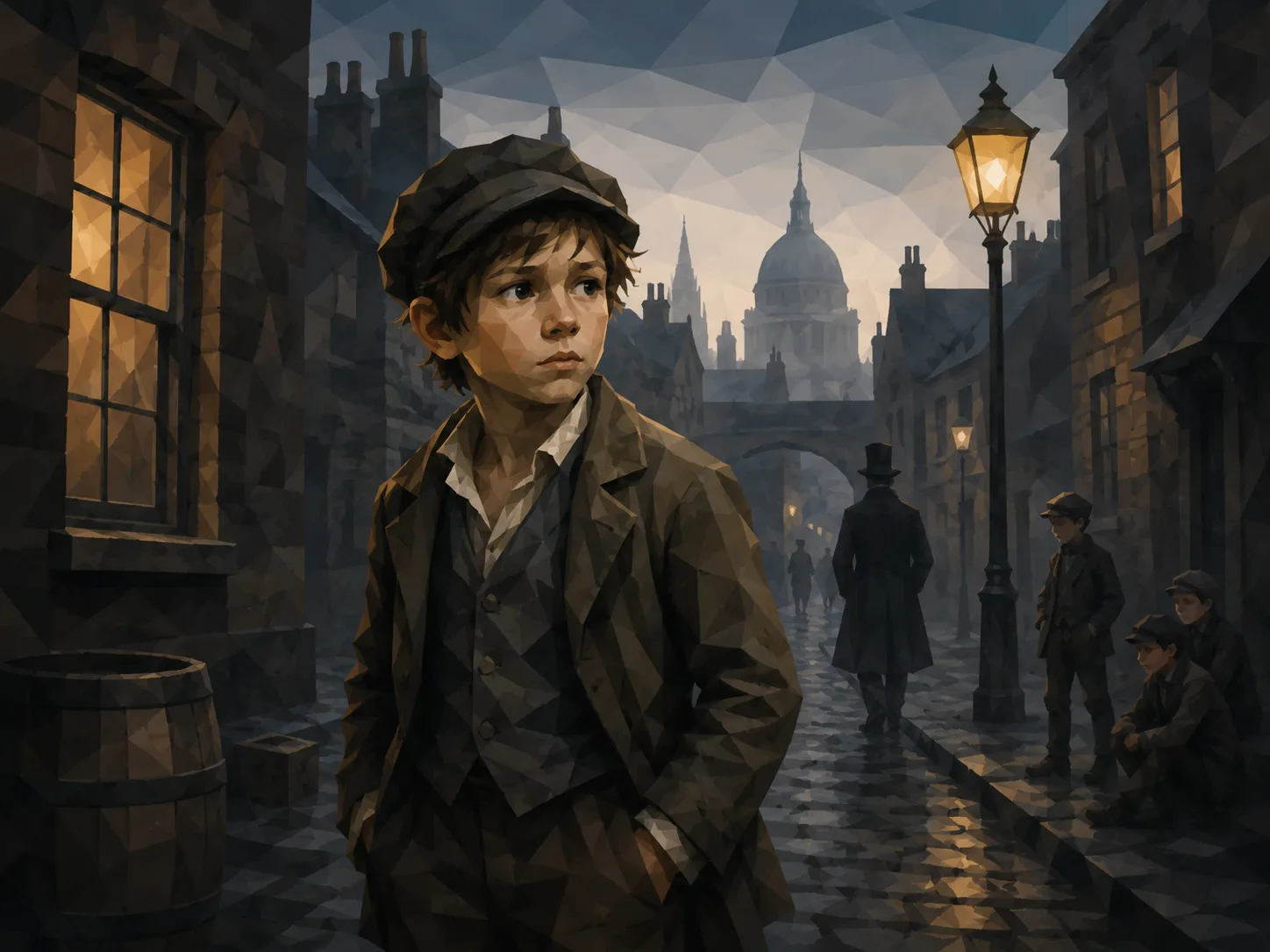
About noon the next day, once the Dodger and Master Bates had gone out to follow their usual occupations, Fagin took the opportunity to give Oliver a long lecture on the terrible sin of ingratitude. He clearly demonstrated that Oliver had been guilty of this to a great extent by intentionally absenting himself from his anxious friends. Furthermore, he emphasized how wrong it was for Oliver to try to escape after Fagin had gone to such trouble and expense to find him. Fagin laid great stress on the fact that he had taken Oliver in and cared for him when, without his timely help, the boy might have died of hunger.
To illustrate his point, he related the dismal and moving history of another young lad whom he had helped under similar circumstances. This boy, however, had proven unworthy of Fagin’s confidence. After showing a desire to speak with the police, he had unfortunately ended up being hanged at the Old Bailey one morning. Fagin did not try to hide his own role in this disaster. Instead, with tears in his eyes, he lamented that the treacherous behavior of the young man had made it necessary for Fagin to provide evidence against him. This evidence, Fagin admitted, might not have been entirely true, but it was absolutely necessary for his own safety and that of his close friends. Fagin concluded by painting a very disagreeable picture of the discomforts of hanging; then, with great politeness, he expressed his sincere hope that he would never be forced to submit Oliver Twist to such an unpleasant operation.
Oliver’s blood ran cold as he listened, even though he only partially understood the dark threats hidden in Fagin’s words. He already knew it was possible for the law to mistake the innocent for the guilty when they were found in bad company. He also thought it highly likely that Fagin had carried out deeply-laid plans to destroy people who knew too much. He remembered the many arguments between Fagin and Mr. Sikes, which often seemed to refer to some past conspiracy of that kind. As he glanced up timidly and met Fagin’s searching look, he felt that his pale face and trembling limbs were being carefully watched by the old man, who seemed to enjoy the boy's terror.
Smiling hideously, Fagin patted Oliver on the head. He remarked that if the boy kept quiet and focused on "business," they might still become very good friends. Then, taking his hat and putting on an old, patched coat, he went out, locking the door firmly behind him.
Oliver remained alone all that day, and for the better part of many days that followed. He saw nobody from early morning until midnight. During those long hours, he was left to his own thoughts, which always returned to his kind friends and the poor opinion they must now have of him. These reflections made him feel deeply miserable.
After a week or so had passed, Fagin began leaving the door unlocked, allowing Oliver the freedom to wander through the house. It was a very dirty place. The upstairs rooms had high wooden mantelpieces and large doors, with decorated walls and ceilings. From these signs, Oliver concluded that a long time ago, before the old man was born, the house had belonged to wealthy people and had been quite elegant. Now, however, it looked dismal and neglected.
Spiders had spun webs in the corners of the ceilings, and occasionally, when Oliver walked softly into a room, mice would scamper across the floor to their holes. Aside from these, there was neither sight nor sound of any living thing. Often, when it grew dark and he was tired of wandering, he would crouch in the corner of the hallway near the street door. He stayed there just to feel closer to the people outside, listening and counting the hours until Fagin or the boys returned.
In every room, the decaying shutters were closed tight, held by bars screwed into the wood. The only light entered through small round holes at the top, which made the rooms feel even more gloomy and filled them with strange, dancing shadows. There was one window in the back attic that had no shutter, though it was protected by rusty bars. Oliver often gazed out of it for hours, but he could see nothing except a crowded mass of blackened rooftops and chimneys. Occasionally, a face might appear over a distant wall, but it was always quickly withdrawn. Because the window was nailed shut and blurred by years of rain and smoke, Oliver had as much chance of being seen or heard as if he were locked inside a dungeon.
One afternoon, since the Dodger and Master Bates were staying home that evening, Jack Dawkins—the Dodger—decided to pay some attention to his appearance. This was unusual for him, but he condescendingly ordered Oliver to assist him with his "toilet" immediately.
Oliver was only too glad to make himself useful. He was happy to see any face, even a dishonest one, and he wished to please those around him whenever he could do so honestly. He expressed his readiness at once. Kneeling on the floor while the Dodger sat on the table, Oliver began a process that Dawkins called "japanning his trotter-cases"—which, in plain English, meant cleaning his boots.
The Dodger seemed to be in a strangely romantic and enthusiastic mood. Perhaps it was the sense of independence he felt while sitting on a table smoking a pipe and having his boots cleaned, or perhaps it was the quality of his tobacco. He looked down at Oliver thoughtfully for a moment, sighed, and said to Master Bates, "What a pity it is he isn’t a thief!"
"Ah!" agreed Charles Bates. "He doesn’t know what’s good for him."
The Dodger sighed again and returned to his pipe. Both boys smoked in silence for several seconds.
"I suppose you don’t even know what a 'prig' is?" the Dodger asked sadly.
"I think I do," replied Oliver, looking up. "It’s a th—; you are one, aren’t you?" He stopped himself before finishing the word "thief."
"I am," replied the Dodger proudly. "I’d be ashamed to be anything else." He adjusted his hat aggressively and looked at Charley Bates as if challenging anyone to disagree. "Charley is one, Fagin is one, Sikes is one. We all are, even the dog. And he’s the cleverest of the lot!"
"And he’s the least likely to talk to the police," added Charley. "He wouldn't bark in a witness box even if you left him there without food for two weeks."
"He’s a strange dog," the Dodger continued. "He growls at any stranger who laughs or sings, and he hates any dog that isn't his own breed. He’s a total professional."
"Anyway," said the Dodger, returning to the main point, "this has nothing to do with young Oliver here."
"True," said Charley. "Why don’t you join us, Oliver? You could make your fortune immediately."
"Then you could retire and live like a gentleman," added the Dodger with a grin.
"I don’t like it," Oliver replied timidly. "I wish they would let me go. I would much rather leave."
"And Fagin would much rather you didn't!" Charley joked.
Oliver knew this only too well. He sighed and continued cleaning the boots.
"Leave!" exclaimed the Dodger. "Where is your spirit? Have you no pride? Would you rather depend on your friends for everything?"
"That’s too low," said Master Bates, taking several silk handkerchiefs from his pocket and tossing them into a cupboard. "I couldn't live like that."
"But you left your friends," Oliver pointed out with a small smile, "and let them be punished for what you did."
The Dodger waved his pipe dismissively. "That was for Fagin’s sake. The police know we work together, and he might have been arrested if we hadn't made our escape. That was the smart move, wasn't it, Charley?"
Charley nodded, but the memory of Oliver’s capture was so funny to him that he began a fit of coughing and laughing that lasted five minutes.
"Look at this!" said the Dodger, showing a handful of silver coins. "This is the life! Who cares where the money comes from? Take some; there’s plenty more where this came from. You won’t? Oh, you are a fool!"
"It’s wrong, isn't it, Oliver?" Charley Bates teased. "He thinks he’ll end up being 'scragged'."
"I don't know what that means," Oliver said.
Charley took the end of his necktie, held it up in the air, and dropped his head to one side while making a clicking sound with his teeth. It was a vivid imitation of a person being hanged.
"That's what it means," said Charley. "Look at him stare! Jack, this boy is the best company I've ever had. He'll be the death of me!"
"You’ve been raised poorly," the Dodger said, looking at his polished boots with satisfaction. "But Fagin will make something of you. You should start at once, because you'll join the trade sooner than you think. You're just wasting time, Oliver."
Both boys spent the next hour describing the many pleasures of their criminal life. They dropped various hints that Oliver should try to gain Fagin’s favor as they had done.
"And remember this, Nolly," the Dodger said, as they heard Fagin unlocking the door upstairs. "If you don't take the pocket-handkerchiefs and watches, someone else will. The people who lose them will be no better off, and you'll be worse off. You have as much right to them as anyone else."
"To be sure, to be sure!" said Fagin, who had entered the room quietly. "It’s very simple, my dear. The Dodger understands the rules of his trade perfectly." The old man rubbed his hands together with delight at his pupil’s progress.
The conversation ended there because Fagin had returned with Miss Betsy and a young man Oliver had never seen before. The Dodger called him Tom Chitling. Mr. Chitling was about eighteen years old, but he treated the Dodger with great respect, as if he knew he was less talented at thievery than the younger boy. He had small, twinkling eyes and a face marked by past illness. He wore a fur cap and greasy clothes that were in bad condition.
He explained that he had just finished six weeks in prison and had been forced to wear the "regimentals" (prison uniform), so he hadn't been able to fix his own clothes. He complained bitterly that the prison authorities had burnt holes in his private clothes while disinfecting them and that his hair had been cut against his will. He added that he hadn't had a drink for forty-two long, hard days and was desperately thirsty.
"Where do you think this gentleman has come from, Oliver?" Fagin asked with a grin.
"I—I don't know, sir," Oliver replied.
"Who’s that?" Tom Chitling asked, looking at Oliver with contempt.
"A young friend of mine," Fagin replied.
"He’s lucky then," said the young man. "Don't worry about where I've been, kid; you'll find your way there soon enough, I'll bet on it!"
The boys laughed and whispered with Fagin for a moment before leaving. Later, Fagin led a conversation about the great advantages of their trade and how generous he was to his followers. Eventually, everyone grew tired, and the party went to sleep.
From that day on, Oliver was rarely left alone. He was forced to spend all his time with the two boys, who played the "pickpocket game" with Fagin every day. At other times, the old man would tell stories of robberies from his youth. These stories were told in such a funny and interesting way that Oliver could not help laughing, despite his better judgment.
In short, the clever old man had trapped the boy. Having used solitude and gloom to make Oliver crave any company at all, he was now slowly filling the boy's mind with the poison he hoped would change his character forever.