


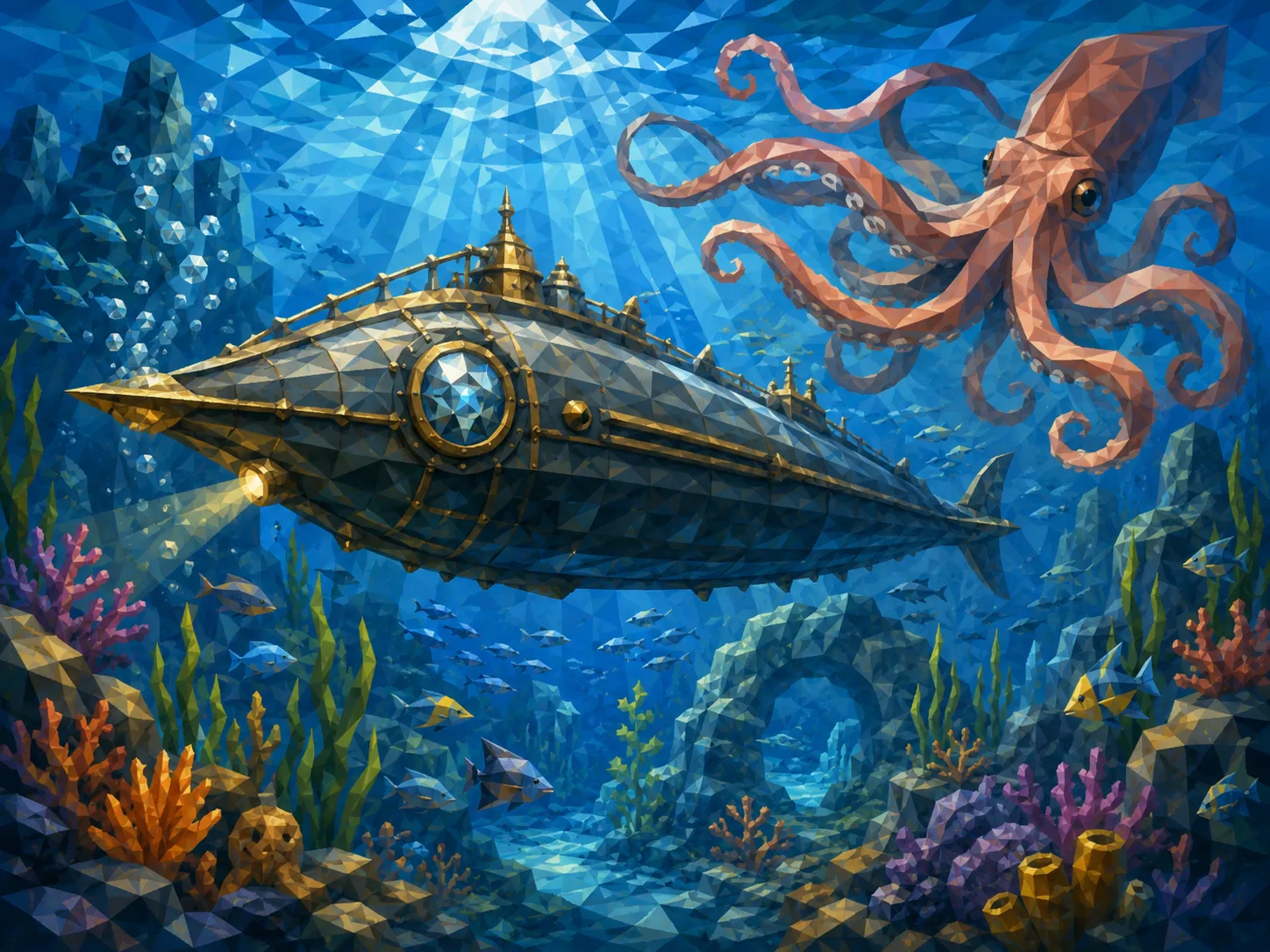
In the year 1866, something very strange happened. It was a mystery that no one could explain. People in cities and people by the sea all talked about it. Sailors and captains were especially excited. Merchants, common sailors, and naval officers from Europe and America were very interested. Even the governments of many countries wanted to know the truth.
For some time, ships saw "an enormous thing" in the ocean. It was a long object that was shaped like a spindle (a pin that is fat in the middle and thin at the ends). Sometimes the object was phosphorescent (shining with a soft light in the dark). It was much larger and faster than a whale.
Many captains wrote about this thing in their log-books (a book where a captain writes the daily events on a ship). They all said the same things. The object moved very fast and was very strong. Some people said the object was two hundred feet long. Other people said it was three miles long. Everyone agreed that this mysterious being was real. It was not just a story.
On July 20, 1866, a ship named the Governor Higginson was near Australia. Captain Baker saw a big mass in the water. At first, Captain Baker thought it was a sandbank (a large pile of sand under the water). Then, the object shot two columns of water high into the air. The water went one hundred and fifty feet up.
Captain Baker was surprised. A sandbank does not shoot water. He decided the object was a huge mammal (an animal that breathes air and gives milk to its babies). This animal was unknown to science. It was a new kind of giant creature.
Three days later, another ship named the Columbus saw the object. It was in the Pacific Ocean. This was very far from Australia. The object moved very fast across the sea. In only three days, it traveled more than two thousand miles.
Fifteen days later, two more ships saw the monster. These ships were the Helvetia and the Shannon. They saw the object in the Atlantic Ocean between the United States and Europe. The ships were three hundred feet long. The captains saw that the monster was longer than their ships!
Whales are the largest animals in the world. The largest whales are only sixty yards long. This new monster was much bigger than any whale. Many other ships reported seeing the monster too. One ship even hit the monster. Some people laughed at the stories, but England and America took the matter seriously.
The monster became very famous. People sang about it in cafes and wrote about it in newspapers. Actors even played the monster on stage. Some people thought it was a kraken (a giant sea monster with many arms from old stories). Others thought it was a giant sea serpent.
Scientists began to argue about the monster. Some scientists believed the monster was real. Other scientists thought the sailors were lying. They wrote many long articles in science journals. They argued for six months. At last, one writer wrote a very funny article. Everyone laughed, and for a short time, they forgot about the monster.
In early 1867, the mystery returned. Now, the monster was not just a story. It was a real danger to ships. The monster was like a reef (a line of rocks or sand near the surface of the sea). It moved from place to place, so it was not on any map.
On March 5, 1867, a ship named the Moravian hit a rock at night. But there was no rock on the map in that part of the sea. The ship was very strong, so it did not sink. When the ship arrived home, the sailors looked at the bottom. Part of the ship was broken.
Three weeks later, something even more serious happened. A ship named the Scotia was in the middle of the ocean. The weather was beautiful and the ship was moving fast. On April 13, 1867, the passengers were eating lunch. Suddenly, they felt a small hit on the side of the ship.
The hit was not very strong. No one was worried at first. But then the carpenter ran onto the bridge. He shouted that the ship was sinking. The passengers were very afraid. Captain Anderson told the passengers to stay calm. He said the Scotia was a safe ship.
Captain Anderson went to the bottom of the ship. He saw that water was coming in very fast. He ordered the men to stop the engines. A sailor went down to look at the damage. He found a very large hole in the bottom of the Scotia.
The hole was two yards wide. The Scotia had to travel slowly for three days. Finally, the ship reached the city of Liverpool. Engineers looked at the Scotia in a dry dock (a place where a ship is taken out of the water for repairs). They could not believe their eyes.
There was a clean hole in the iron plates (the flat pieces of metal that make the outside of a ship). The hole was in the shape of a triangle. Something very strong pushed through the thick iron. Then, it pulled back out. This was not an accident with a rock.
Now, everyone was very worried. People blamed the monster for every ship that disappeared at sea. Every year, many ships never came home. Now, people thought the monster killed all those sailors. Everyone wanted the sea to be safe again. They wanted to find the monster and destroy it.