


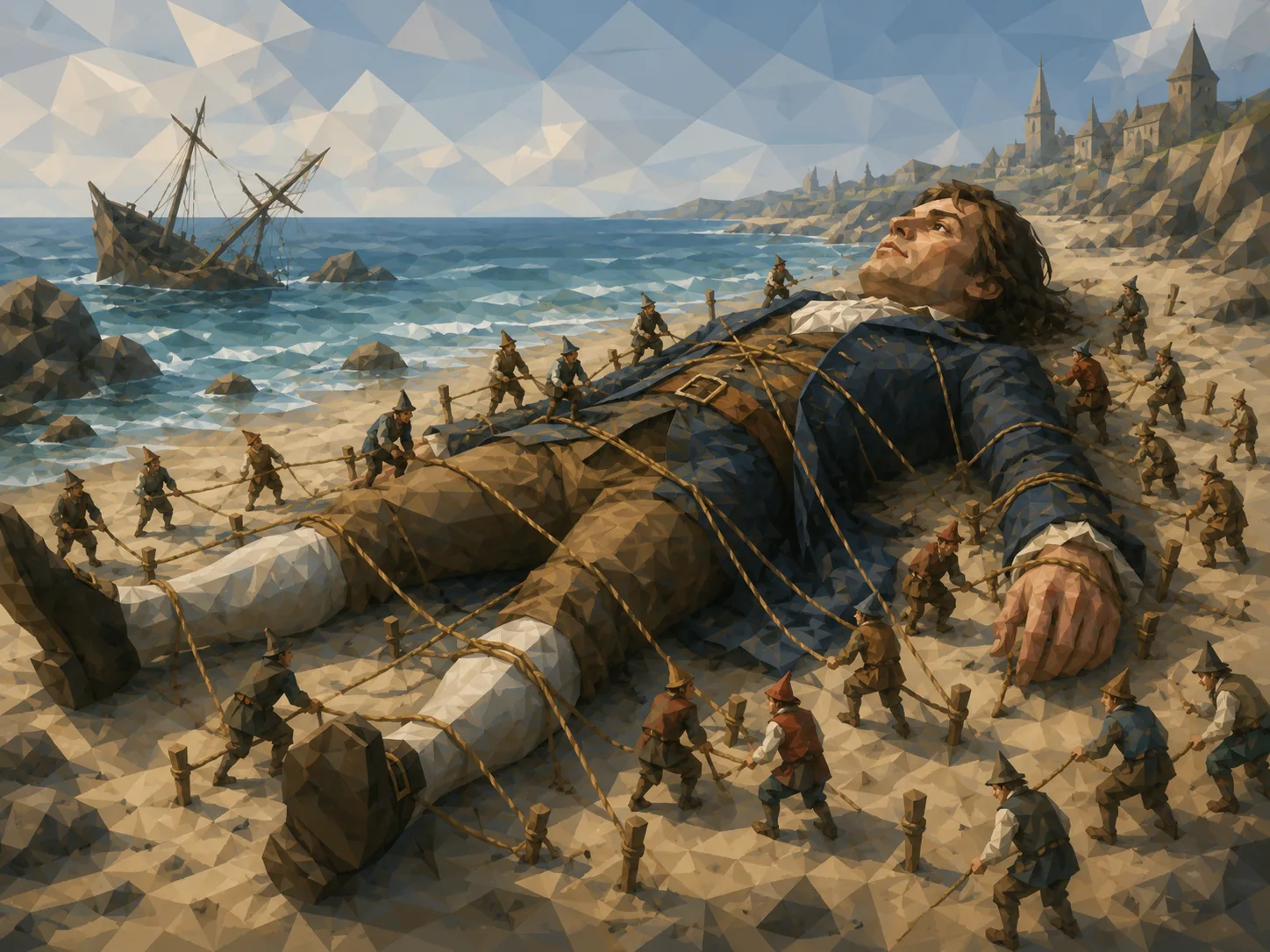
The Author Leaves Luggnagg and Sails to Japan. From Thence He Returns in a Dutch Ship to Amsterdam, and from Amsterdam to England.
I trust my account of the struldbrugs has provided some entertainment to the reader, as the subject is certainly unusual. In my extensive reading of travel literature, I do not recall ever encountering a similar description. While there is a steady trade between Luggnagg and the great Empire of Japan, my stay in the latter was so brief, and my knowledge of the language so limited, that I could not investigate whether Japanese authors had recorded similar phenomena.
Although the King of Luggnagg repeatedly urged me to accept a high-ranking position at his court, he eventually realized I was firmly determined to return to my native land. Consequently, he granted me permission to depart and provided me with a letter of recommendation, written in his own hand, to the Emperor of Japan. He also presented me with a generous gift of four hundred and forty-four large gold pieces—the people of Luggnagg having a curious preference for even numbers—and a magnificent red diamond.
On May 6, 1709, I took a solemn leave of His Majesty and my friends. The King, in a final gesture of kindness, provided a royal guard to escort me to Glanguenstald, a significant port on the southwest coast. Within six days, I found a vessel bound for Japan, and after a fifteen-day voyage, we landed at Xamoschi. Upon arrival, I presented my royal letter to the custom-house officers. They immediately recognized the King of Luggnagg’s seal, which depicted a monarch lifting a beggar from the earth. News of my arrival spread quickly, and the local magistrates, treating me as a distinguished diplomat, arranged for my transport to Yedo, the capital.
In Yedo, I was granted an audience with the Emperor. The ceremony was conducted with immense gravity. An interpreter, who was responsible for dealings with the Dutch, translated the letter. Afterward, the Emperor informed me that any request I made would be granted out of respect for his "royal brother" in Luggnagg. The interpreter, noticing my European features, spoke to me in perfect Dutch. I replied that I was a Dutch merchant who had been shipwrecked in a remote land and had traveled through Luggnagg in hopes of finding a way home.
I then made a very specific and delicate request: I begged that, for the sake of the King of Luggnagg, I might be excused from the ceremony imposed on all Dutchmen—that of trampling upon the crucifix. I explained that my arrival in Japan was the result of misfortune, not a desire for trade. The Emperor appeared astonished. He remarked that I was the first of my countrymen to ever express a moral objection to this practice, and he began to suspect I might be a Christian rather than a true Dutchman. Nevertheless, he agreed to grant this extraordinary favor. He warned me, however, that the matter must be handled with great discretion; if my fellow Dutchmen discovered the secret, they would likely murder me during the voyage home.
On June 9, 1709, I arrived at the port of Nagasaki after a long and exhausting journey. There, I encountered the crew of the Amboyna, a substantial Dutch ship of 450 tons. Having studied at Leyden in my youth, I spoke Dutch fluently and was able to convince the sailors of my origins. I invented a plausible story about my life in the province of Gelderland to satisfy their curiosity. When the captain, Theodorus Vangrult, learned I was a trained surgeon, he offered to take me to Holland for half the usual fare, provided I served in my professional capacity during the journey.
While we were preparing to sail, some of the crew suspiciously asked if I had performed the mandatory ceremony at court. I answered vaguely that I had satisfied the Emperor in all matters. However, one malicious sailor went to a Japanese official and whispered that I had not yet trampled on the crucifix. Fortunately, the official had already received private instructions from the Emperor. Instead of arresting me, he gave the informant a severe beating with a bamboo cane, and I was not troubled by such questions again.
The voyage was largely uneventful. We sailed with favorable winds toward the Cape of Good Hope, stopping only briefly to replenish our water supply. By April 10, 1710, we arrived safely in Amsterdam. Our only losses were three men who succumbed to illness and a fourth who tragically fell from the mast near the coast of Guinea.
From Amsterdam, I soon secured passage on a small vessel bound for England. On April 16, 1710, we anchored at the Downs. I landed the following morning and felt a profound sense of relief to see my native country again after an absence of five years and six months. I traveled directly to my home in Redriff, where I arrived that afternoon to find my wife and children in excellent health. Despite the wonders and horrors I had witnessed in distant lands, there was no greater comfort than being reunited with my family at last.