


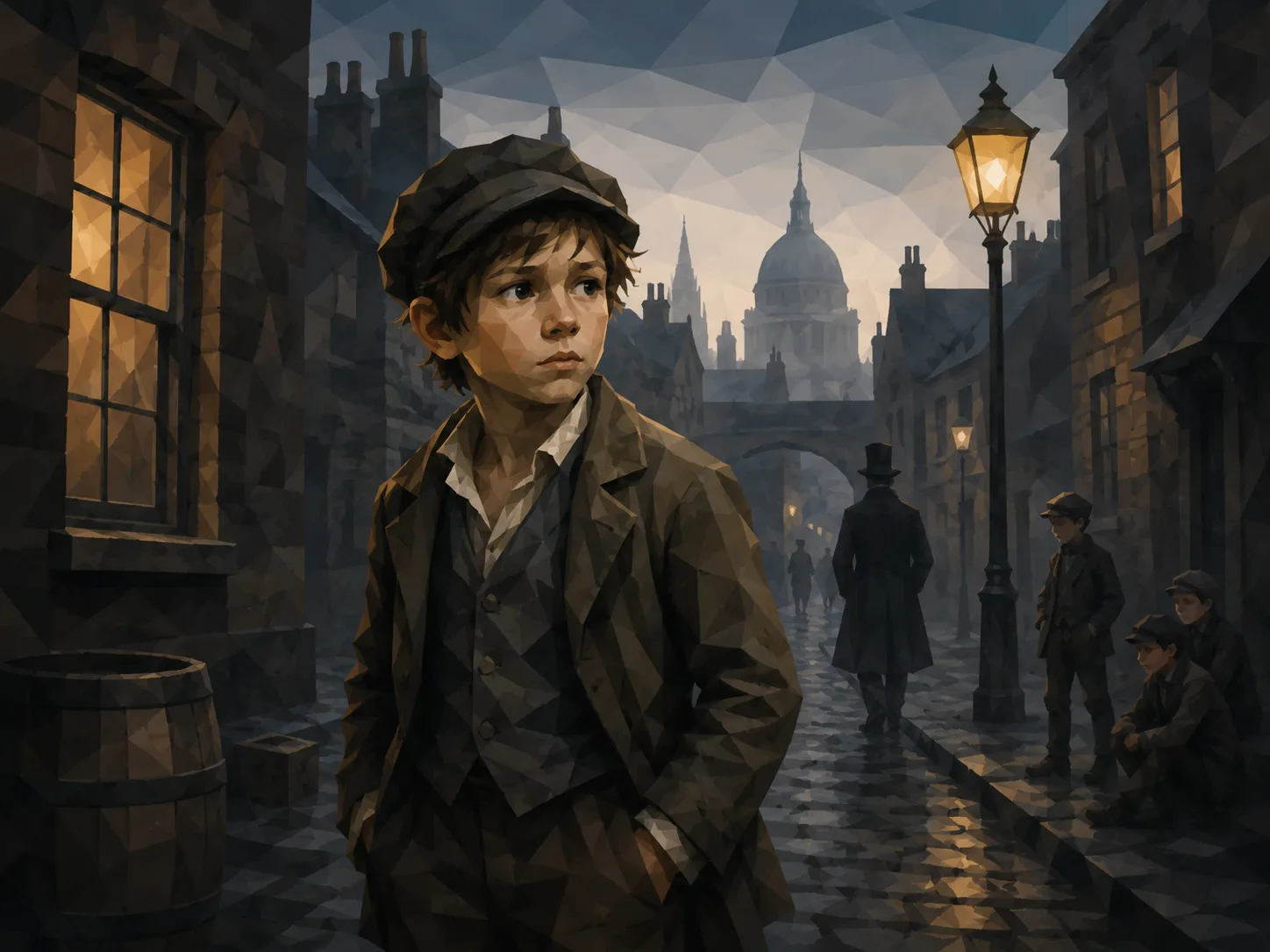
The old man had reached the street corner before he began to recover from the shock of Toby Crackit’s news. He did not slow his unusual pace, but continued pressing forward in the same wild and disordered manner. Suddenly, a carriage dashed past him, and the loud shouts of pedestrians who saw his danger drove him back onto the pavement. Avoiding the main streets as much as possible, he skulked through side streets and narrow alleys until he finally emerged at Snow Hill. Here, his pace quickened even further, and he did not stop until he had turned into a small courtyard. Feeling as though he were finally in his proper element, he fell into his usual shuffling walk and seemed to breathe more freely.
Near the spot where Snow Hill and Holborn Hill meet, a narrow and dismal alley opens on the right, leading toward Saffron Hill. In its filthy shops, huge bunches of second-hand silk handkerchiefs of every size and pattern are displayed for sale; this is where the traders live who buy stolen goods from pickpockets. Hundreds of these handkerchiefs dangle from pegs outside the windows or wave from the doorposts, and the shelves inside are piled high with them. Despite its small size, Field Lane has its own barber, coffee shop, beer shop, and fried-fish warehouse. It is a commercial colony of its own—an emporium of petty crime—visited at dawn and dusk by silent merchants who conduct their business in dark back rooms and disappear as mysteriously as they arrive. Here, the sellers of old clothes, shoes, and rags display their goods to attract the petty thief; in grimy cellars, piles of old iron, bones, and moldy fragments of wool and linen rot in the damp air.
It was into this place that Fagin turned. He was well known to the pale inhabitants of the lane; those who were looking to buy or sell nodded familiarly as he passed. He acknowledged them with a similar nod but did not stop until he reached the far end of the alley. There, he addressed a salesman of small stature who had squeezed as much of his body into a child’s chair as possible and was smoking a pipe at his warehouse door.
"Why, the sight of you, Mr. Fagin, would cure a sore eye!" said this respectable trader, acknowledging the Jew’s inquiry about his health.
"The neighborhood was a little too 'hot' for me lately, Lively," said Fagin, raising his eyebrows and crossing his hands over his shoulders.
"Well, I’ve heard that complaint once or twice before," replied the trader. "But things soon cool down again, don’t they?"
Fagin nodded in agreement. Pointing toward Saffron Hill, he asked whether anyone was "up there" tonight.
"At the Cripples?" asked the man.
The Jew nodded again.
"Let me see," the merchant reflected. "Yes, about half a dozen of them have gone in that I know of. I don’t think your friend is there, though."
"Sikes is not there, I suppose?" Fagin asked, his face showing his disappointment.
"He is nowhere to be found, as the lawyers say," replied the little man, shaking his head with a sly look. "Do you have anything for me tonight?"
"Nothing tonight," said Fagin, turning away.
"Are you going to the Cripples, Fagin?" the little man called after him. "Wait! I wouldn’t mind a drink there myself!"
However, the Jew looked back and waved his hand to indicate that he preferred to be alone. Furthermore, since the little man could not easily extract himself from the tiny chair, the Three Cripples pub was deprived of Mr. Lively’s presence for the moment. By the time he managed to stand up, Fagin had disappeared. Mr. Lively stood on tiptoe in a vain attempt to see him, then forced himself back into the chair, exchanged a suspicious look with a lady in the opposite shop, and resumed his pipe with a serious expression.
The Three Cripples was the public house where Mr. Sikes and his dog had appeared before. Making a brief sign to the man at the bar, Fagin walked straight upstairs. He opened the door to a room and, quietly slipping inside, looked around anxiously, shading his eyes with his hand as if searching for a specific person.
The room was lit by two gas lamps, though the barred shutters and heavy red curtains prevented the light from being seen outside. The ceiling was blackened by smoke, and the air was so thick with tobacco fumes that it was initially difficult to see anything. Gradually, as the smoke cleared through the open door, a confused crowd of people could be seen gathered around a long table. At the head of the table sat a chairman with a wooden hammer, while a professional musician with a blue-tinged nose and a bandage on his face for a toothache played a jingling piano in a far corner.
As Fagin stepped softly into the room, the musician played a short introduction on the keys, leading to a general cry for "Order!" so a song could begin. A young lady then entertained the group with a long ballad. When she finished, the chairman offered a toast, and two other men performed a duet to great applause.
It was fascinating to observe the faces in the crowd. The chairman himself, the landlord of the house, was a coarse, heavy-built man. While the songs were being sung, his eyes moved constantly; though he seemed to be enjoying himself, he had a sharp eye and ear for everything happening in the room. Near him were the singers, who accepted compliments with professional indifference while drinking glass after glass of spirits offered by their admirers. The faces of the guests were repulsive, expressing every kind of vice. Cunning, violence, and drunkenness were visible everywhere. The women were the saddest part of the picture: some were mere girls whose youthful freshness was already fading, while others showed the marks of a long life of crime and misery.
Fagin, untroubled by any deep emotion, looked eagerly from face to face but did not find the person he was looking for. Finally catching the eye of the landlord, he gave a slight signal and left the room as quietly as he had entered.
"What can I do for you, Mr. Fagin?" the landlord asked, following him onto the landing. "Won't you join us? Everyone would be delighted."
The Jew shook his head impatiently and whispered, "Is he here?"
"No," replied the man.
"And no news of Barney?" Fagin inquired.
"None," replied the landlord. "He won’t move until it’s safe. You can be sure the police are searching down there, and if he moved, he’d give the whole thing away. Barney is fine; he knows how to manage things. Leave it to him."
"Will he be here tonight?" asked the Jew, emphasizing the word as he had before.
"Monks, you mean?" the landlord whispered, hesitating.
"Hush!" said Fagin. "Yes."
"Definitely," replied the man, checking his gold watch. "I expected him before now. If you wait ten minutes, he’ll be—"
"No, no," Fagin said hastily. Even though he clearly wanted to see the man, he seemed relieved by his absence. "Tell him I came to see him and that he must come to me tonight. No, tell him tomorrow. Since he isn't here, tomorrow will be soon enough."
"Very well," said the man. "Anything else?"
"Not a word for now," Fagin said, descending the stairs.
"I say," the landlord whispered hoarsely over the railing. "This would be a great time for a betrayal! I’ve got Phil Barker here; he’s so drunk a child could arrest him!"
"Ah! But it’s not Phil Barker’s time yet," Fagin replied, looking up. "Phil has more work to do before we can afford to lose him. Go back to your guests, my dear, and tell them to enjoy their lives—while they last! Ha! ha! ha!"
The landlord joined in the laugh and returned to his guests. As soon as Fagin was alone, his face returned to its expression of anxiety. After thinking for a moment, he hailed a cab and told the driver to go toward Bethnal Green. He got out about a quarter of a mile from Sikes’s house and walked the rest of the way.
"Now," Fagin muttered as he knocked on the door, "if there is any trickery going on here, I’ll find it out from you, my girl, no matter how clever you are."
The woman at the door said Nancy was in her room. Fagin crept upstairs and entered without knocking. The girl was alone, her head resting on the table and her hair scattered over it.
"She’s been drinking," Fagin thought coldly, "or perhaps she is just miserable."
As he turned to close the door, the noise woke her. She looked at his crafty face closely as he told her Toby Crackit’s story. When he finished, she returned to her previous position without saying a word. She pushed the candle away and shifted her feet feverishly, but that was all.
During the silence, Fagin looked restlessly around the room to see if Sikes had secretly returned. Satisfied that he wasn't there, he coughed a few times to start a conversation, but the girl ignored him as if he were a statue. Finally, he tried again, rubbing his hands together in his most persuasive manner.
"And where do you think Bill is now, my dear?"
The girl moaned an unintelligible reply, saying she didn't know. From the muffled sound of her voice, she seemed to be crying.
"And the boy, too," Fagin said, trying to see her face. "Poor little child! Left in a ditch, Nancy; just think!"
"The child," the girl said, suddenly looking up, "is better off there than among people like us. If Bill isn't caught because of it, I hope the boy lies dead in that ditch and his bones rot there."
"What!" Fagin cried in amazement.
"Yes, I do," she replied, meeting his gaze. "I’ll be glad to have him away from my sight and to know the worst is over. I can’t stand having him around me. The sight of him makes me hate myself and all of you."
"Nonsense!" said Fagin scornfully. "You’re drunk."
"Am I?" the girl cried bitterly. "It’s no fault of yours if I’m not! You’d prefer me to be drunk all the time, wouldn't you? It just doesn't suit your mood right now, does it?"
"No!" Fagin replied furiously. "It does not!"
"Then change it!" the girl laughed.
"Change it!" Fagin exclaimed, losing his temper completely due to her stubbornness and the frustrations of the night. "I will change it! Listen to me, you wretch. Listen to me—with six words, I could have Sikes hanged as surely as if I had my hands around his throat right now. If he comes back without that boy—if he escapes but fails to bring him back to me, dead or alive—then you had better kill him yourself if you want to save him from the executioner. Do it the moment he enters this room, or it will be too late!"
"What are you talking about?" Nancy cried involuntarily.
"What am I talking about?" Fagin shouted, mad with rage. "That boy is worth hundreds of pounds to me! Am I to lose the chance to get that money safely just because of the whims of a drunken gang whose lives I could end with a single whistle? And I am tied to a devil who has the power to—to—"
Panting for breath, the old man struggled for a word. In that instant, he suddenly checked his anger and changed his entire behavior. A moment before, his hands had been clenched in the air, his eyes wide with passion; but now, he shrank into a chair, trembling with the fear that he had revealed too much of his own villainy. After a short silence, he ventured to look at his companion. He felt somewhat relieved to see her in the same listless state as before.
"Nancy, dear!" Fagin croaked in his usual voice. "Were you listening, dear?"
"Don’t worry me now, Fagin!" the girl replied, raising her head slowly. "If Bill didn't succeed this time, he will another. He has done many jobs for you, and he’ll do more when he can. Enough about that."
"And regarding the boy, my dear?" the Jew said, rubbing his palms together nervously.
"The boy must take his chances like the rest of us," Nancy interrupted. "I say again, I hope he’s dead and out of your way—as long as Bill is safe. If Toby escaped, Bill is almost certainly safe; Bill is worth two of Toby any day."
"And about what I was saying, my dear?" Fagin asked, keeping his sharp eyes on her.
"You’ll have to say it all over again if you want me to do something," Nancy replied. "If so, you’d better wait until tomorrow. You made me angry for a minute, but now I’m tired again."
Fagin asked several other questions, trying to see if she had understood his hidden threats. However, she answered so readily and seemed so unmoved that he became convinced she was simply drunk. Indeed, Nancy suffered from a habit common among Fagin’s pupils. Her messy appearance and the strong smell of gin in the room confirmed his suspicion. As she began to cry one minute and shout "Never say die!" the next, Fagin—who had much experience with such matters—saw with satisfaction that she was indeed completely intoxicated.
Relieved by this discovery, and having achieved his goals of telling her the news and checking if Sikes had returned, Fagin headed home. He left Nancy asleep with her head on the table.
It was nearly midnight. The weather was dark and piercingly cold, so he had no desire to linger. The sharp wind had cleared the streets of both people and dust. He shivered as every fresh gust of wind pushed him rudely along his path.
He had reached the corner of his own street and was fumbling in his pocket for his key when a dark figure emerged from a shadow and glided up to him.
"Fagin!" a voice whispered in his ear.
"Ah!" said the Jew, turning quickly. "Is that—"
"Yes!" the stranger interrupted. "I’ve been waiting here for two hours. Where have you been?"
"On your business, my dear," Fagin replied, glancing uneasily at his companion. "On your business all night."
"Oh, of course!" the stranger sneered. "Well, what happened?"
"Nothing good," said Fagin.
"Nothing bad, I hope?" the stranger asked, stopping and looking startled.
The Jew shook his head and was about to reply when the stranger signaled toward the house. He remarked that they should speak inside, as he was freezing from standing in the wind so long. Fagin looked as if he didn't want a visitor at such a late hour and muttered something about having no fire, but the stranger insisted. Fagin unlocked the door and asked him to close it quietly while he got a light.
"It’s as dark as the grave," the man said, stepping forward. "Hurry up!"
"Shut the door," Fagin whispered from the end of the passage. Suddenly, the door slammed shut with a loud noise.
"That wasn't me," the other man said, feeling his way. "The wind blew it, or it shut on its own. Get a light, or I’ll hit my head against something in this hole."
Fagin went down to the kitchen and returned with a candle. He mentioned that Toby Crackit was asleep in the back room and the boys were in the front. He led the stranger upstairs.
"We can talk in here, my dear," Fagin said, opening a door on the first floor. "Since there are holes in the shutters and we don't want the neighbors to see a light, we’ll leave the candle on the stairs. There!"
He placed the candle on the stairs opposite the door and led the way into the room. It was empty except for a broken armchair and an old sofa. The stranger sat on the sofa looking exhausted, while Fagin sat in the armchair opposite him. The room was not completely dark; the door was partly open, and the candle outside threw a faint reflection on the wall.
They whispered for some time. Although a listener couldn't have heard the whole conversation, it was clear that Fagin was defending himself while the stranger—whom Fagin called "Monks"—was very irritated. After about fifteen minutes, Monks raised his voice slightly.
"I tell you again, it was a bad plan. Why didn't you just keep him here with the others and turn him into a pickpocket immediately?"
"Listen to him!" Fagin exclaimed, shrugging his shoulders.
"Are you saying you couldn't have done it if you wanted to?" Monks demanded sternly. "Haven't you done it to dozens of other boys? If you had been patient for a year, couldn't you have gotten him arrested and sent away from the country forever?"
"Whose interests would that have served, my dear?" Fagin asked humbly.
"Mine," replied Monks.
"But not mine," said Fagin submissively. "He might have been useful to me. When two people make a deal, both should benefit, shouldn't they?"
"What then?" Monks demanded.
"I saw that it wasn't easy to train him," Fagin replied. "He wasn't like other boys in the same situation."
"Curse him, no!" the man muttered. "Otherwise he would have been a thief long ago."
"I had no way to make him worse," Fagin continued, watching Monks closely. "I had nothing to frighten him with, which we always need at the beginning. What could I do? Send him out with the Dodger and Charley? I tried that, and I was terrified for all of us."
"That wasn't my fault," Monks observed.
"No, no, my dear!" Fagin agreed. "And I’m not complaining now. If that hadn't happened, you might never have seen the boy and realized he was the one you were looking for. Well, I got him back for you using Nancy; but then she began to feel sorry for him."
"Kill the girl!" Monks said impatiently.
"We can’t afford to do that right now," Fagin replied with a smile. "Besides, that’s not our style—though one day I might be glad to see it done. I know these girls well, Monks. As soon as the boy becomes a real criminal, she won’t care about him anymore. You want him to be a thief. If he’s alive, I can make him one; and if—if—" Fagin drew closer, "it’s unlikely, but if the worst has happened and he is dead—"
"It’s not my fault if he is!" Monks interrupted, looking terrified and grabbing Fagin’s arm with trembling hands. "Remember that, Fagin! I didn't do it. I told you from the start: anything but his death. I won't have blood on my hands; it’s always discovered and haunts a man forever. If they shot him, it wasn't my doing! Do you hear me? What was that?"
"What!" cried Fagin, grabbing the frightened man as he jumped to his feet. "Where?"
"There!" Monks replied, staring at the wall. "The shadow! I saw the shadow of a woman in a cloak and bonnet pass along the wall like a ghost!"
Fagin let go, and they both rushed out of the room. The candle was still where they had left it. It showed only the empty stairs and their own pale faces. They listened intently, but the house was completely silent.
"It was just your imagination," Fagin said, picking up the light.
"I swear I saw it!" Monks replied, trembling. "It was leaning forward when I first saw it, and when I spoke, it darted away."
Fagin looked contemptuously at his companion’s pale face and told him to follow if he liked. They searched all the rooms, but they were cold and empty. They went down to the cellars, where the walls were damp and still, but they found no one.
"What do you think now?" Fagin asked when they returned to the hallway. "There’s nobody in the house except Toby and the boys, and they’re locked in. Look!"
Fagin showed him two keys and explained that he had locked them in earlier to prevent any interruptions.
This evidence finally convinced Monks. His protests became less certain as they finished their search without finding anyone. He laughed a bit nervously and admitted his imagination must have been working overtime. However, he refused to continue the conversation that night, realizing it was past one o'clock. And so, the two men parted ways.