


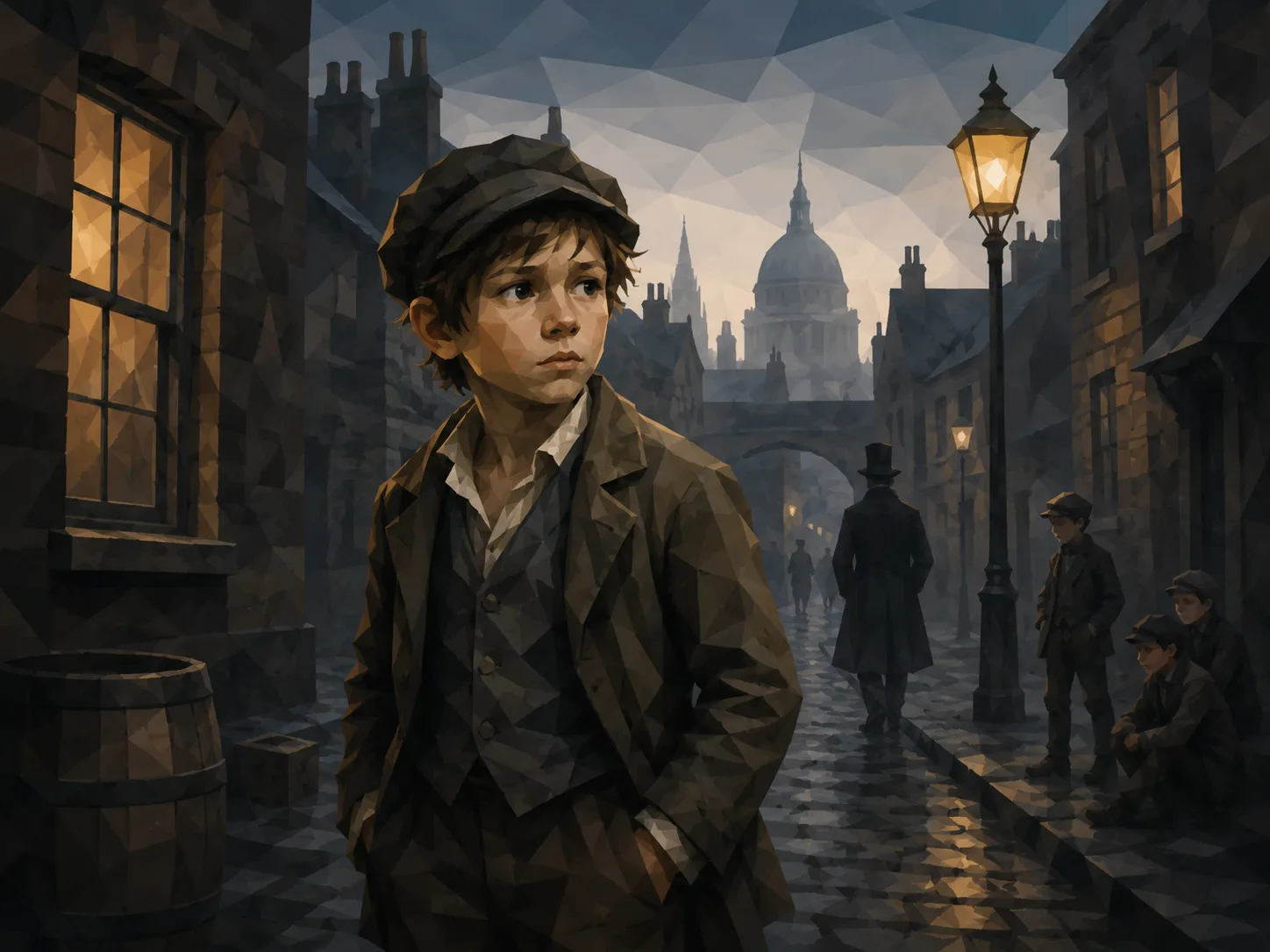
Oliver reached the stile where the path ended and stepped once more onto the high road. It was now eight o’clock in the morning. Although he was nearly five miles away from the town he had fled, he continued to run and hide behind hedges by turns until noon, fearing that he might be pursued and overtaken. Eventually, he sat down to rest beside a milestone and began to consider, for the first time, where he should go to try and make a living.
The stone beside him bore large letters indicating that it was exactly seventy miles from that spot to London. The name sparked a new sequence of thoughts in the young boy’s mind.
London! That vast city! Surely no one—not even the dreaded Mr. Bumble—could ever find him there. He had often heard the old men in the workhouse remark that a boy with any spirit would never go hungry in London. They claimed there were ways of surviving in that enormous city that people from the country could not even imagine. It seemed the perfect destination for a homeless boy who might otherwise perish in the streets. Driven by these thoughts, he jumped to his feet and started walking forward again.
He had reduced the distance to London by another four miles before he realized how much he would have to endure before reaching his destination. As this realization dawned on him, he slowed his pace and thought about his meager resources. In his bundle, he had a crust of bread, a coarse shirt, and two pairs of stockings. In his pocket, he had a single penny—a gift from Mr. Sowerberry after a funeral where Oliver had behaved particularly well. "A clean shirt is a comfort," Oliver thought, "and two pairs of mended stockings are useful, as is a penny. However, they are very small helps for a sixty-five-mile walk in the middle of winter." Like most people, Oliver was quick to identify his difficulties but struggled to find a practical way to overcome them. After much fruitless thinking, he shifted his bundle to his other shoulder and trudged on.
Oliver walked twenty miles that day. During that entire time, he tasted nothing but his dry crust of bread and a few sips of water, which he begged from cottages along the road. When night fell, he turned into a meadow and crawled under a haystack, intending to sleep there until morning. At first, he felt frightened; the wind moaned dismally over the empty fields, and he was cold, hungry, and more alone than he had ever been. However, being exhausted from his long walk, he soon fell into a deep sleep and forgot his troubles.
He felt cold and stiff when he woke the next morning. He was so hungry that he was forced to spend his only penny on a small loaf of bread in the very first village he passed. He managed to walk twelve miles that day before night fell again. His feet were sore, and his legs trembled with weakness. Another night spent in the cold, damp air made his condition worse; when he set out the next morning, he could hardly crawl.
He waited at the bottom of a steep hill until a stagecoach approached and then begged the passengers for help. Very few took any notice of him. Some cruelly told him to wait until they reached the top of the hill, promising a halfpenny if he could run fast enough to keep up. Poor Oliver tried to run alongside the coach, but his fatigue and sore feet made it impossible. Seeing this, the passengers put their coins back in their pockets, calling him a lazy dog who deserved nothing, and the coach rattled away, leaving him in a cloud of dust.
In some villages, large signs warned that anyone caught begging would be sent to jail. This terrified Oliver, making him leave those areas as quickly as possible. In other places, he would stand near inn yards, looking mournfully at the travelers. Usually, the landlady would notice him and order a servant to drive the "strange boy" away, certain that he was there to steal. If he begged at a farm, the owners often threatened to set their dogs on him. When he appeared at a shop, they spoke of calling the beadle—a threat that made Oliver’s heart sink.
In fact, if it had not been for a kind-hearted road worker and a benevolent old lady, Oliver’s journey might have ended as tragically as his mother’s life. The man gave him a meal of bread and cheese, and the old lady—who had a grandson of her own wandering somewhere far away—took pity on the orphan. she gave him what little she could afford, accompanied by such gentle words and sincere tears of compassion that her kindness touched Oliver more deeply than all his previous suffering.
Early on the seventh morning after leaving his home, Oliver limped slowly into the town of Barnet. The window shutters were closed and the streets were empty. The sun was rising in all its splendor, but its light only emphasized the boy’s loneliness as he sat on a doorstep, his feet bleeding and his clothes covered in dust.
Gradually, the town woke up. People began to pass by, some stopping to stare at Oliver for a moment before hurrying on. No one offered him help or asked why he was there. Having lost the courage to beg, he simply sat there.
He had been crouching on the step for some time, gazing listlessly at the passing coaches and wondering how they could travel in hours a distance that had taken him a week of determination to cover. Suddenly, he noticed a boy who had passed him earlier. This boy had returned and was now observing him intensely from across the street. Eventually, the stranger crossed the road, walked up to Oliver, and spoke.
"Hello, mate! What’s the trouble?"
The boy who addressed him was about his own age, but he was one of the strangest-looking individuals Oliver had ever seen. He had a flat face and a snub nose, and he was as dirty a child as one could imagine. Despite this, he had the manners and attitude of a grown man. He was short for his age, with bow-legs and sharp, ugly eyes. His hat was perched so loosely on his head that it threatened to fall off at any moment, though he had a habit of twitching his head to keep it in place. He wore a man’s coat that reached his heels, with the sleeves turned back so he could use his hands. He was a swaggering, bold young gentleman.
"I am very hungry and tired," Oliver replied, tears welling in his eyes. "I have been walking for seven days."
"Walking for seven days!" the boy exclaimed. "Oh, I see. By order of the magistrate, eh? But I suppose you don't know what a 'beak' is, my stylish friend."
Oliver mildly replied that he thought a "beak" was a bird’s mouth.
"My goodness, you are innocent!" laughed the boy. "A 'beak' is a judge. And when you walk by his order, you’re usually on the treadmill in prison. Have you never been on the mill?"
"What mill?" Oliver inquired.
"The prison mill, of course! But never mind that. You need food, and you shall have it. I’m short of money myself, but I’ll pay for what I can. Get up on your feet. There! Now, let's go!"
Assisting Oliver to rise, the boy took him to a nearby shop where he bought some ham and a loaf of bread. He cleverly hollowed out the bread to hide the ham inside. Then, he led Oliver to a small pub and ordered a pot of beer. Oliver ate a hearty meal while the strange boy watched him closely.
"Going to London?" the boy asked when Oliver had finished.
"Yes."
"Do you have a place to stay?"
"No."
"Any money?"
"No."
The strange boy whistled and thrust his hands into his pockets. "Do you live in London?" Oliver asked.
"I do, when I’m at home," the boy replied. "I suppose you need a place to sleep tonight?"
"I do indeed," Oliver answered. "I haven't slept under a roof since I left the country."
"Don’t worry about that," the young gentleman said. "I have to be in London tonight, and I know a respectable old gentleman there who will give you a room for free—provided a friend introduces you. And he certainly knows me!"
The boy smiled ironically and finished the beer. This offer was too tempting for Oliver to refuse, especially when he was told that the old gentleman would likely find him a job as well. During their conversation, Oliver learned that his new friend’s name was Jack Dawkins, though he was better known among his associates as "The Artful Dodger."
Mr. Dawkins' appearance did not suggest that his patron provided much in the way of comfort. However, Oliver concluded that since the Dodger seemed rather careless and rebellious, he simply hadn't followed the old gentleman’s good advice. Oliver resolved to earn the old man’s respect as soon as possible.
Since Dawkins preferred to enter London under the cover of darkness, it was nearly eleven o'clock when they reached the city. They hurried through a series of narrow, muddy streets. Oliver had never seen a more wretched or filthy place. The air was filled with terrible smells, and even at that late hour, the streets were crowded with screaming children and drunken men and women.
Oliver was just considering whether he should run away when they reached the bottom of a hill. His guide pushed open the door of a house and pulled him into a dark passage.
"Is that you?" a voice called from below after the Dodger whistled.
"Plummy and slam!" Dawkins replied.
This was evidently a signal that all was well. A man’s face appeared at the end of the passage, illuminated by a weak candle. "There are two of you," the man remarked. "Who’s the other one?"
"A new friend," replied Jack Dawkins, pulling Oliver forward. "Is Fagin upstairs?"
"Yes, he's sorting the silk handkerchiefs. Go on up!"
Oliver followed his companion up the dark, broken stairs. Dawkins threw open the door of a back room and led Oliver inside. The walls and ceiling were black with age and grime. Before the fire stood a table with a candle stuck in a bottle, some beer pots, and a loaf of bread. Sausages were cooking in a pan over the fire. Standing there with a toasting-fork was a shriveled old man with a repulsive face and matted red hair. He wore a greasy flannel gown and seemed to be dividing his attention between the sausages and a clothes-horse covered in silk handkerchiefs.
Several rough beds made of old sacks lay on the floor. Seated around the table were four or five boys, none older than the Dodger, who were smoking pipes and drinking like middle-aged men. They all crowded around as Dawkins whispered to the old man. The man, Fagin, grinned at Oliver.
"This is him, Fagin," said Jack Dawkins. "My friend Oliver Twist."
Fagin bowed and took Oliver’s hand, saying he hoped they would become close friends. The other boys then gathered around him. One offered to hang up his cap, while another helpfully put his hands in Oliver’s pockets so the tired boy wouldn't have to empty them himself. These suspicious "kindnesses" only stopped when Fagin used his toasting-fork to hit the boys.
"We are very glad to see you, Oliver," said Fagin. "Dodger, take the sausages off the fire. Oliver, you’re staring at the handkerchiefs, aren't you? There are a lot of them, my dear, but we’ve just gathered them for the wash. That’s all! Ha! ha! ha!"
The boys laughed loudly at this. Oliver ate his supper, and then Fagin gave him a glass of hot gin and water. Almost immediately after drinking it, Oliver felt himself being lifted onto one of the sacks, and he sank into a heavy, dreamless sleep.