


Theme & Story
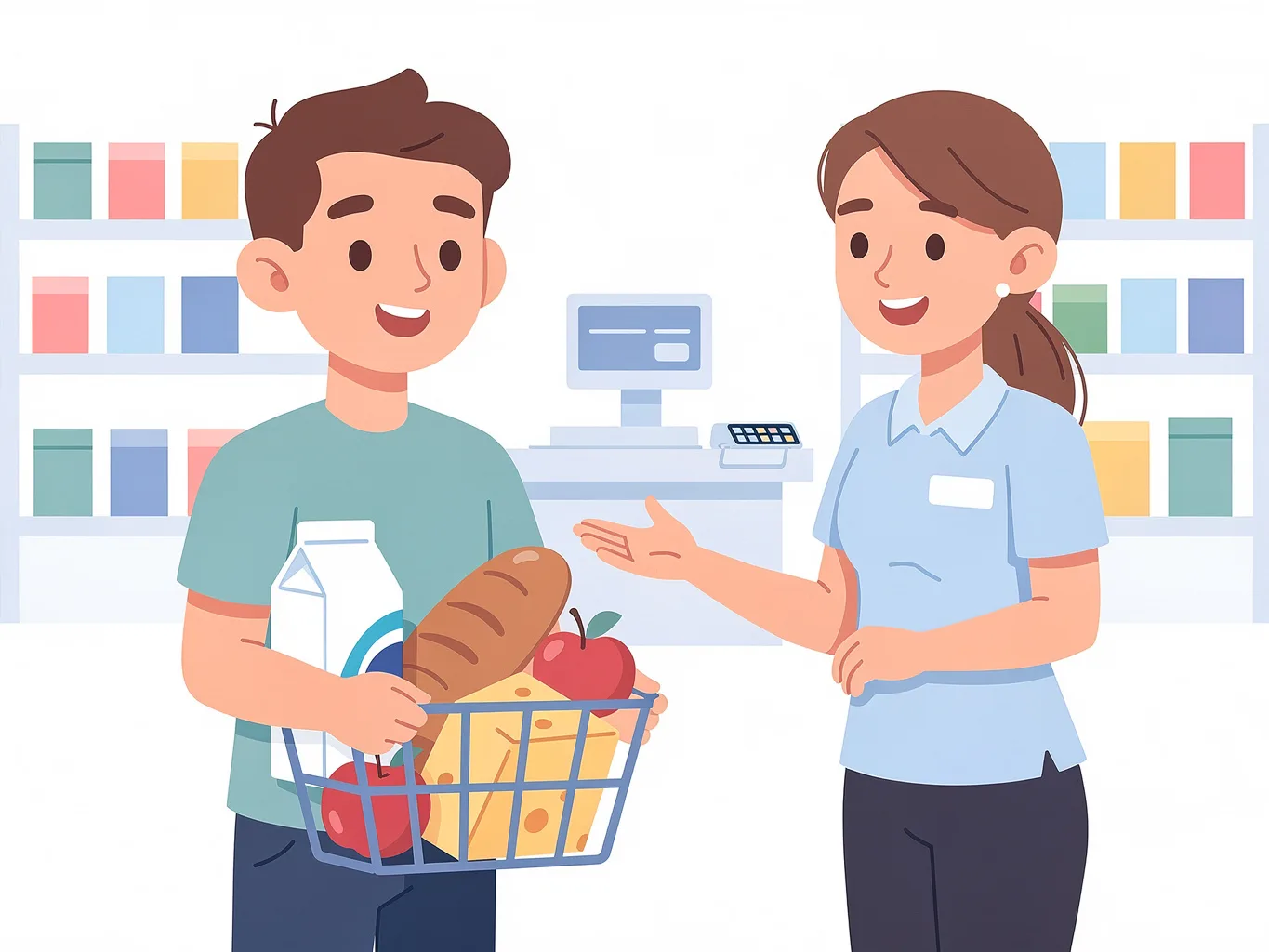
This song is a simple, friendly supermarket dialogue designed for English learners. The speaker enters a supermarket, asks a shop assistant for help, chooses groceries, goes to the checkout, pays by card, receives a receipt, and says goodbye politely.
The story follows a very common real-life situation: shopping for food. Because the lyrics repeat useful phrases like “Can I help you?”, “I would like…”, and “Yes, please,” the song works like a practice conversation. It helps learners build confidence for everyday interactions.
Metaphors & Meaning
There is very little figurative language here. The lyrics are mostly literal and practical, which makes them ideal for beginners.
However, the line “Shopping is easy. Give it a try.” has an encouraging meaning beyond supermarket shopping. It tells learners that speaking English in real situations may feel difficult at first, but they can succeed if they practice.
The repeated phrase “always with a smile” suggests politeness and friendliness. In many English-speaking cultures, smiling and using polite words like “please” and “thank you” are important in customer service interactions.
Vocabulary & Slang
- supermarket: A large store where people buy food and household items.
- shop assistant: A person who works in a shop and helps customers. In American English, people may also say sales assistant, store clerk, or employee.
- aisle: A walkway between shelves in a store. Pronounced like “eye-ul”; the s is silent.
- groceries: Food and everyday items bought from a supermarket.
- checkout: The place where you pay for your items.
- cashier: The person who takes your payment at the checkout.
- basket: A small container you carry while shopping.
- receipt: The paper or digital record showing what you bought and how much you paid.
- Cash or card?: A common question meaning, “Will you pay with money or with a bank card?”
- Keep the change: A phrase used when paying with cash, meaning the cashier or server can keep the extra money. In this song, it appears after paying by card, so it is not fully natural in context.
- Have a nice day! / You too!: A very common polite exchange when leaving a shop.
- One unusual phrase is “for this heavy tag.” In natural English, learners would more likely say “for these heavy things,” “for this heavy bag,” or “because my items are heavy.” The word tag usually means a small label attached to a product, not the shopping itself.
Grammar Notes
- “I would like…” is a polite way to ask for something. It is softer and more formal than “I want…”
- Example: “I would like some apples.”
- “Can I help you?” is a standard service question. It means the worker is offering assistance.
- “Where is the milk?” uses the question form:
- Where + is + noun?
- This is useful for asking locations in shops, cities, or buildings.
- “Do you need a bag?” uses the present simple question form:
- Do + you + base verb...?
- “How would you like to pay?” is a polite question with would like to + verb. It means, “What payment method do you prefer?”
- “I will pay by card” uses will + base verb to express a decision or future action.
- “some apples / some cheese” shows how some works with both countable and uncountable nouns:
- some apples = plural countable noun
- some cheese = uncountable noun
- The song uses direct speech with quotation marks to show a conversation. This makes it useful for role-play practice between a customer and a shop worker.