


Theme & Story
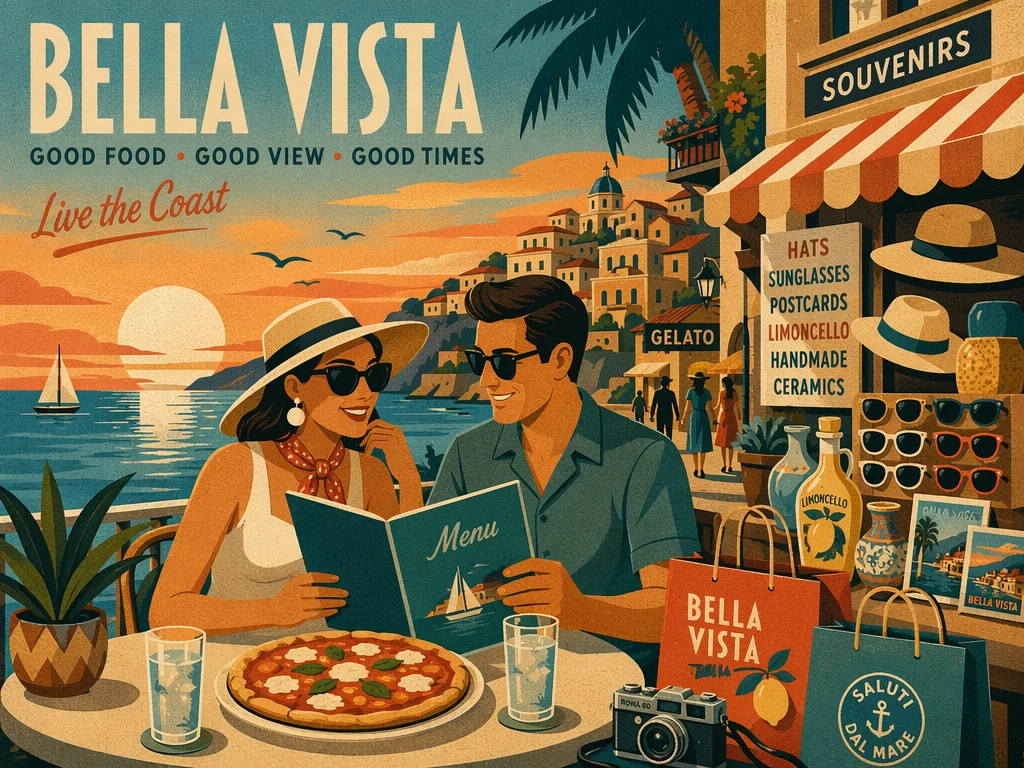
“Delicious Day (Restaurant & Shopping)” is a friendly, beginner-level travel song about eating at a restaurant and shopping at a market. The story begins at sunset: two people are hungry, find a table by the sea, order food and drinks, enjoy a delicious meal, pay the bill, then go shopping for souvenirs, a hat, and sunglasses.
The song is built around useful real-life phrases for travelers: ordering food, asking prices, trying on clothes, paying, tipping, and using polite words. Its main message is simple: travel is more enjoyable when you can communicate politely.
Metaphors & Meaning
There is very little hidden or complex metaphor here because the song is designed for language learning. Most lines are practical and literal.
One important poetic phrase is:
- “These are the words where the magic comes from!” Here, “magic” means the positive effect of polite language. Words like please, thank you, and you’re welcome can make social interactions warmer and easier.
- “I have so many memories I want to keep!” This connects shopping, food, photos, and travel experiences. The souvenirs and camera represent memories of a happy trip.
- A table for two, please — a polite way to ask for a restaurant table for two people.
- Menu — the list of food and drinks in a restaurant.
- Are you ready to order? — a common waiter/waitress question.
- I would like... — a polite way to request something. More formal and softer than “I want.”
- Can I have...? — a very common polite request in restaurants and shops.
- The bill, please / The check, please — both mean you want to pay. Bill is common in British English; check is common in American English.
- Keep the change! — you tell the seller or server they do not need to return the remaining money.
- Leave a tip — give extra money to restaurant staff for their service. Tipping customs differ by country.
- How much is this/that? — asks for the price.
- How much does it cost? — another natural way to ask the price.
- I’ll take it / I will take it — means “I want to buy it.”
- Can I try it on? — asks if you can wear clothing or accessories before buying.
- Do you have my size? — asks if the shop has the correct size for you.
- Souvenirs — objects bought to remember a place or trip.
- Expensive / cheap — high price / low price.
- Please — makes requests polite.
- Thank you — used when someone helps you or gives you something.
- You’re welcome — used as a response when someone says “thank you.”
- Let’s find a table.
- Let’s go to the market.
- I would like a pizza.
- I would like some water.
- Can I have the soup?
- Can I have the bill?
- a pizza — countable: one pizza.
- some water — uncountable: water is not usually counted one-by-one.
- a hat — countable.
- souvenirs — plural countable noun.
- How much is this? — something near you.
- How much is that? — something farther away or being pointed to.
Another emotional idea appears near the end:
Vocabulary & Slang
Key travel and restaurant phrases:
Important politeness words:
Note: The lyric says, “If somebody helps you, say YOU ARE WELCOME.” In normal English, if somebody helps you, you usually say “Thank you.” The helper then says “You’re welcome.”
Grammar Notes
1. “Let’s” for suggestions
Let’s + base verb means “I suggest that we do this together.” It is very useful for travel plans.
2. Polite requests with “would like”
Would like is a polite structure. It is often used in restaurants, cafés, hotels, and shops.
Pattern: I would like + noun
Example: I would like a coffee.
3. “Can I have...?” for asking
This is a common spoken-English request. It is grammatically a question, but socially it means “Please give me...”
4. Countable and uncountable nouns
5. “This” and “that”
6. Repetition for learning
The song repeats useful phrases many times: Can I have...?, How much is...?, I would like... This repetition helps learners memorize sentence patterns and use them automatically in real situations.