


Theme & Story
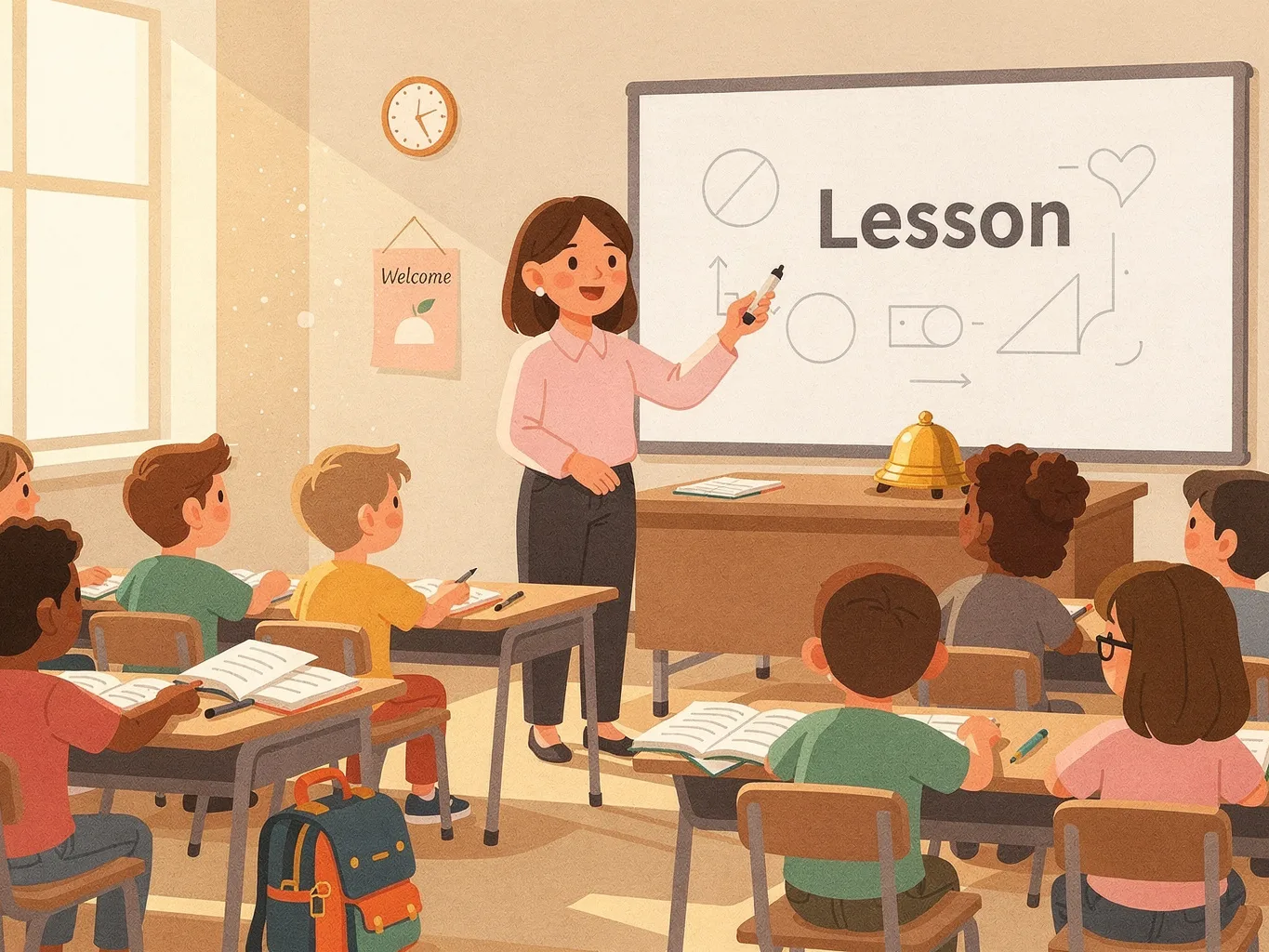
“In the Classroom” is a simple, cheerful song about a normal school day. The speaker wakes up early, goes to school, listens to the teacher, reads, writes, asks questions, and finishes the lesson when the bell rings. The song introduces everyday classroom objects and actions, making it very useful for beginner English learners.
The story moves in a clear order: morning routine → classroom learning → repeated study actions → the end of the lesson. This makes the lyrics easy to follow and remember.
Metaphors & Meaning
This song is mostly literal, not metaphorical. The words describe real school objects and activities: a teacher, board, desk, book, pen, paper, screen, and bell.
The main deeper meaning is that learning is a regular part of life. The line “Learning is important for every age” suggests that education is not only for children; people can learn at any age. The repeated actions “Read and write, listen and speak” also show the four major language skills, which is especially relevant for English learners.
There are no complex cultural references, but the song reflects a common school routine in many English-speaking contexts: students attend school five days a week, sit at desks, listen to a teacher, and hear a bell at the end of a lesson.
Vocabulary & Slang
There is no slang in the song. The vocabulary is clear, practical, and classroom-focused.
Key words and phrases:
- wake up early: to stop sleeping in the morning before it is late.
- go to school: to travel to school and attend classes.
- in front of the board: the teacher stands before the classroom board.
- listen to every word: to pay careful attention.
- desk: the table where a student sits and works.
- letters and numbers: the basic symbols used for reading, writing, and math.
- take a look: to look at something briefly.
- five days a week: Monday to Friday in many school systems.
- ask a question / answer it: useful classroom verbs for participation.
- the lesson is over: the class has finished.
- See you tomorrow: a friendly goodbye used when you expect to meet again the next day.
- Simple present tense: The song uses the simple present for routines and facts: “I wake up,” “I go,” “We listen,” “We have.” This is perfect for practicing daily activities.
- Subject + verb + object structure: Many lines are basic English sentence patterns: “I open my book,” “I hold my pen,” “We draw a picture.” These are clear examples of beginner-friendly grammar.
- There are: “There are letters and numbers” introduces plural nouns. Use there are with more than one thing.
- Imperatives: “Close your book” is a command or instruction. Teachers often use imperatives in the classroom.
- Prepositions: The song uses useful location phrases like “in front of the board,” “at my desk,” “on the page,” and “at the screen.” These help learners describe where people and objects are.
- Repeated chorus: The lines “Read and write, listen and speak” repeat to help learners remember key verbs. Repetition is common in songs because it supports rhythm, memory, and pronunciation practice.
The list of words near the end—“School. Classroom. Teacher. Student.”—works like a vocabulary chant. It helps learners memorize nouns and verbs connected to school.