


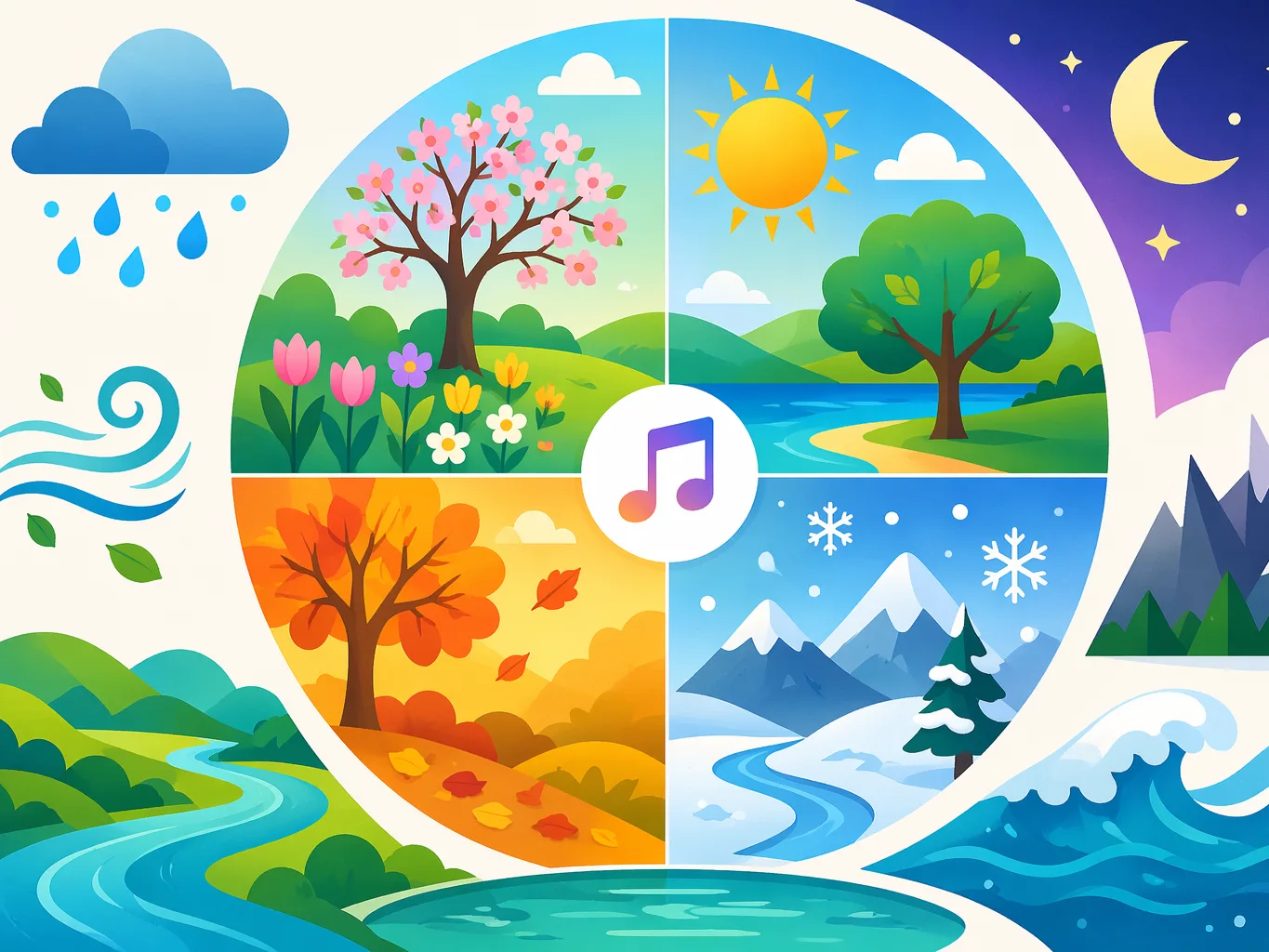
Theme & Story
“The World Around Us (Seasons and Weather)” is a simple, educational song that invites the listener to notice nature. It begins with imagination—“Imagine the world. Imagine the sky.”—then moves through the four seasons, different kinds of weather, things in the sky, things on the land, and bodies of water.
The song does not tell a dramatic story with characters. Instead, it creates a calm journey of observation: look around, look up, look down, and see how beautiful nature is every day and in every season.
Metaphors & Meaning
Most of the language is literal and clear, which makes it excellent for beginners. However, a few lines carry a deeper feeling:
- “Everything changes.” This line refers to the natural cycle of seasons and weather. It can also suggest a life lesson: change is normal and constant.
- “Water is life.” This is a common meaningful phrase. It means that water is necessary for plants, animals, and people to live. It is not just describing water; it shows water’s importance.
- “The world is white.” This describes winter snow covering the ground. It creates a visual image of a snowy landscape.
- Seasons: spring, summer, autumn, winter
- Weather: sun, rain, snow, wind, storm
- Sky words: sky, moon, stars
- Land words: grass, mountain
- Water words: river, lake, sea, ocean
- bright = full of light
- wet = covered with water
- cold = low temperature
- blue / silver / green / white = color adjectives
- long / quiet / big / deep / high = simple adjectives describing size, sound, or position
- Imperatives / commands
- “Imagine the world.”
- “Listen and see.”
- “Look out the window.”
- “Look up high.”
- “Look down low.”
- Simple present with “be”
- “The sun is hot.”
- “The sky is blue.”
- “The ocean is deep.”
- Plural noun + “are”
- “The stars are shining.”
- Present continuous
- “The wind is blowing.”
- “The stars are shining.”
- “A storm is coming.”
- Short sentence fragments for rhythm
- “Spring. Summer. Autumn. Winter.”
- “Sun. Rain. Snow. Wind. Storm.”
There are no slang words or complex cultural references. The song uses universal images—sun, rain, snow, sky, stars, rivers—that many cultures recognize.
Vocabulary & Slang
This song is especially useful for learning basic nature vocabulary:
Key descriptive words include:
There is no slang in the lyrics. The language is clean, direct, and classroom-friendly.
Grammar Notes
The grammar is simple and repetitive, which helps learners remember patterns.
These are command forms. In English, imperatives often start with the base verb: look, listen, imagine.
Pattern: The + noun + is + adjective. This is a very useful beginner structure.
Because stars is plural, the verb is are, not is.
Pattern: be + verb-ing. This describes something happening now or in progress.
Overall, the song is a strong learning tool because it combines basic vocabulary, clear grammar patterns, and memorable repetition.