


Theme & Story
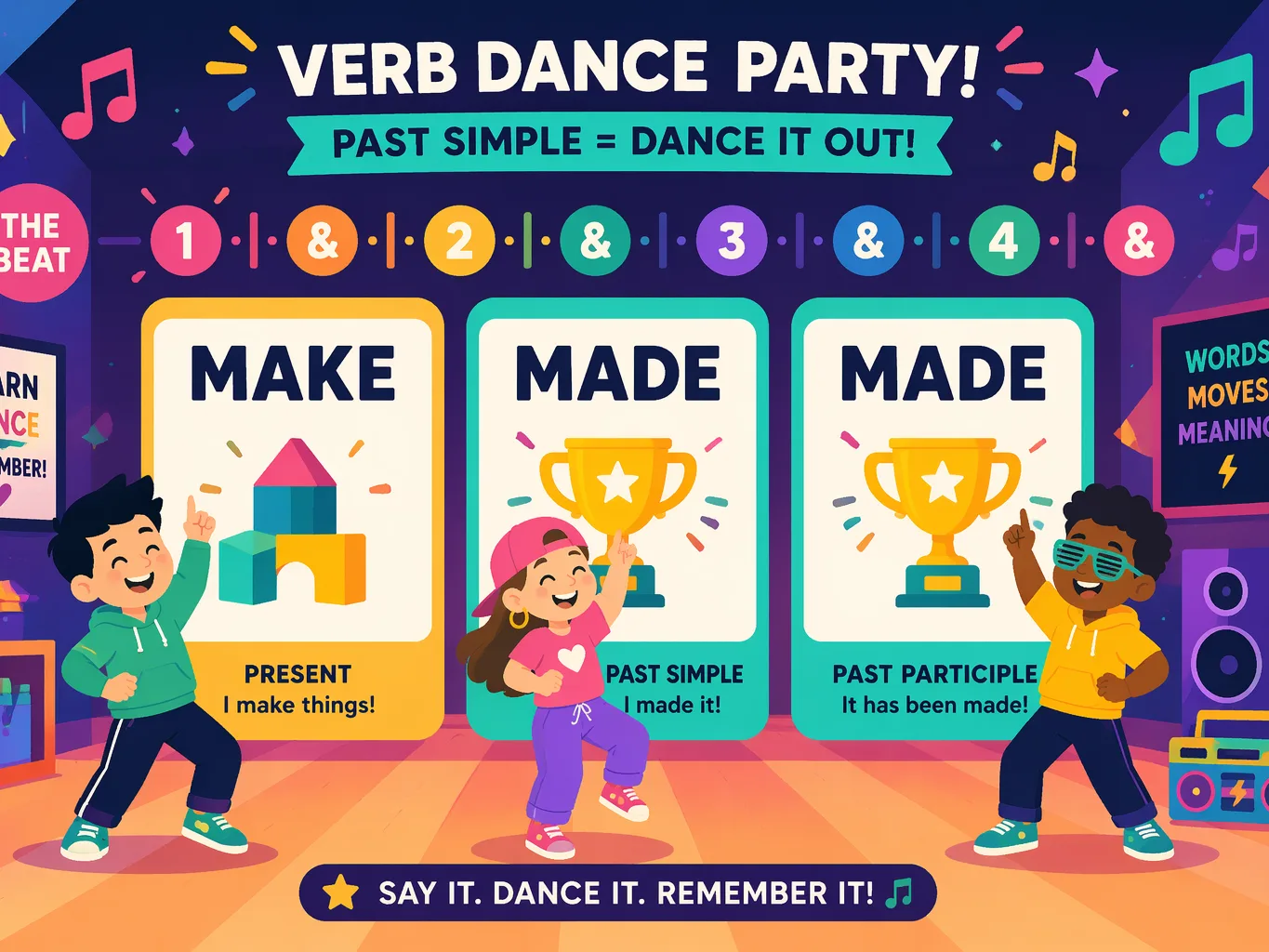
This song is a rhythmic grammar chant designed to help English learners memorize a special group of irregular verbs. The main idea is simple: for these verbs, the past simple form and the past participle form are the same.
For example:
- make → made → made
- find → found → found
- keep → kept → kept
- hear → heard → heard
- beat: the rhythm of music.
- exactly the same: completely identical.
- sing it out: sing loudly and confidently.
- matching: being the same or going together.
- accept it: stop resisting something and agree that it is true.
- without a drop of guilt: with no guilt at all; “a drop of” emphasizes a very small amount.
- brave and bold: confident and not afraid.
- two of a kind: two things that are very similar or the same in an important way.
- Base form / present form: make, find, sit
- Past simple: made, found, sat
- Past participle: made, found, sat
- sit → sat → sat
- sleep → slept → slept
- sell → sold → sold
- tell → told → told
- I found my keys yesterday.
- She left early.
- I have found my keys.
- The house was built in 1990.
The “story” of the song is really a learning routine: listen to the beat, repeat the verb forms, and remember the pattern. It turns grammar practice into something musical and memorable.
Metaphors & Meaning
The title “Two Of A Kind” refers to forms number two and three: the past simple and the past participle. They are “of a kind” because they match.
The line “make the memory last” means repetition helps learners remember the verbs for a long time. The song uses rhythm, rhyme, and chanting as memory tools.
“You know you must accept it!” is playful. Irregular verbs do not always follow normal rules, so learners sometimes just have to accept and memorize them.
“Without a drop of guilt” is a humorous phrase. It means you can sing loudly and proudly, without feeling embarrassed.
Vocabulary & Slang
Grammar Notes
The song teaches the three main forms of irregular verbs:
The key grammar pattern is:
Verb 1 + Verb 2 + Verb 3
present + past simple + past participle
In this group, forms 2 and 3 are identical:
The past simple is used for completed actions:
The past participle is often used with perfect tenses or passive voice: