


Ocean Mysteries We Can Explain
Discover how ocean animals survive, why seawater behaves as it does, and what connects life beneath the waves.
Preview
Questions with solutions-
1. योग्य उत्तर निवडा.
Why must the whale return to the surface?
A whale can stay underwater for a long time, but it cannot stay there forever.
- To breathe air.
- To drink fresh water.
- To lay its eggs.
Whales are mammals, like us.
Show solution
- To breathe air.
Whales have lungs, not gills. They breathe through openings on top of their heads.
-
2. योग्य उत्तर निवडा.
What mainly causes these regular tides?
At the beach, the water level rises and falls in a regular pattern. These changes are called tides.
- Rain falling into the ocean.
- The pull of the Moon and the Sun.
- Winds blowing toward the beach.
Think about objects beyond Earth.
Show solution
- The pull of the Moon and the Sun.
The Moon has the stronger effect on tides because it is much closer to Earth than the Sun.
-
3. योग्य उत्तर निवडा.
What kind of living things build coral reefs?
Coral reefs may look like colorful underwater gardens, but their builders are not plants.
- Tiny sea plants.
- Tiny bacteria.
- Tiny sea animals.
Their garden-like shape can fool us.
Show solution
- Tiny sea animals.
Reef-building coral animals produce hard structures. Over time, these structures form reefs.
-
4. योग्य उत्तर निवडा.
How does the dark cloud help the octopus escape?
An octopus releases ink into the water, creating a dark cloud between itself and a hunting fish.
- It makes the octopus harder to see.
- It changes the color of the octopus's skin.
- It pushes the octopus forward faster.
Think about the hunting fish's view.
Show solution
- It makes the octopus harder to see.
Ink hides the escape route. An octopus can also move away quickly by pushing water out of its body.
-
5. योग्य उत्तर निवडा.
What supports a shark's body instead of bone?
A shark has a strong skeleton, but it is not made of hard bone like ours.
- A hard shell outside its body.
- A flexible material like the one in our ears.
- Water filling its body, with no skeleton.
Feel the part of your ear that bends.
Show solution
- A flexible material like the one in our ears.
This material is called cartilage. It is lighter and more flexible than bone.
-
6. योग्य उत्तर निवडा.
Where can seagrass grow well?
Seagrass is a flowering plant that lives in the ocean. It needs sunlight to make food.
- Deep below the reach of sunlight.
- Beneath a thick cover that blocks the light.
- In shallow water where light reaches the bottom.
The roots are on the bottom, but the leaves need light.
Show solution
- In shallow water where light reaches the bottom.
Seagrass beds also give young fish places to hide and grow.
-
7. योग्य उत्तर निवडा.
What helps protect clownfish from the stings?
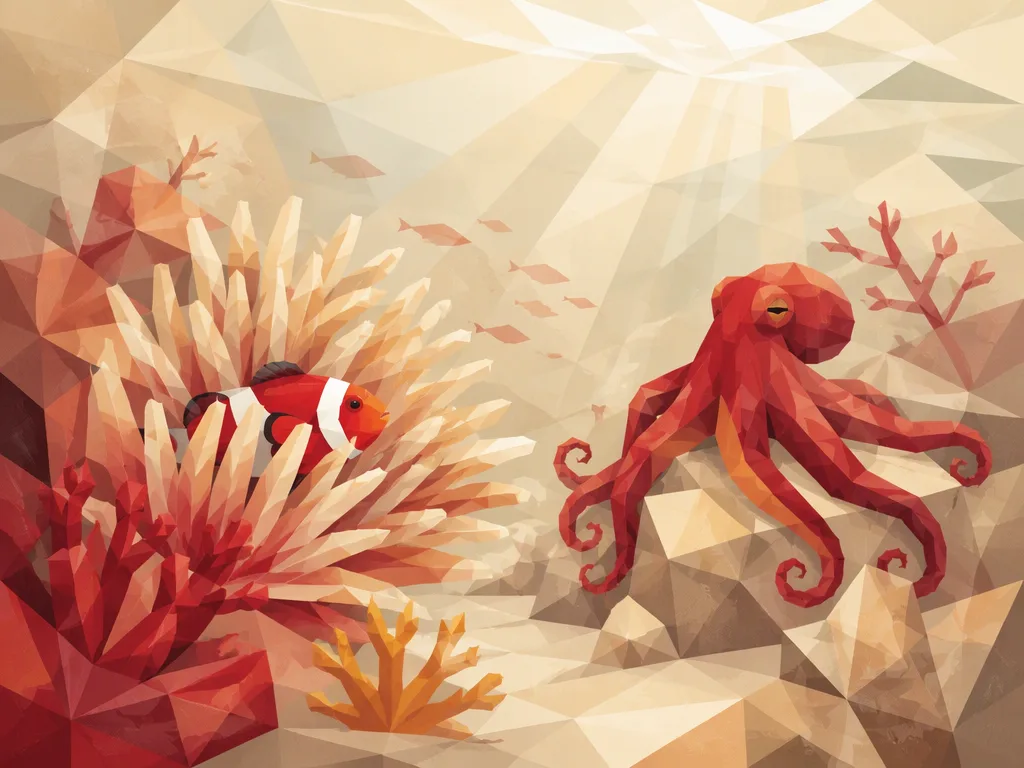
Sea anemones have arms that sting. Clownfish can live safely among these arms.
- A special coating on their skin.
- Their orange color.
- Their ability to remove all the stinging cells.
The protection is on the fish's body.
Show solution
- A special coating on their skin.
The coating helps prevent stings. The anemone's arms can then provide shelter from other fish.
-
8. योग्य उत्तर निवडा.
How do both fish benefit?
A cleaner fish eats tiny unwanted animals from a larger fish's skin. The larger fish usually lets it continue.
- The larger fish gets food, and the cleaner fish gets cleaned.
- The cleaner fish gets food, and the larger fish gets cleaned.
- Both fish get food by eating from each other's skin.
Notice which fish is eating.
Show solution
- The cleaner fish gets food, and the larger fish gets cleaned.
This is a partnership in which both animals benefit. Some cleaner fish work at regular meeting places.
-
9. योग्य उत्तर निवडा.
Where does the fish's light come from?
In a part of the deep ocean with no sunlight, a fish produces a small glow.
- Sunlight stored in its scales.
- Light reflected from the ocean surface.
- A chemical reaction inside its body.
There is no outside light for the fish to reflect.
Show solution
- A chemical reaction inside its body.
Living things can produce light through chemical reactions. Some ocean animals use this light to attract food or send signals.
-
10. योग्य उत्तर निवडा.
Why does water pressure increase with depth?
As a diver swims deeper, the surrounding water presses more strongly on the diver's body.
- There is more water above the diver, pushing down.
- Deep water always contains more oxygen.
- Deep water is always hotter than surface water.
Imagine the weight of the water above the diver.
Show solution
- There is more water above the diver, pushing down.
Deep-sea animals have bodies suited to high pressure. Many cannot survive a sudden move to the surface.
-
11. योग्य उत्तर निवडा.
What does this tell us about the weight of sea ice?
A piece of sea ice floats at the ocean's surface instead of sinking.
- It weighs more than an equal volume of seawater.
- It weighs less than an equal volume of seawater.
- It weighs the same as an equal volume of seawater.
Compare ice and liquid water that take up the same amount of space.
Show solution
- It weighs less than an equal volume of seawater.
Water expands as it freezes. This helps explain why ice floats rather than sinking.
-
12. योग्य उत्तर निवडा.
What energy source do these microbes use to make food?
Tiny living things called microbes live near hot springs on the deep ocean floor. They make food where sunlight never reaches.
- Sunlight passing through the ocean.
- Heat alone, without using any chemicals.
- Chemicals released by the hot springs.
Making food does not always require light.
Show solution
- Chemicals released by the hot springs.
These microbes support whole communities of animals, including tube worms and shellfish.
-
13. योग्य उत्तर निवडा.
Why does the remaining water become saltier?
In a warm, dry bay, a lot of seawater evaporates: it turns into water vapor and enters the air.
- Water leaves, but most of the salt remains.
- Sunlight changes some of the water into salt.
- The rising water vapor brings extra salt into the bay.
Think about whether salt turns into vapor the way water does.
Show solution
- Water leaves, but most of the salt remains.
Salt can be collected by letting seawater evaporate in shallow pools.
-
14. योग्य उत्तर निवडा.
How would a bright red object usually look deep underwater without a lamp?
Sunlight contains many colors. As it travels through seawater, red light disappears sooner than blue light.
- Brighter red, because depth makes red light stronger.
- Dark, because little red light reaches it.
- Bright red, because red objects produce their own light.
An object can only reflect light that reaches it.
Show solution
- Dark, because little red light reaches it.
A diver's lamp can reveal colors that seem to disappear underwater.
-
15. योग्य उत्तर निवडा.
What is most likely to happen to the kelp if many otters disappear?
Sea otters eat sea urchins. Sea urchins eat kelp, a large seaweed. In this area, otters are the main animals that eat the urchins.
- There may be more kelp because otters no longer eat it.
- The amount of kelp will stay the same because otters do not eat kelp.
- There may be less kelp because more urchins survive.
Follow the chain from otters to urchins to kelp.
Show solution
- There may be less kelp because more urchins survive.
Predators can help protect plants indirectly by controlling the animals that eat those plants.