


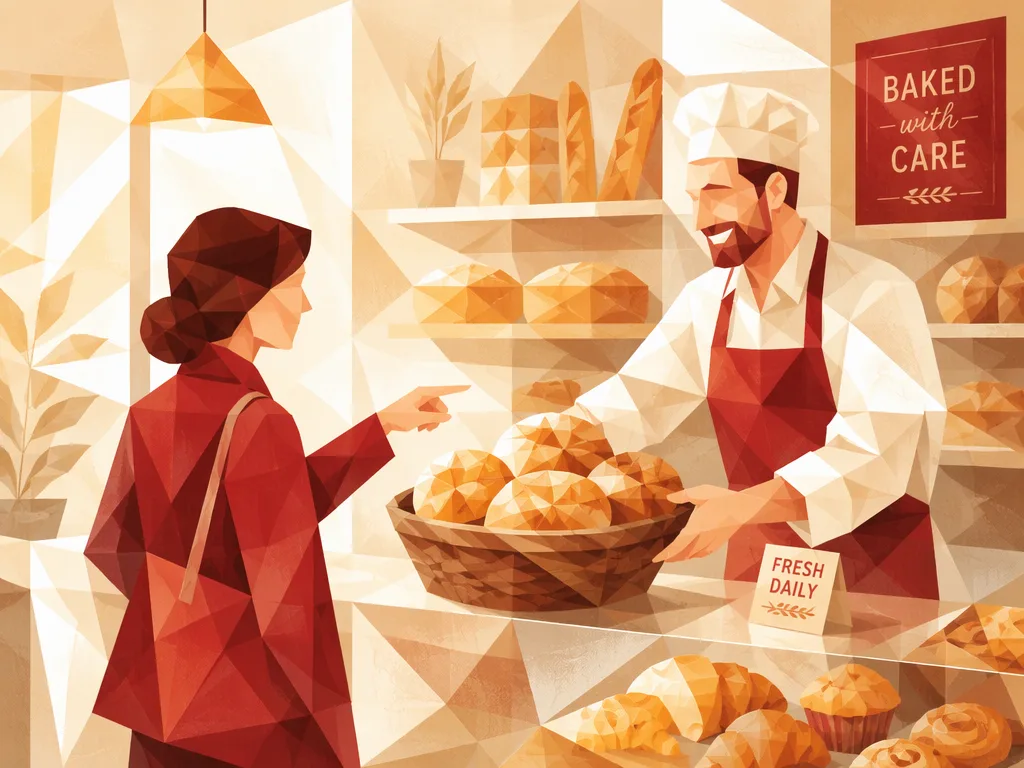
Polite Requests: Könnten Sie, Würden Sie, Ich hätte gern
Practice asking politely in German in shops, offices and with strangers. You will use Könnten Sie …? and Würden Sie …? with the infinitive at the end of the sentence, as well as Hätten Sie …? and Ich hätte gern … with a noun.
Preview
Questions with solutions-
1. योग्य उत्तर निवडा.
You're at a bakery and want two bread rolls. Which sentence is correct and polite?
- Ich hätte gern zwei Brötchen.
- Ich habe gern zwei Brötchen.
- Ich hätte zwei Brötchen gern haben.
- Gib mir zwei Brötchen!
Use the polite form of haben, not the normal present tense.
Show solution
- Ich hätte gern zwei Brötchen.
"Ich hätte gern …" is the standard polite way to order in a shop. "Ich habe gern …" means "I like having …", and "Gib mir …!" sounds rude to a stranger.
-
2. रिकामी जागा भरा.
Add the missing verb.
Könnten Sie mir bitte ___?
- helfen
- hilfst
- helft
- geholfen
After Könnten Sie, the second verb comes at the end in its basic form.
Show solution
Könnten Sie mir bitte helfen?
With Könnten Sie and Würden Sie, the main verb stays in the infinitive at the end: "Könnten Sie mir bitte helfen?"
-
3. रिकामी जागा भरा.
You ask a stranger to wait a moment. Pick the form that goes with Sie.
___ Sie bitte kurz warten?
- Könnten
- Könnte
- Könntest
- Konnten
Look at the umlaut and the ending for Sie.
Show solution
Könnten Sie bitte kurz warten?
For Sie the form is "Könnten" (with ö and the ending -en). "Konnten" without the umlaut is the past tense: "they could / were able to".
-
4. योग्य उत्तर निवडा.
You're at a bank counter and need a pen from the employee, whom you don't know. Which request fits best?
- Könnten Sie mir bitte einen Stift geben?
- Gib mir einen Stift!
- Kannst du mir einen Stift geben?
- Du gibst mir einen Stift.
With strangers and staff you use Sie, not du.
Show solution
- Könnten Sie mir bitte einen Stift geben?
With people you don't know, use Sie. "Könnten Sie mir bitte …?" is polite and friendly. "Kannst du …?" is fine for friends, but too informal here.
-
5. रिकामी जागा भरा.
You ask someone at a train station whether they happen to have a pen for you.
___ Sie vielleicht einen Stift für mich?
- Hätten
- Könnten
- Würden
- Hättest
There's no second verb in this sentence, so you need the polite form of haben.
Show solution
Hätten Sie vielleicht einen Stift für mich?
"Hätten Sie …?" is the polite way of saying "Do you have …?". Könnten and Würden need a second verb at the end, for example "Könnten Sie mir einen Stift geben?"
-
6. उत्तर लिहा.
At a hotel reception: type the missing word to ask politely for a room.
Ich ___ gern ein Zimmer für zwei Nächte.
It's the polite form of haben for ich.
Show solution
- hätte
"Ich hätte gern …" works everywhere you order or ask for something: in a shop, at a café or at a hotel.
-
7. शब्द योग्य क्रमाने लावा.
At a restaurant, ask the waiter for the bill.
- Sie
- die Rechnung
- bringen?
- Könnten
- mir bitte
Start with the verb Könnten; the infinitive comes last.
Show solution
Könnten Sie mir bitte die Rechnung bringen?
Polite questions start with Könnten, followed by Sie. The infinitive (bringen) goes at the very end.
-
8. योग्य उत्तर निवडा.
At an office you didn't understand what the official said. Which sentence is correct?
- Würden Sie das bitte wiederholen?
- Würdest Sie das bitte wiederholen?
- Werden Sie das bitte wiederholen?
- Würden Sie das bitte wiederholt?
Check three things: the umlaut, the ending for Sie and the form of the last verb.
Show solution
- Würden Sie das bitte wiederholen?
"Würden Sie …?" + infinitive is a polite request. "Werden Sie …?" without the umlaut asks about the future ("Will you …?"), and the last verb must be the infinitive "wiederholen".
-
9. रिकामी जागा भरा.
At the citizens' office, the official asks you something.
Würden Sie bitte das Formular ___?
- ausfüllen
- ausgefüllt
- füllen aus
- ausfüllt
With a separable verb, the infinitive stays together at the end.
Show solution
Würden Sie bitte das Formular ausfüllen?
After Würden Sie, a separable verb such as ausfüllen stays in one piece at the end: "Würden Sie bitte das Formular ausfüllen?"
-
10. रिकाम्या जागा भरा.
At the ticket counter of a train station.
Guten Tag, ich ___ gern eine Fahrkarte nach Berlin. ___ Sie mir auch den Fahrplan geben?
- hätte
- Könnten
- habe
- Könnte
- Hätten
The first gap needs the ich form of haben; the second needs a polite verb that goes with Sie and geben.
Show solution
Guten Tag, ich hätte gern eine Fahrkarte nach Berlin. Könnten Sie mir auch den Fahrplan geben?
"Ich hätte gern …" orders the ticket, and "Könnten Sie mir … geben?" asks for the timetable. "Hätten Sie" doesn't fit, because there is already a second verb (geben).
-
11. उत्तर लिहा.
You're lost in a new town. Type the polite form of können that goes with Sie.
___ Sie mir bitte den Weg zeigen?
It starts with K and has an umlaut.
Show solution
- Könnten
"Könnten Sie …?" is softer and more polite than "Können Sie …?", which makes it perfect for asking strangers for directions.
-
12. रिकाम्या जागा भरा.
On the phone with a customer service agent, you can't hear well.
___ Sie bitte etwas lauter ___?
- Würden
- sprechen
- Wird
- spricht
- gesprochen
Polite verb first, infinitive last.
Show solution
Würden Sie bitte etwas lauter sprechen?
"Würden Sie bitte etwas lauter sprechen?" Würden comes first and sprechen goes at the end in the infinitive.
-
13. शब्द योग्य क्रमाने लावा.
At the market, order some apples.
- Ich
- hätte
- gern
- ein Kilo Äpfel.
gern comes right after hätte.
Show solution
Ich hätte gern ein Kilo Äpfel.
The usual order is: Ich hätte gern + what you want. It's an easy pattern for any shop.
-
14. योग्य उत्तर निवडा.
You want to know when the office opens. Which polite question is correct?
- Könnten Sie mir sagen, wann das Büro öffnet?
- Könnten Sie mir sagen, wann öffnet das Büro?
- Könnten Sie sagen mir, wann das Büro öffnet?
- Könnten Sie mir sagen, wann das Büro öffnen?
After "wann" in the second part, the verb goes to the end.
Show solution
- Könnten Sie mir sagen, wann das Büro öffnet?
In "Könnten Sie mir sagen, wann …?" the second part is a subordinate clause, so the conjugated verb (öffnet) goes at the end. "mir" comes before "sagen".
-
15. ऐका आणि उत्तर लिहा.
It starts with a word you use to get a stranger's attention.
Show solution
- Entschuldigung, könnten Sie mir bitte helfen?
"Entschuldigung" followed by "könnten Sie mir bitte helfen?" is a perfect way to start talking to someone you don't know.
-
16. ऐका आणि उत्तर लिहा.
You're ordering a drink at a café.
Show solution
- Ich hätte gern eine Tasse Tee mit Zitrone.
"Ich hätte gern …" plus the item: a polite order at a café.
-
17. ऐका आणि उत्तर लिहा.
Listen for the polite verb at the beginning and the infinitive at the end.
Show solution
- Würden Sie bitte die Tür schließen?
"Würden Sie bitte …?" + infinitive asks someone politely to do something, here to close the door.