


What is the song about?
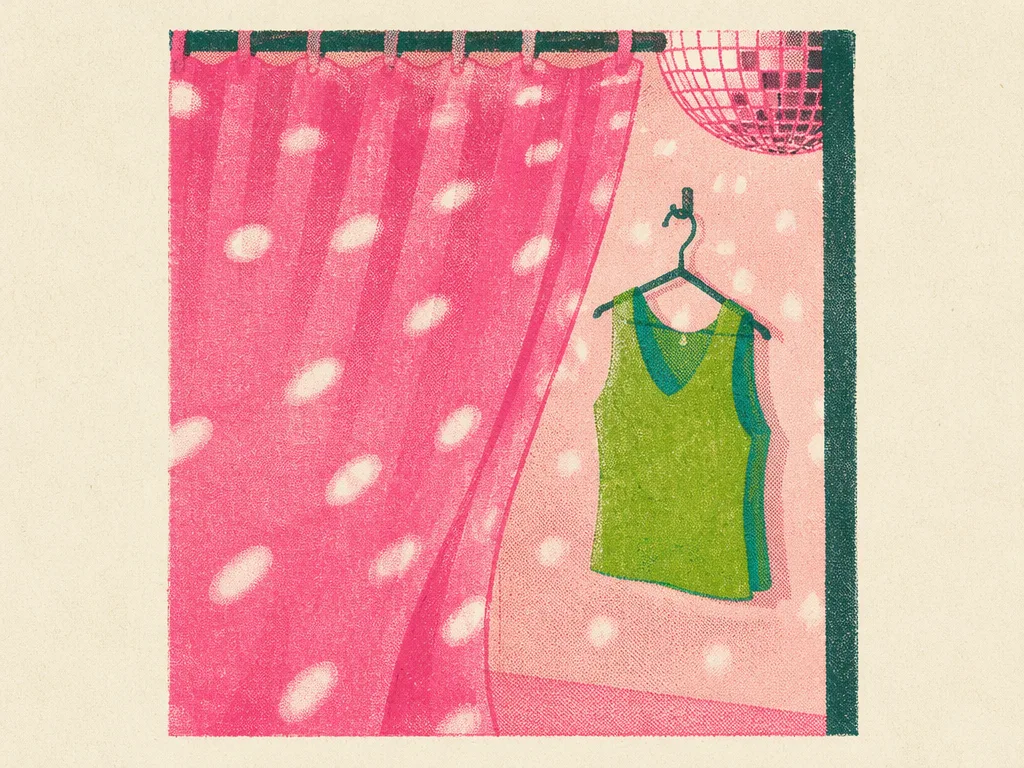
The singer walks into a clothing shop. They look at jackets, jumpers and trousers, go to the fitting room, find that a top is too tight and that a pair of trousers is too short, and then the sales assistant brings them a style that fits perfectly. They pay at the checkout and walk out proud of their style.
Useful vocabulary
Clothes
- une veste, un pull, un haut, un pantalon, une robe, un t-shirt
- le tissu: the fabric or material of a piece of clothing
- un modèle: a style or version of a piece of clothing
- la cabine (d'essayage): the small room where you try on clothes
- le rideau: the fabric that closes the fitting room
- la glace / le miroir: two words for the same thing
- la taille: S, M, L…
- le vendeur / la vendeuse
- la caisse: the place where you pay
- les prix
Describing a piece of clothing
- serré (≠ large), court (≠ long)
- C'est trop serré. / Les jambes sont trop courtes.
Expressions
- Puis-je l'essayer ?: a polite way to ask if you can try on a piece of clothing. In spoken French, people also often say Je peux l'essayer ?
- Où est la cabine ?: to find the fitting room.
- Avez-vous du S, du M ou du L ?: the question is understandable, but it sounds more natural to say Vous l'avez en S ? or Vous avez la taille M ?
- Ça me va comme un gant: the piece of clothing is perfect for me.
- Avoir bonne mine: to look healthy and well-rested. The expression refers to the face, not clothes.
- tout de suite: immediately.
- S'il vous plaît, aidez-moi.: to ask for help politely.
Grammar
- Inversion in questions: Puis-je… ?, Avez-vous… ? The subject pronoun goes after the verb, joined by a hyphen. This is a polite, slightly formal style. Puis-je is the form of pouvoir used in inversion (you do not say « peux-je »).
- Direct object pronoun before the infinitive: Puis-je l'essayer ?; l' replaces the piece of clothing (le / la becomes l' before a vowel). In the present tense, the pronoun goes before the conjugated verb: Je le mets, Je l'achète.
- Trop + adjective: trop serré, trop courtes. The adjective agrees with the noun: les jambes → courtes.
- The negation ne… plus: Je ne respire plus means that I can no longer breathe.
- The polite imperative: aidez-moi (the pronoun goes after the verb, with a hyphen).
- Position of colour adjectives: they go after the noun and agree with it: une veste rouge, une robe jaune clair (compound colours like jaune clair remain invariable).
Watch out: what the song changes for the rhyme
- « une veste en rouge », « un pull en bleu », « un t-shirt en blanc »: you normally say une veste rouge, un pull bleu, un t-shirt blanc. En is used instead in a question like Vous l'avez en rouge ?
- « je vais pour voir »: this does not sound natural. Say je vais essayer or je vais voir.
- « pour un look absolu »: an odd expression, chosen to rhyme with plus.
- « je suis très agile »: agile (moving easily) does not really make sense here. It is only used to rhyme with style.
- « mon style est connu »: a forced phrasing to rhyme with dû. You would rather say je me sens bien or j'adore mon style.
- « belle » and « content »: the same person says pour être vraiment belle (feminine) and then je suis très content (masculine). The same « je » must keep the same gender: belle… contente or beau… content.