


What is the song about?
The narrator is going on vacation. He orders a car with an app, follows the route on the map, loads his suitcases into the trunk, and drives across the city to the terminal. In the bridge, he explains that he was afraid of missing his flight and asked the driver to go fast.
Useful words and expressions
- le chauffeur: the person driving the taxi
- le trajet: the route from one point to another; le trajet est tracé = it is drawn on the map
- le billet d'avion: the plane ticket
- la navette: a shuttle vehicle that goes back and forth (here, the word refers to the taxi)
- le coffre: the trunk / boot, the space at the back of the car for luggage
- l'autoroute (f.): the highway / motorway
- la course: a taxi ride; la course fut parfaite
- le tarif: the fare / price; le pourboire: the tip, extra money given as a thank you
- filer (informal): to go fast; on file vers le terminal
- rater un vol: to arrive too late to catch the plane, to miss a flight
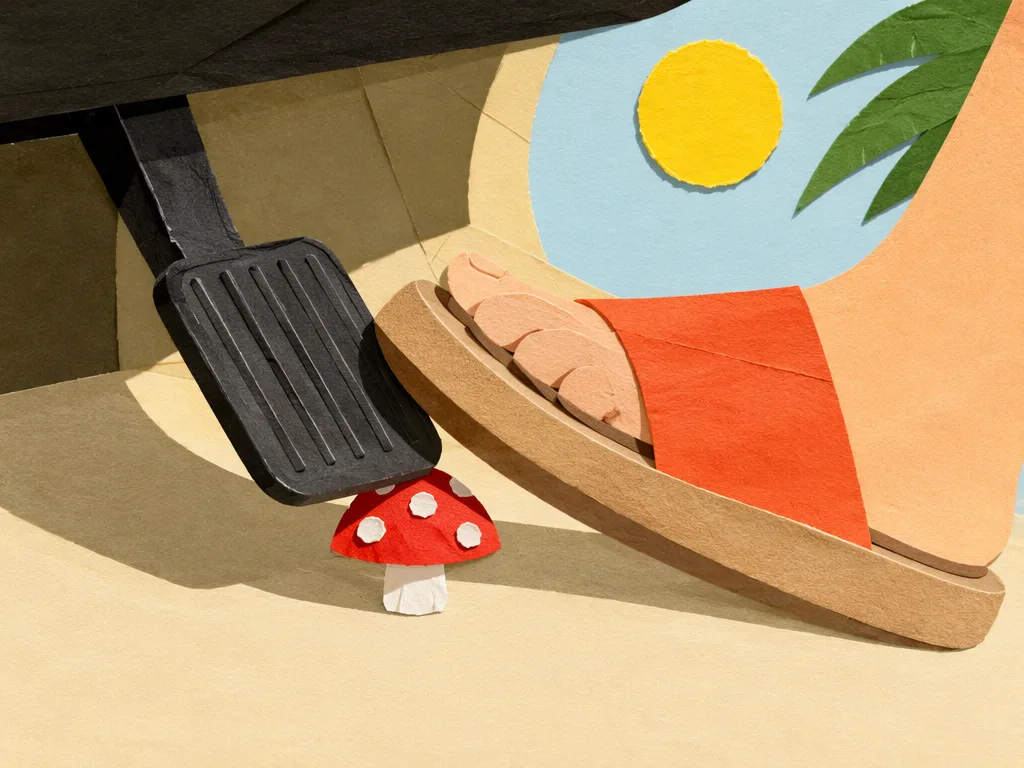
- appuyer sur le champignon (informal): to accelerate, drive fast (the « champignon » or mushroom is the gas pedal)
- profiter de quelque chose: to enjoy or make the most of something; on va bien en profiter
Grammar
- Narrative present (le présent de narration): almost the entire story is told in the present tense (j'ouvre, je regarde, on roule).
- Near future (le futur proche): aller + infinitive for an immediate future: on va bientôt voler, on va bien en profiter.
- The pronoun en replaces de + noun: profiter des vacances → en profiter.
- Pronominal / reflexive verbs (les verbes pronominaux): la voiture se rapproche, je me sens très bien.
- Imparfait and passé composé in the bridge: the imperfect describes the situation (l'heure tournait, j'avais peur), while the passé composé expresses a specific action (j'ai dit).
- The relative pronoun qui: le voyage qui commence.
Watch out: what not to copy
- J'avais un peu très peur is incorrect: you do not combine un peu and très. Say j'avais un peu peur or j'avais très peur.
- La course fut parfaite: the passé simple is a literary form. In spoken French, say la course a été parfaite.
- Il vient pour me voir is there for the rhyme; for a taxi, you would say il vient me chercher instead.
- Je paie le tarif juste is unusual; say je paie le bon prix or le prix indiqué.
- In the bridge, the narrator says mon ami and then switches to the formal vous (s'il vous plaît, appuyez). With a driver you do not know, you do use vous, but mon ami does not fit with this level of formality.