


What is it about?
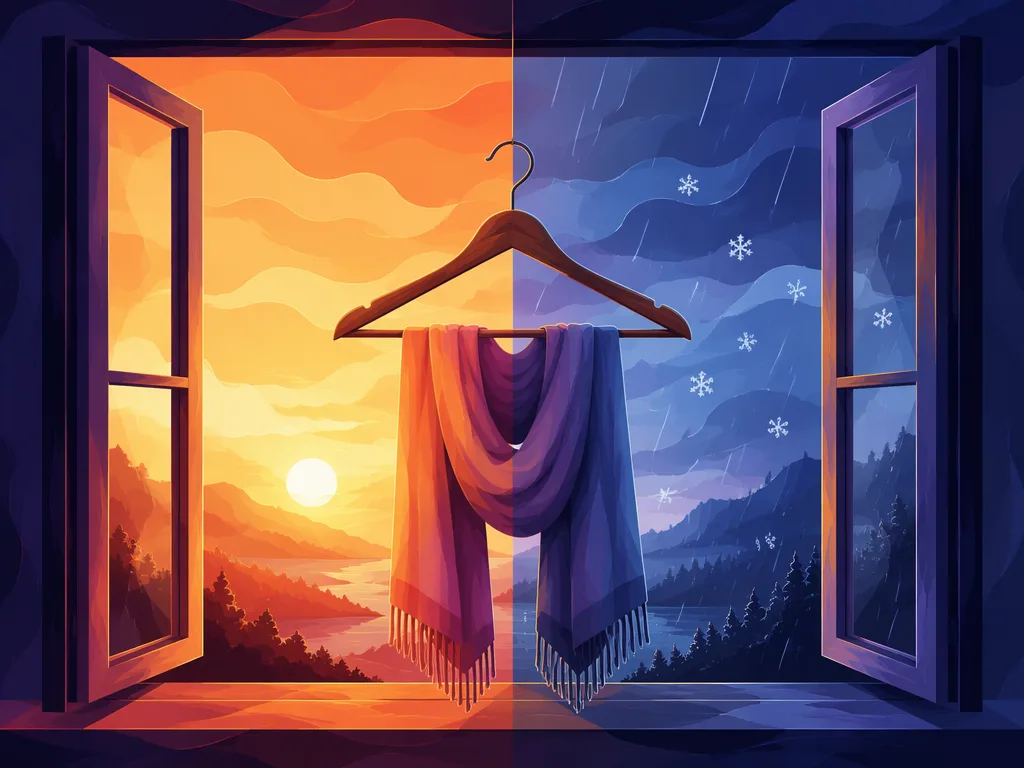
Someone is standing in front of the wardrobe asking themselves: Was soll ich anziehen? Each verse shows different weather. When it's sunny, a T-shirt, jeans, and sunglasses fit. When it rains, you need a jacket and rubber boots. In winter, you need a scarf, coat, hat, and gloves. In the bridge, the person dresses up in the evening to go out.
Useful words
- Clothing: das T-Shirt, die Jeans, die Sonnenbrille, der Pullover, das Kleid, die Jacke, die Gummistiefel, die Uhr, der Schal, der Mantel, der Hut, die Handschuhe, die Schuhe, der Gürtel
- Weather: Die Sonne scheint. Die Wolken sind dunkel. Es fängt an zu regnen. Der Wind weht stark. Der Winter ist kalt.
- Adjectives: bequem, leicht, weich, hübsch, warm, dick
- der Schrank: der Kleiderschrank
- der Spiegel: Ich steh vor dem Spiegel.
Expressions
- Was soll ich anziehen? is a typical question in front of the wardrobe.
- Sag es mir gleich! means: Tell me right away.
- etwas anprobieren: You put on clothes to see if they fit (Ich probiere viel an).
- Die Handschuhe passen. They are the right size.
- sich in Schale werfen (colloquial): to dress up really nicely.
- Das ist kein Problem. means: That's easy.
Grammar
- Modal verb sollen in questions: Was soll ich anziehen? The modal verb is in the second position, and the infinitive is at the end.
- Separable verbs: an|ziehen, an|fangen (es fängt an zu regnen), an|probieren (ich probiere viel an). In the present tense, the prefix goes to the end of the sentence.
- brauchen + accusative: Ich brauche die Jacke. Ich brauche den Schal. With masculine nouns, der becomes den.
- Adjective endings after ein (nominative): ein weicher Pullover, ein hübsches Kleid, ein warmer Mantel, ein dicker Hut. After Ich brauche, it would have to be einen warmen Mantel in the accusative. In the song, however, the line stands as its own list.
- Spoken short forms: Ich schau, ich steh, ich werf stand for ich schaue, ich stehe, ich werfe. This is normal in spoken language.
Watch out: bent for the rhyme
- „mein Schrank ist reich“: People don't say it like that. It only rhymes with gleich. Correct is: Mein Schrank ist voll.
- „um dem zu begegnen“: This sounds clunky and is here because of the rhyme with regnen. Better is: um mich vor dem Regen zu schützen.
- „Eine Uhr am Arm, die jeder kennt“: This line is mainly there for the rhyme with Moment. Normally you say eine Uhr am Handgelenk.
- „probiere viel an“: More common is Ich probiere vieles an, or Ich probiere viel an only colloquially.
- „der Beste“ is what a man says. A woman says die Beste.