


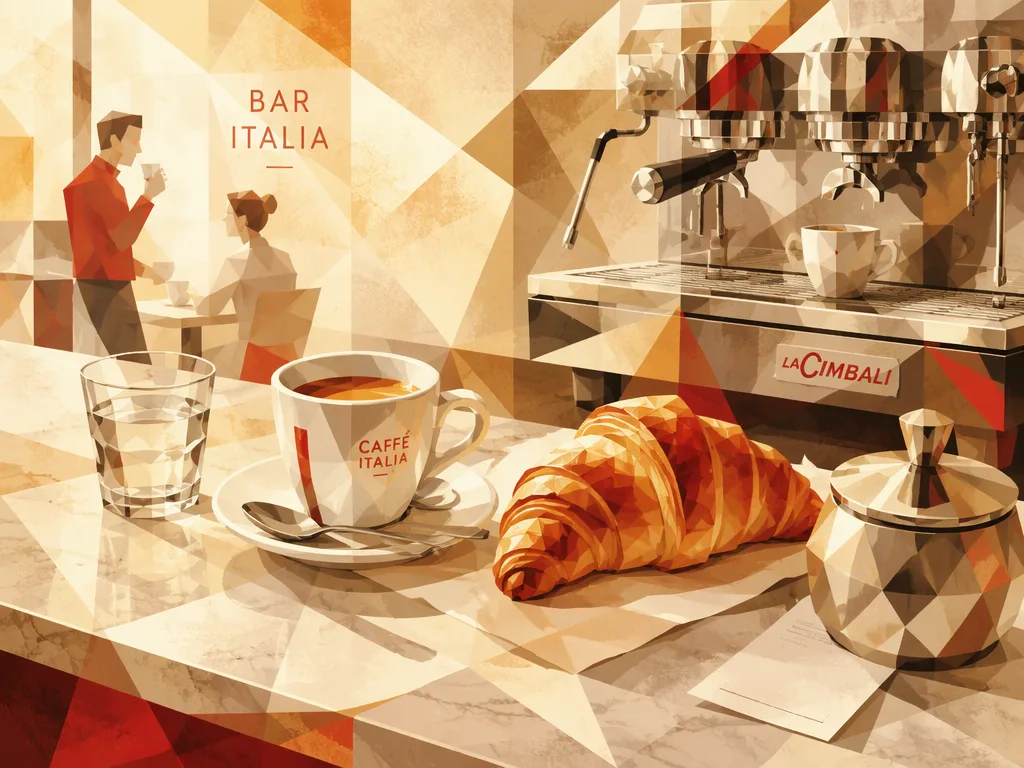
At the Bar: Coffee and Breakfast

Public
•
November 9, 2026
Generating pronunciation audio...
This might take a moment. Feel free to explore other parts of the set in the meantime.
0
Listen & review
Add at least 2 Voca cards to unlock Listen & review and practice with audio.
Step into an Italian bar for morning coffee and breakfast, from ordering at the counter to paying at the till.
- How the bar works: standing at the counter (al banco), sitting at a table (al tavolo), or paying first at the till (la cassa)
- Polite questions from the barista using the formal Lei form
- Ordering coffee, filled or plain pastries, and a glass of water
Voca cards
1.
il bar
café, coffee shop
Prendiamo un caffè al bar?
Should we get a coffee at the café?
In Italy, 'il bar' is a daytime café for coffee, pastries and quick snacks, not just a place for drinks at night.
2.
al banco
at the counter
Prende il caffè al banco?
Are you having your coffee at the counter?
Having coffee standing at the counter ('al banco') is the quickest way and usually costs less than sitting down.
3.
al tavolo
at a table
Ci sediamo al tavolo o restiamo al banco?
Should we sit at a table or stay at the counter?
In many bars, sitting at a table ('al tavolo') with waiter service costs more than ordering at the counter.
4.
la cassa
cash register, cashier
Scusi, si paga prima alla cassa?
Excuse me, do I pay at the register first?
In busy bars, you often pay at the till ('la cassa') first and take your receipt to the counter to order.
5.
lo scontrino
receipt
Ecco lo scontrino, vorrei un caffè.
Here's my receipt, I'd like a coffee.
Put your receipt ('lo scontrino') down on the counter so the barista sees what you have paid for.
6.
Mi dica.
How can I help you?, What can I get for you?
Buongiorno! Mi dica.
Good morning! What can I get for you?
Literally 'tell me', this is the polite way a barista or shopkeeper asks how they can help you.
7.
Cosa prende?
What will you have?, What can I get you?
Signora, cosa prende?
What will you have, ma'am?
Polite form using 'Lei'. In Italian, you order food and drink with the verb 'prendere' (to take).
8.
per me
for me
Per me un caffè, per favore.
A coffee for me, please.
A natural way to order your drink or food at the counter without needing a verb.
9.
il caffè
coffee, espresso
Prendo solo un caffè, grazie.
I'll just have a coffee, thank you.
If you ask for 'un caffè' in Italy, you always get a single espresso.
10.
il cappuccino
cappuccino
Vorrei un cappuccino, per favore.
I'd like a cappuccino, please.
Italians drink 'il cappuccino' in the morning for breakfast, almost never after lunch or dinner.
11.
macchiato
macchiato, with a dash of milk
Un caffè macchiato caldo, grazie.
An espresso with a dash of hot milk, thank you.
An espresso with a dash of milk. The barista often asks 'caldo o freddo?' to check if you want the milk hot or cold.
12.
il cornetto
croissant
Prendo anche un cornetto.
I'll have a croissant too.
The classic Italian breakfast pastry. In northern Italy, people usually call it 'la brioche'.
13.
vuoto
plain, unfilled
Il cornetto lo vuole vuoto o alla crema?
Would you like your croissant plain or custard-filled?
Literally 'empty'. Ask for 'un cornetto vuoto' (or 'liscio') when you want a plain pastry with no filling.
14.
alla crema
custard-filled, with cream
Un cornetto alla crema, per favore.
A custard-filled croissant, please.
Filled with sweet pastry custard. Other common fillings are 'alla marmellata' (jam) and 'al cioccolato' (chocolate).
15.
la spremuta
freshly squeezed juice
Per me una spremuta d'arancia.
A freshly squeezed orange juice for me.
Freshly squeezed juice, almost always orange ('d'arancia'). Bottled fruit juice is 'il succo di frutta'.
16.
un bicchiere d'acqua
a glass of water
Mi dà anche un bicchiere d'acqua, per favore?
Could I also get a glass of water, please?
Often served free with espresso; if it is not given automatically, you can always ask for one.
17.
naturale
still
L'acqua la vuole naturale o frizzante?
Would you like still or sparkling water?
Used for still water ('acqua naturale' or 'liscia'), as opposed to sparkling ('frizzante' or 'gassata').
18.
lo zucchero
sugar
Scusi, dov'è lo zucchero?
Excuse me, where's the sugar?
19.
Quant'è?
How much is it?
Scusi, quant'è in tutto?
Excuse me, how much is it in total?
Short for 'quanto è?' (how much is it?), used when paying at a bar or shop.
20.
con la carta
by card, with a card
Posso pagare con la carta?
Can I pay by card?
For cash, you can say 'in contanti'.