


Eating Out

Public
•
November 9, 2026
Generating pronunciation audio...
This might take a moment. Feel free to explore other parts of the set in the meantime.
0
Listen & review
Add at least 2 Voca cards to unlock Listen & review and practice with audio.
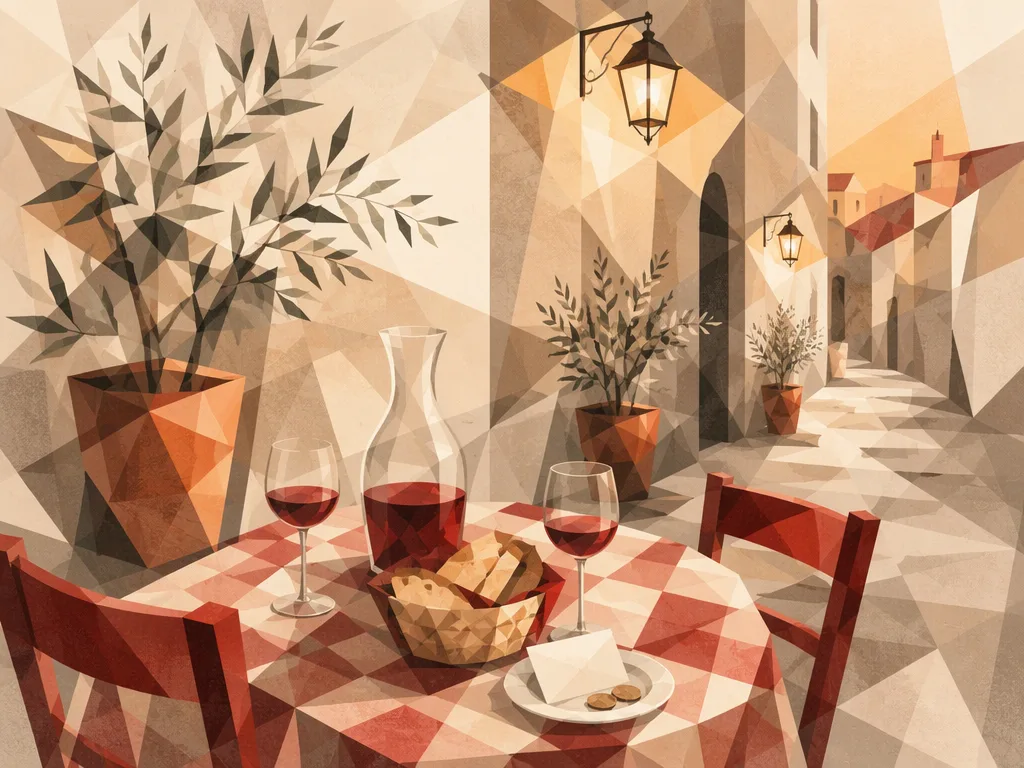
At a trattoria or restaurant in Italy with a friend or partner: from booking a table and choosing courses on the menu to explaining an allergy, ordering for the table and paying the bill.
- Waiters address a single guest politely with Lei (Signora, prende anche un contorno?) and the table together with voi (Siete pronti per ordinare?).
- To order food and drink, Italians use prendere (Prendo…, Prendiamo…) rather than the verbs for 'have' or 'want'.
- A menu is split into l'antipasto, il primo, il secondo, il contorno and il dolce, and you only order the courses you feel like eating.
Voca cards
1.
prenotare un tavolo
to book a table, to reserve a table
Buonasera, vorrei prenotare un tavolo per due per stasera alle otto.
Good evening, I'd like to book a table for two for tonight at eight.
2.
all'aperto
outside, outdoors
Preferite un tavolo dentro o all'aperto?
Would you prefer a table inside or outside?
Staff use 'voi' ('Preferite…?') when speaking to a couple or a group.
3.
accomodarsi
→ accomodare
to take a seat
Buonasera! Accomodatevi pure al tavolo vicino alla finestra.
Good evening! Please go ahead and take a seat at the table by the window.
A polite verb staff use to invite you to sit down: 'Si accomodi' to one guest, 'Accomodatevi' to two or more.
4.
il menù
the menu
Vi porto subito il menù e un po' d'acqua.
I'll bring you the menu and some water right away.
5.
l'antipasto
the appetizer, the starter
Vuoi prendere un antipasto in due mentre aspettiamo?
Do you want to get an appetizer to share while we wait?
'In due' means shared between two people.
6.
il primo
the first course
Come primo prendo gli spaghetti alle vongole.
For my first course, I'll have the spaghetti with clams.
In Italy, the first course is pasta, risotto, gnocchi or soup, served before the meat or fish course.
7.
il secondo
the second course, the main course
Prendi anche il secondo o ti fermi al primo?
Are you getting a second course too, or stopping at the first?
The main meat or fish course. In a trattoria, it is normal to order just two courses rather than a full meal.
8.
il contorno
the side dish, the side
Signora, con il pesce prende anche un contorno di verdure?
Ma'am, would you also like a vegetable side dish with the fish?
Meat and fish courses usually come by themselves, so vegetables, salad or potatoes are ordered separately.
9.
il piatto del giorno
the special of the day, today's special
Scusi, qual è il piatto del giorno oggi?
Excuse me, what's the special of the day today?
10.
Che cosa c'è dentro?
What's in it?
Scusi, non conosco questo piatto: che cosa c'è dentro?
Excuse me, I'm not familiar with this dish: what's in it?
11.
a base di
made with, based on
È un piatto tipico a base di melanzane, olive e capperi.
It's a traditional dish made with eggplant, olives, and capers.
12.
Sono allergico a…
I'm allergic to…
Scusi, sono allergico alle noci: ce ne sono in questa salsa?
Excuse me, I'm allergic to walnuts: are there any in this sauce?
A man says 'allergico' and a woman says 'allergica'.
13.
vegetariano
vegetarian
Sono vegetariana: avete dei primi senza carne né pesce?
I'm vegetarian: do you have any first courses without meat or fish?
Use 'vegetariano' for a man and 'vegetariana' for a woman; for vegan, use 'vegano' and 'vegana'.
14.
ordinare
to order
Siete pronti per ordinare o vi lascio ancora qualche minuto?
Are you ready to order, or should I give you a few more minutes?
15.
prendere
to have, to get
Allora, per il tavolo prendiamo una bruschetta mista e due primi.
So, for the table we'll have a mixed bruschetta and two first courses.
When ordering, Italians say 'Prendo…' ('I'll take…') or 'Prendiamo…' ('We'll take…') rather than using 'avere'.
16.
da bere
to drink
E da bere che cosa vi porto?
And what can I bring you to drink?
17.
l'acqua naturale
the still water
Ci porta una bottiglia di acqua naturale e una di frizzante, per favore?
Could you bring us a bottle of still water and one of sparkling, please?
Waiters always ask 'Naturale o frizzante?' (still or sparkling); you may also hear 'liscia o gassata'.
18.
il vino della casa
the house wine
Prendiamo anche mezzo litro di vino rosso della casa.
We'll also have half a liter of the house red wine.
In a trattoria, house wine is often served in a carafe by 'un litro', 'mezzo litro' (half a litre) or 'un quarto' (a quarter-litre).
19.
il dolce
the dessert
Tutto bene? Gradite un dolce o un caffè?
Everything alright? Would you like a dessert or a coffee?
'Gradire' ('Gradisce…?' to one person, 'Gradite…?' to the table) is a polite verb waiters use for 'Would you like…?'.
20.
il conto
the check, the bill
Scusi, ci può portare il conto, per favore?
Excuse me, could you bring us the check, please?
In Italy, the waiter will not bring the bill until you ask for it.
21.
il coperto
the cover charge
Guarda, sul conto ci sono due euro a persona per il coperto.
Look, on the check there's two euros per person for the cover charge.
A standard per-person charge in Italian restaurants that covers bread, tableware and table linen.
22.
dividere il conto
to split the check, to split the bill
Possiamo dividere il conto e pagare ciascuno con la carta?
Can we split the check and each pay by card?
Between friends, you can also say 'Facciamo a metà?' ('Shall we split it fifty-fifty?').