


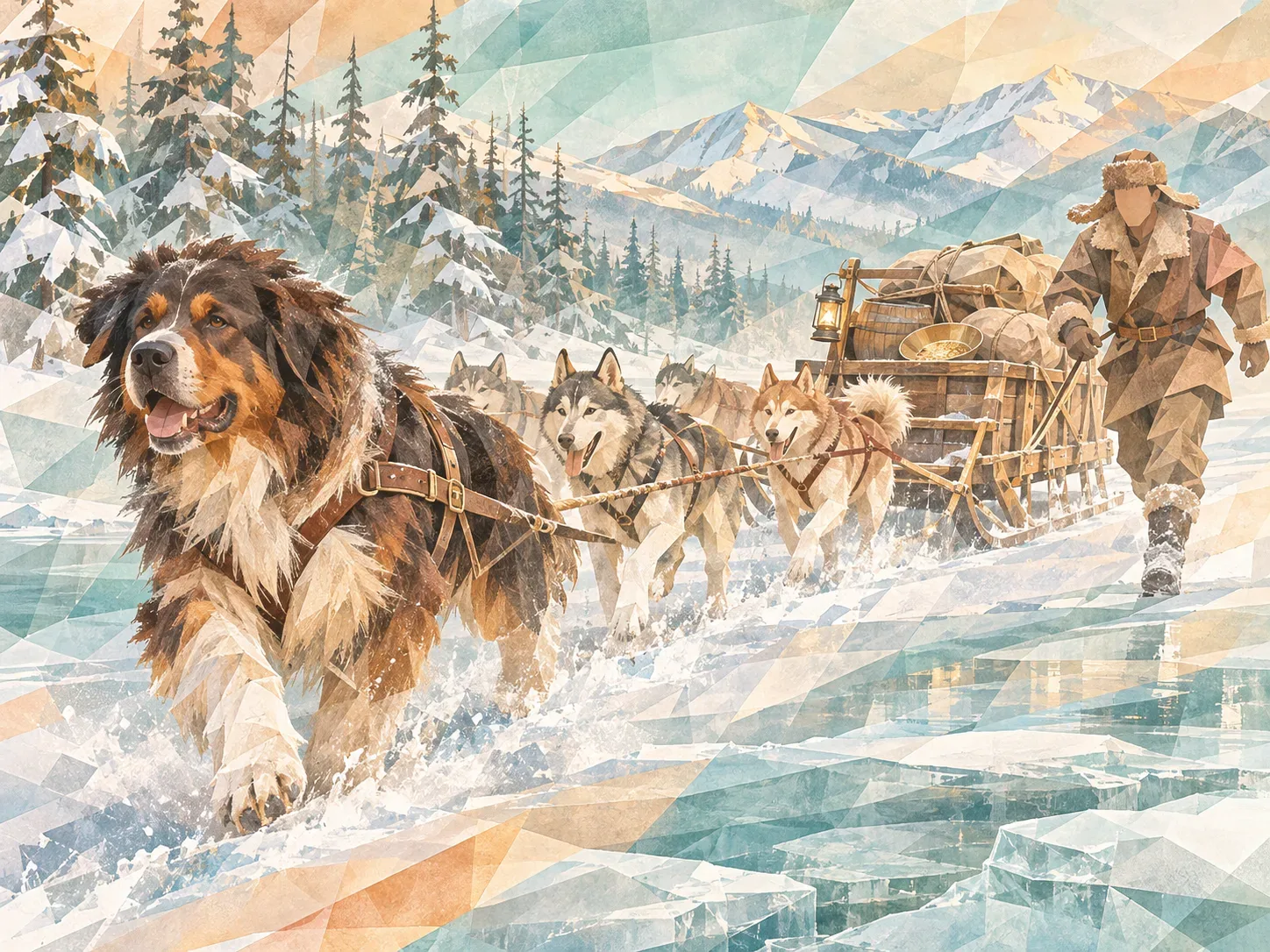
Still the chance did not come, and they pulled into Dawson one gray afternoon with the great fight still ahead of them. Here were many men and countless dogs, and Buck saw that every dog worked. All day long, teams trotted up and down the main street, and at night their harness bells still rang past. They pulled cabin logs, firewood, and heavy supplies up to the mines, doing all the work that horses did back in the Santa Clara Valley. Most of them were fierce, wolf-like huskies. Every night, at nine, twelve, and three o'clock, they lifted their heads in a strange, sad song, and Buck loved to join in.
Under the cold northern lights and bright winter stars, in a frozen, silent land, the song of the huskies sounded like the sorrow of living. It was an old song, as old as the wild dogs of long ago, full of long cries and half-sobs. As Buck moaned and sang with them, he felt the ancient pain of his wild ancestors and their fear of the cold and dark.
Seven days after reaching Dawson, they dropped down the steep bank onto the Yukon Trail and headed back toward the sea. Perrault carried even more urgent mail, and the pride of the trail had gripped him too—he meant to make the fastest trip of the year. Everything helped him. The week of rest had made the dogs strong again. Other travelers had packed the trail hard, and the police had left food waiting along the way so the sled could stay light.
They covered fifty miles on the first day and sped up the Yukon on the second. Yet this fast travel brought endless trouble for François. Buck's quiet rebellion had broken the team apart. They no longer leaped forward together as one dog. With Buck backing them up, the dogs stopped fearing Spitz and challenged him openly. One night Pike stole half of Spitz's fish and gulped it down safely beside Buck. Another night Dub and Joe fought Spitz and escaped punishment. Even friendly Billee grew less friendly and whined far less politely than before. Whenever Buck came near Spitz, his hair stood up and he snarled, marching boldly right in front of Spitz's nose.
Soon the dogs fought more and more among themselves, until camp was a noisy mess. Only Dave and Sol-leks stayed unchanged, though the endless fighting annoyed them. François swore, stamped the snow in helpless anger, and swung his whip, yet it did little good. The moment his back was turned, they started again. François backed up Spitz with his whip, while Buck backed up the rest of the team. François knew Buck caused all the trouble, and Buck knew he knew, yet Buck was too clever to get caught. He pulled hard in harness—he loved the work now—yet he loved even more to start a quiet fight behind François's back and tangle the harnesses.
One night after supper, Dub scared up a snowshoe rabbit, stumbled, and missed it. In one second, the whole team gave chase. A hundred yards away sat a camp of the Northwest Police with fifty huskies, and all fifty joined the hunt. The rabbit raced down the river and turned into a small frozen creek. It ran lightly over the top of the snow while the dogs crashed through behind it. Buck led the pack of almost sixty dogs around bend after bend, though he could not catch up. He stretched low to the snow, whining eagerly as his strong body leaped forward in the pale moonlight. Ahead of him, the snowshoe rabbit flashed like a white ghost.
Every wild instinct woke inside Buck. He was running at the head of the pack, hunting living meat to kill with his own teeth and wet his nose in warm blood. A deep joy filled every muscle and bone as he flew under the stars—he felt completely alive, running like the wolves of long ago.
Yet Spitz stayed cold and clever, even in the middle of the hunt. He left the pack and cut across a narrow piece of land where the creek made a long bend. Buck did not see him go. As Buck rounded the bend with the pale rabbit still racing ahead, another larger white shape leaped from the high bank straight into the rabbit's path. It was Spitz. The rabbit could not turn. Spitz's white teeth broke its back in midair, and it cried out sharply. At that sound, the whole pack behind Buck raised a wild chorus of delight.
Buck did not cry out, and he did not slow down. He crashed straight into Spitz, shoulder to shoulder, so hard that he missed the throat. They rolled over and over in the powdery snow. Spitz sprang to his feet almost as if he had not fallen, cut Buck's shoulder open, and leaped clear. Twice his teeth snapped together like the steel jaws of a trap as he backed away for better footing, his lips curled back in a fierce snarl.
In a flash Buck knew it. The time had come. It was a fight to the death. As they circled each other with flat ears and sharp eyes, the scene felt strangely familiar to Buck—the white woods, the moonlight, the thrill of battle. Over the white snow hung a ghostly stillness. Not a breath of wind stirred a leaf, and the dogs' breaths rose slowly into the frosty air. Those sixty dogs, little more than half-tamed wolves, had finished the rabbit in seconds and now stood in a silent, waiting circle, only their eyes shining.
Spitz was a skilled fighter. From the far Arctic across Canada, he had fought all kinds of dogs and defeated them all. He burned with bitter anger, yet never blind anger. He never rushed without being ready for a rush, and never attacked without guarding himself first.
Buck tried again and again to sink his teeth into the white dog's neck, yet every time he struck at softer flesh, Spitz met him with his own teeth. Teeth clashed against teeth, cutting their lips until they bled, yet Buck could not break through Spitz's guard. Then Buck grew fiercer and threw himself at Spitz in a storm of fast rushes. Again and again he aimed for the white throat, where life beat close to the skin, and every time Spitz cut him and leaped away. Then Buck tried a trick. He rushed as if for the throat, pulled his head back at the last moment, and drove his shoulder sideways into Spitz's shoulder to knock him down. Instead, Spitz leaped lightly away and slashed Buck's shoulder each time.
Spitz was untouched, while Buck was streaming with blood and panting hard. The fight was growing desperate. All the while, the silent, wolf-like circle waited to finish off whichever dog went down. As Buck grew tired, Spitz began rushing him, keeping him stumbling and fighting for balance. Once Buck went down, and the whole circle of almost sixty dogs started forward. Buck caught himself almost in midair, and the circle sank down again to wait.
Yet Buck had a gift that made him great: a mind that could see ahead. He fought by instinct, yet he could also fight with his head. He rushed as if trying the old shoulder trick, then at the last instant dropped low to the snow and lunged inward. His teeth closed on Spitz's left front leg. Bone crunched, and the white dog faced him on three legs. Three times Buck tried to knock him over, then repeated the trick and broke Spitz's right front leg. Despite the terrible pain, Spitz struggled wildly to stay up. He saw the silent circle—shining eyes, hanging tongues, and silver breaths drifting upward—closing in on him as he had seen circles close around beaten dogs before. Only this time, he was the beaten one.
There was no hope for him. Buck showed no mercy. He moved in for the final rush. The circle had tightened until Buck could feel the huskies' breaths on his sides. He could see them past Spitz and on either side, half crouching to leap, eyes locked on him. A pause fell. Every animal stood still as stone. Only Spitz shook and bristled as he staggered back and forth, snarling terribly as if trying to scare away death. Then Buck leaped in and out—and while he was in, shoulder finally met shoulder squarely. The dark circle became a dot on the moonlit snow as Spitz disappeared from view. Buck stood and looked on, the champion, the wild beast who had made his kill and found it good.