


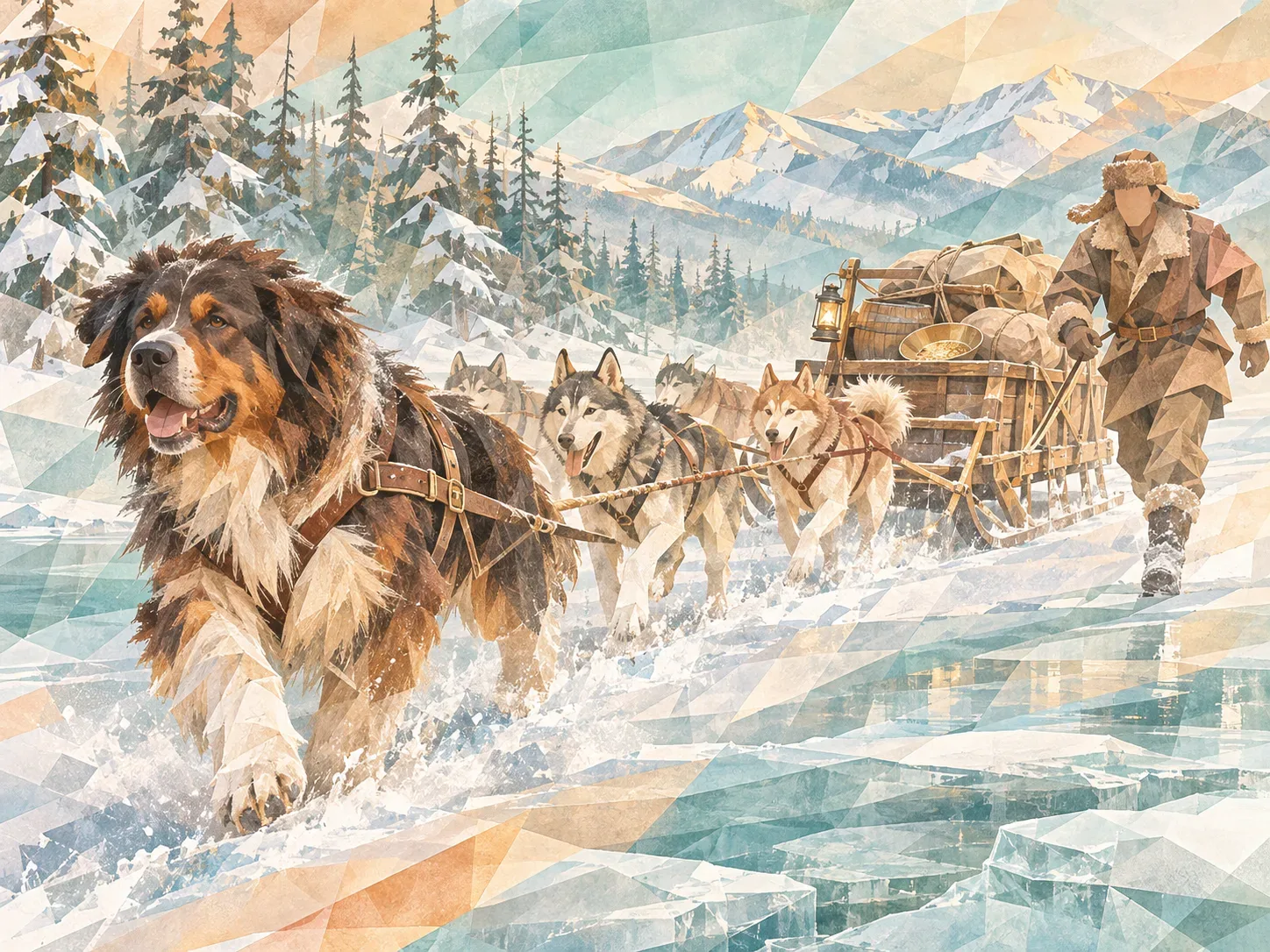
Soon Buck began sleeping out at night and staying away from camp for days at a time. Once he crossed the ridge at the head of the stream and went back down into the land of forests and rivers. He wandered there for a week, searching with no luck for any fresh sign of the wild brother. Traveling at a long, easy trot that never tired him, he hunted and killed his own meat along the way.
In a wide river that ran toward the sea, he fished for salmon. Beside that river he killed a big black bear that had been blinded by mosquitoes while fishing and was crashing blindly through the trees, helpless and fierce. It was a hard fight, and it woke the last of the wildness still sleeping in Buck. Two days later, returning to his kill, he found twelve wolverines fighting over the meat. He scattered them in all directions, leaving two behind that would never fight again.
His hunger for hunting grew stronger than ever. He was a creature of the wild now, living on what he killed, alone and needing no help, surviving by his own strength in a hard world where only the strong lived.
Because of this, a deep pride filled him. It showed in every step and every muscle, and in the way he carried himself. Except for the brown hair on his nose and above his eyes, and the line of white down his chest, he looked like a giant wolf—bigger than the biggest wolf in the North. From his St. Bernard father came his great size and weight, and from his shepherd mother came his shape, with a wolf's long nose and broad head—only much larger.
His cleverness was a wolf's cleverness, sharpened by the hardest life in the North. Eating only meat, he was at the full peak of his life and strength. When Thornton ran a hand along his back, sparks snapped and crackled through the fur. Every nerve and muscle worked in perfect balance. He saw a movement, decided, and leaped twice as fast as any husky could. Life poured through him in a glad, powerful flood.
"Never was there such a dog," said John Thornton one day as the partners watched Buck walk out of camp.
"When he was made, they broke the mold," said Pete.
"By Jingo! I think so myself," Hans agreed.
They saw him walk proudly out of camp, yet they did not see the sudden change that happened the moment he entered the trees. Out of their sight, he became a wild thing, slipping silently from shadow to shadow. He used every cover, crawled flat on his belly like a snake, and struck just as fast. He caught wild birds on their nests and sleeping rabbits before they woke. Fish in open pools were not too quick for him, and beavers mending their dams could not hide from him. He killed only to eat, never just for the sake of killing, and he liked best the meat he had killed himself. Still, he kept a playful side, creeping up on squirrels until he almost had them—and then letting them go, chattering in terror to the treetops.
When fall came, moose moved down in large numbers toward the lower valleys for winter. Buck had already pulled down a half-grown calf, yet he wanted bigger, more dangerous game. One day on the ridge at the head of the stream, he found it.
A herd of twenty moose had crossed over from the forest country, led by a giant bull. Standing over six feet tall, he was in a fierce temper. He tossed his wide, heavy horns—seven feet across, with fourteen points—and roared with rage when he saw Buck.
A feathered arrow stuck out of the bull's side, just ahead of his back leg, which made him even fiercer. Guided by the old hunting wisdom in his blood, Buck set out to cut the bull away from the herd. He barked and danced in front of the moose, staying just out of reach of the great horns and the wide hoofs that could crush him in a single blow. Unable to turn his back on Buck's sharp teeth and walk on, the bull charged in fury. Buck leaped back cleverly, drawing him further from the others. Yet each time the bull got too far from his mates, two or three younger bulls charged Buck and allowed their leader to rejoin the herd.
Still, Buck had the endless patience of a wild hunter. For half a day he clung to the edges of the herd, slowing their march, annoying the young bulls, worrying the cows with their calves, and driving the wounded bull wild with helpless rage. Buck attacked from every side, cutting the bull out again as fast as he rejoined his mates.
As evening drew near—the fall nights were six hours long now—the young bulls grew slower to come back and help their leader. Winter was pushing them toward the lower valleys. Besides, it was not the life of the herd Buck wanted, only the life of one member, and at last they left the old bull behind.
At twilight, the great bull stood with lowered head and watched the cows, the calves, and the younger bulls trot away through the fading light. He could not follow, for in front of his nose leaped the tireless hunter that would not let him go. He weighed well over half a ton and had lived a long, strong life full of fights. Now he faced death from an animal whose head did not even reach above his knees.
From then on, day and night, Buck never left the bull. He never gave him a moment's rest, never let him eat leaves or young branches, and never let him drink from the narrow streams they crossed. Sometimes, wild with pain and thirst, the bull broke into a long run. Buck trotted easily at his heels, lying down when the moose stood still, and attacking fiercely whenever he tried to eat or drink.
Slowly the great head drooped lower under its heavy horns, and the bull's walk grew weak. He took to standing still for long stretches, his nose near the ground and his big ears hanging sadly. That gave Buck time to drink water and rest too.
While he lay panting with his red tongue out and his eyes on the bull, Buck felt a change coming over the land. A new stir was moving through the country. Just as the moose were coming in, other kinds of life were moving in too. Forest, stream, and air seemed alive with them. He heard nothing and saw nothing yet, but he knew the land was different. Strange things were moving through it, and he decided to find out what they were as soon as he finished his work.
At last, at the end of the fourth day, Buck pulled the great moose down. He stayed beside the kill for a day and a night, eating and sleeping by turns. Then, rested and strong again, he turned toward camp and John Thornton. He broke into his long, easy trot and ran hour after hour through the wild country, never losing his way, heading straight home more surely than any man with a compass.