


Perrault nodded seriously. As a mail carrier for the Canadian government, he wanted the best dogs, and he was especially glad to have Buck.
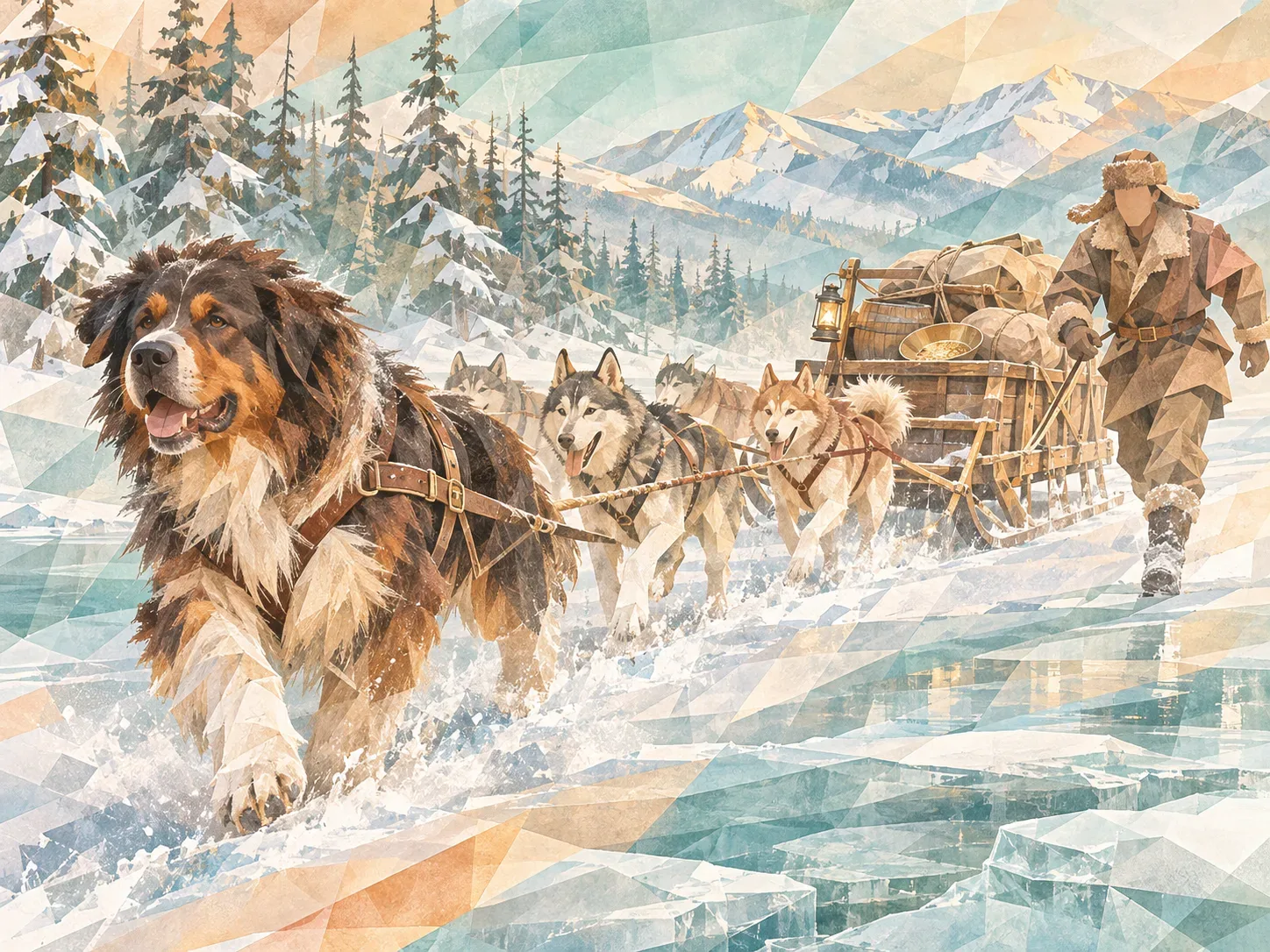
Within an hour, three more huskies joined the team, making nine in all, and soon they were in harness and trotting up the trail toward the Dyea Canyon. Buck was glad to be moving, and though the work was hard, he did not hate it. He was surprised by the team's eagerness—and even more by the change in Dave and Sol-leks. In harness, they became completely different dogs. All their gloom disappeared. They were alert, active, and fiercely angry at anything that slowed the sled. Pulling on the trail seemed to be everything they lived for.
Dave pulled nearest the sled, Buck pulled in front of him, and Sol-leks was ahead of Buck. The rest of the team stretched out in single file up to Spitz at the lead.
Buck had been placed between Dave and Sol-leks to learn, and they were sharp teachers. Whenever Buck made a mistake, they nipped him, backed by François's whip. Once, during a short stop, Buck got tangled in his straps and held up the start. Both Dave and Sol-leks flew at him and gave him a rough beating. Buck took great care to keep his straps clear after that. By evening he had learned his work so well that they almost stopped scolding him. François's whip cracked less often, and Perrault even honored Buck by lifting his feet to check them.
It was a hard day's run—up the canyon, past the last trees, across deep snowdrifts and ice, and over the great Chilkoot Pass that guards the lonely North. They sped down a line of frozen lakes. Late at night they pulled into the huge camp at Lake Bennett, where thousands of gold seekers were building boats for spring, when the ice would break. Buck dug his snow hole and slept deeply, then was dragged out all too soon in the freezing dark before dawn.
That day they covered forty miles on a packed trail. After that, for many days, they had to break their own trail through deep snow, working harder and moving slower. Perrault usually walked ahead on snowshoes to pack the snow and test the thin new ice, while François guided the sled behind.
Day after day, Buck worked hard in harness. They always left camp in the dark and stopped after dark, eating their piece of fish and crawling into the snow to sleep. Buck was always starving. His daily meal was a pound and a half of dried salmon, and it felt like nothing. The other dogs, smaller and born to the North, got only one pound a day and stayed strong, while Buck suffered constantly from hunger.
He soon lost his polite eating habits. At first he ate slowly, and his mates finished early and robbed him. While he fought off two or three, others swallowed the rest. So he learned to eat just as fast as they did. Soon hunger drove him further. Pike, one of the new dogs, was a clever thief who pretended to be lame to get out of work. One day Buck saw him steal a slice of bacon behind Perrault's back. The next day Buck did the same and stole the whole piece. A loud shout went up, yet nobody suspected Buck. Instead, Dub, a clumsy dog who always got caught, took the beating for Buck's crime.
That first theft showed that Buck could survive in the harsh North. Back in the warm South, under the law of love and kindness, a dog respected other people's things and played fair. Here in the North, under the law of club and fang, a dog who followed such rules was a fool and would not survive. Buck did not think this out in words; he simply changed to fit the new life. Back home he would have fought to the death to guard the Judge's riding whip. Now he knew when to run away and save his skin. He did not steal for fun, but because his empty stomach cried for food—and he stole in secret out of respect for club and fang.
Buck changed fast in body and senses. His muscles grew as hard as iron, and he learned to ignore ordinary pain. His stomach turned whatever scraps he could find into tough strength. His eyes, nose, and ears grew amazingly sharp; even in sleep he heard the faintest sound and knew if it meant peace or danger. He learned to bite out ice packed between his toes and break thin ice over water holes with his stiff front legs. Most wonderful of all, he could smell the wind a night before it blew, and always dug his snow bed in the shelter of a tree or bank.
He learned from the hard days on the trail, but that was not all. Old instincts, long asleep, woke inside him. The soft ways of tame house dogs fell away. Dimly he remembered the earliest days of dogs, when wild packs ran through ancient forests and killed their own meat. Fighting with quick wolf snaps came easily to him, as if forgotten ancestors had left those old tricks in his blood. On still, freezing nights he pointed his nose at a star and howled long, like a wolf. Then it was his ancestors, long dead, pointing their noses at the stars and howling down through the centuries and through him. His voice carried their sorrow, and what the cold and dark meant to them.
So the old song came to him, and he became what his kind had once been. It happened because men had found a yellow metal in the North, and because Manuel was a gardener's helper whose pay was not enough for his wife and his many small children.