


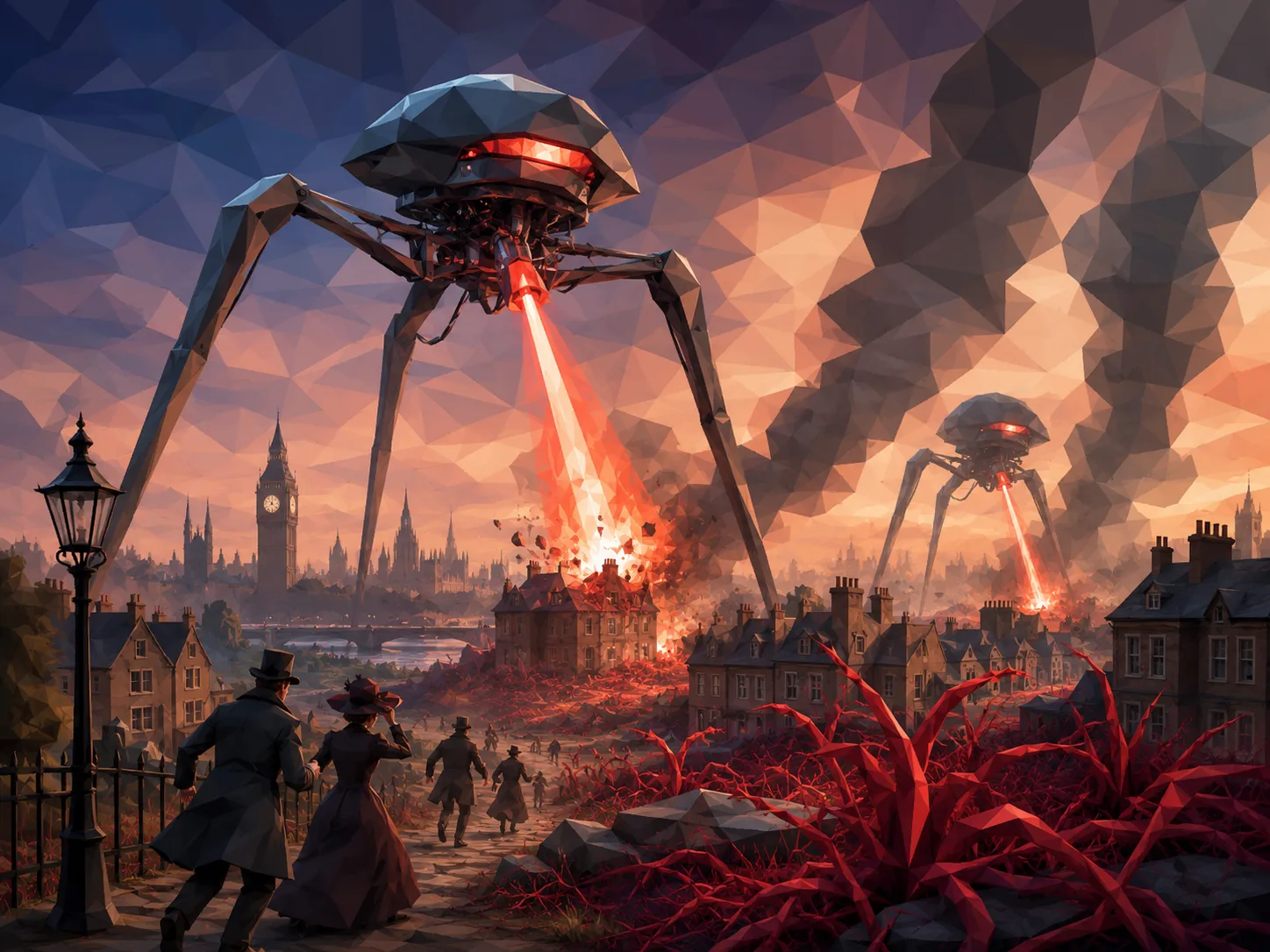
No one would have believed, in the last years of the nineteenth century, that this world was being watched closely by minds greater than ours, and yet as mortal as our own.
People went to work, travelled and made plans for their lives. They felt sure that this world belonged to them. But far away, other minds were studying us. Perhaps they watched us as we watch the tiny creatures in a drop of water.
Few people thought about danger from other worlds. Some believed that there might be people on Mars. But they imagined people like us, perhaps less clever than us. They did not imagine anything to fear.
Yet across the gulf of space, minds that are to our minds as ours are to those of the animals, minds vast and cool and unfriendly, looked at this earth with envious eyes, and slowly and surely made their plans against us.
Mars was older than our world. It was colder, too, and life there was slowly dying. The Martians looked towards our warmer earth. Here they could see water, green plants and everything they needed to live. To them, we were only animals standing in their way.
Before we judge them, we must remember our own history. People killed every dodo. Settlers from Europe destroyed the Tasmanians in fifty years. We had done terrible things to animals and to other people. Could we really say that we were kinder than the Martians?
The storm burst upon us six years ago now.
At that time I lived with my wife on Maybury Hill, near Woking. I wrote about philosophy, and my life was quiet. Then came some strange news from Mars.
One night, a man watching the planet from Java saw a great flash of burning gas. It rushed out from Mars towards the earth. He described it as fire coming out of a gun.
The next day, there was only a short report in a newspaper. Almost nobody noticed it. I might never have heard about it, but I met Ogilvy at Ottershaw.
Ogilvy was a well-known astronomer. He was very excited by the news and invited me to his observatory that night. We could watch Mars together through his telescope.
I still remember that night very clearly. The observatory was dark and quiet. A lamp gave a little light in one corner. Above us, through an opening in the roof, I could see the stars. The telescope made a steady ticking sound as it moved.
Through it, Mars looked like a small, bright circle. There were a few darker marks across it. It seemed very far away, very still and very small. Nothing about it frightened me.
Then, at midnight, I saw a red flash at its edge.
It was another great cloud of burning gas. Another shot had begun its journey towards us.
But we did not know that. I told Ogilvy what I had seen, and he took my place at the telescope. We talked about the flashes and tried to understand them.
Ogilvy thought that rocks from space might be falling on Mars. Perhaps a great fire was breaking out inside the planet. He did not believe that anyone there was trying to send us a message.
“The chances against anything manlike on Mars are a million to one,” he said.
For ten nights, there was a flash on Mars at about the same time. Then the flashes stopped.
People began to read about them in the newspapers. Some papers made jokes about messages from Mars. Even the people who studied the stars did not understand the danger.
Meanwhile, life went on as usual. I worked on my essays and learned to ride a bicycle. Those lessons interested me much more than the strange lights on another planet.
One warm evening, I went for a walk with my wife. The stars were bright, and I showed her Mars. It was only a little point of light above us.
The first shot from Mars was already travelling through space towards the earth.
On our way home, we passed a group of people singing and playing music. Lights shone in the upstairs windows of houses as people went to bed. From the distant railway station came the sounds of moving trains.
My wife pointed to the railway signals. Their red, green and yellow lights were bright against the night sky.
It seemed so safe and peaceful.