


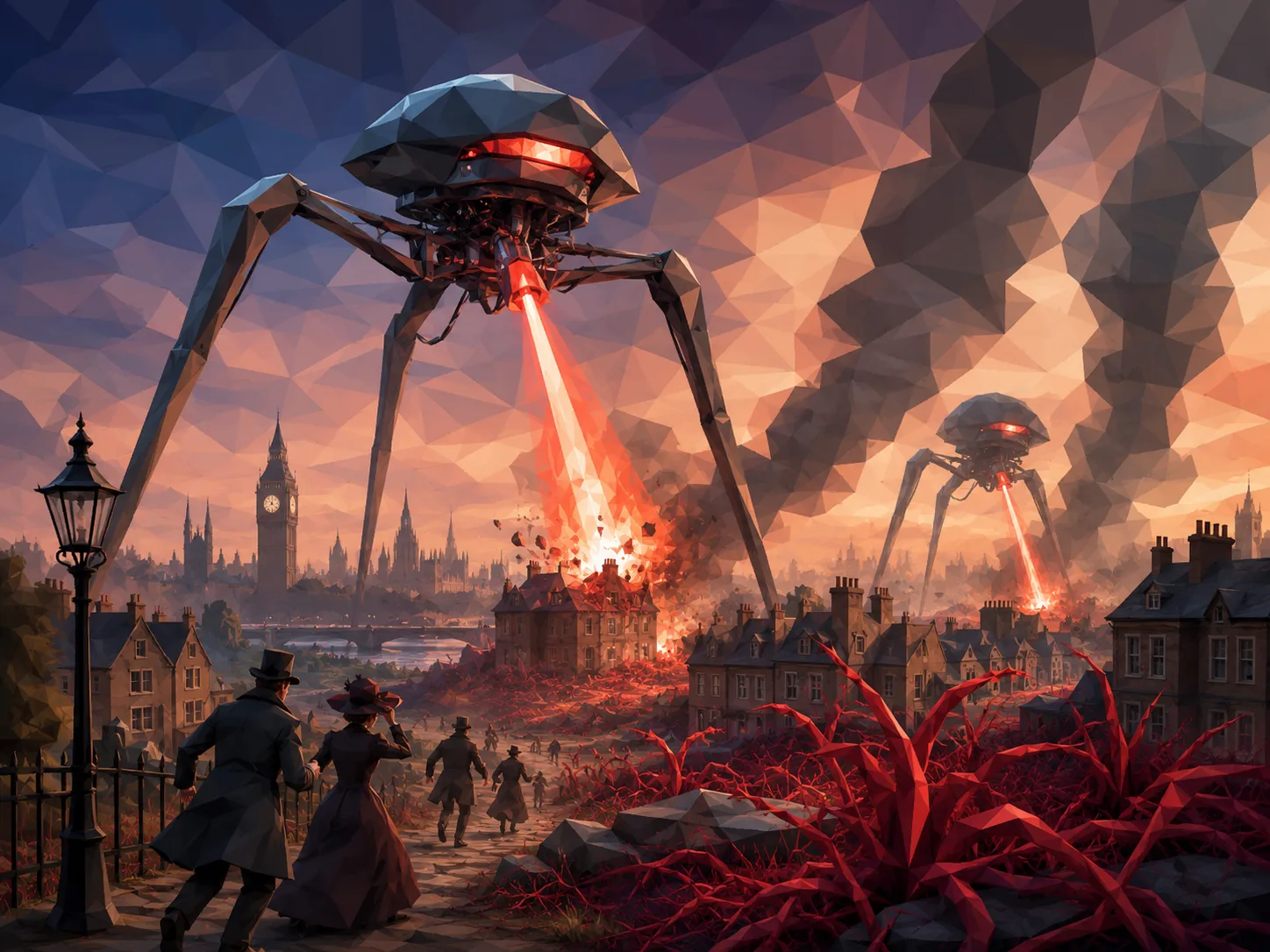
My brother first tried to get onto a train at Chalk Farm.
The station was full of people fighting to escape. Trains moved slowly through the crowds, while railway men struggled to keep people off the engines.
There was no way onto a train.
He fought his way out to the road again. Carts and carriages were rushing past, and he had to run between them.
Nearby, people had broken the window of a bicycle shop.
My brother was among the first to reach it. He pulled a bicycle through the broken glass, cutting his wrist. The front tyre was damaged, but he got on and rode away.
At the foot of a steep hill, fallen horses blocked the road. He turned into another street and kept going.
For a time, he stayed ahead of the worst of the crowd.
But the bicycle could not carry him far. By the time he reached the country lanes near Barnet, it was useless, and he had to go on foot.
Then he heard women screaming.
He hurried round a corner.
Two men were trying to drag two women out of a small pony cart. A third man held the frightened pony’s head.
One woman was short and dressed in white. She was screaming helplessly. The other was dark and slender. A man held her arm, but she struck at him with the whip in her free hand.
My brother shouted and ran towards them.
One of the men turned to face him.
My brother was a good boxer. He struck the man and knocked him against the wheel. Then he kicked him and caught the other man by the collar.
The pony moved wildly. The woman’s whip struck my brother across the face.
The third man hit him between the eyes.
For a moment, my brother could hardly see. The man he was holding pulled himself free and ran down the lane.
Then there was a shot.
The slender woman had found a revolver under the seat. She had fired it, and the men were escaping.
“Take this!” she said.
She gave my brother the revolver.
He stood beside the pony cart, breathing hard. His face hurt, and blood ran from his wrist. But the women were safe.
They were Mrs Elphinstone and Miss Elphinstone, the wife and younger sister of a surgeon called George Elphinstone.
They lived at Stanmore.
George had been out helping a sick person during the night. On his way home, he had heard that the Martians were advancing.
He had hurried back and woken the two women. Then he had packed some food, put the revolver under the seat, and told them to drive to Edgware.
They might be able to get a train there.
He had stayed behind to warn the neighbours.
He had promised to join them at about half past four. Now it was nearly nine, and they had seen nothing of him.
There had been too much traffic in Edgware. They could not wait there, so they had turned into the side lane.
Mrs Elphinstone wanted to go back.
“George!” she kept saying. “Oh, George!”
Miss Elphinstone was frightened too, but she listened quietly while my brother spoke.
He did not think they should try to return towards London. He wanted to go east, across Essex to the sea. From the coast, they might find a ship.
The two women agreed to let him travel with them.
He took the pony’s head, and they went on towards the main road.
Before they reached it, they could hear the noise.
The road was a river of people rushing north.
Dust rose from thousands of feet and wheels. It hung in the sunlight, hiding everything near the ground. Through it came horses’ heads, turning wheels, and the faces of men, women and children.
“Way! Way! The Martians are coming!”
The cry travelled along the road.
My brother stopped the pony cart at the end of the lane.
There seemed to be no space between the carts. People on foot pushed past the horses. Drivers shouted at one another and struck out with their whips.
Some people sat straight and silent, staring ahead. Others lay in the bottoms of carts, too tired to move.
The horses were wet and white with foam.
In one cart stood a blind man in a Salvation Army uniform. He raised his hands and shouted above the noise.
“Eternity! Eternity!”
His rough voice carried far down the road. My brother could still hear it after the cart had disappeared into the dust.
He stood beside the pony, unable to see how they could cross.
An old man limped out of the crowd and sat down nearby. He took off his boot. His sock was bloody. He shook a stone from the boot, put it on again, and limped away.
Then a little girl threw herself down under the hedge.
She was alone and crying.
“I can’t go on! I can’t go on!”
My brother lifted her gently. At once, she became very still, as if she was afraid of him.
He carried her towards Miss Elphinstone.
“Ellen!” a woman screamed from the road. “Ellen!”
“Mother!”
The child struggled free and ran back into the crowd.
The people kept coming. Behind every cart was another cart. Behind every group on foot came more tired faces.
Near the lane, a man was dying in a ditch. Another man came to ask my brother for water.
“He’s very thirsty,” he said. “He’s dying fast. It is Lord Garrick.”
“Lord Garrick?” my brother asked. “The Chief Justice?”
But there was no time to think about him.
A bearded man was pushing through the crowd with a small bag. As my brother looked at him, the bag split open.
Gold coins poured onto the road.
They rolled between people’s feet and under the horses.
The man stopped and stared. Part of a passing cab struck his shoulder and sent him backwards. He cried out, moved aside, and narrowly escaped a cartwheel.
But he would not leave the money.
He went down among the feet and wheels and began gathering the coins.
My brother tried to reach him.
Then he heard a scream.
Through the dust, he saw a wheel pass over the man’s back.
The driver struck at my brother with his whip as he ran round the cart. The injured man lay among the scattered coins. His back was broken, and he could not get up.
My brother shouted at the next driver to stop.
A man on a black horse came to help him. But the crowd was too strong. Men, horses and carts kept pressing forward.
My brother was pushed away.
When he looked back, the man with the gold lay crushed and still beneath the passing wheels.
Miss Elphinstone covered her eyes.
“Let us go back!” my brother shouted.
He began turning the pony.
“We cannot cross this, this hell,” he said.
They went back a hundred yards, until the bend in the lane hid the crowd.
As they passed the ditch, my brother saw the dying Lord Garrick again. His face was white and wet.
The two women sat close together, shaking.
Beyond the bend, my brother stopped.
Mrs Elphinstone was crying. She no longer even called for George. Miss Elphinstone’s face was very pale.
For a moment, none of them moved.
But now that he had turned away, my brother understood that they had to cross the road. They could not stay there, and going back would not save them.
He looked at Miss Elphinstone.
“We must go that way.”
Then he turned the pony round again.
This time, Miss Elphinstone held the reins.
My brother went into the moving crowd and caught the head of a cab horse. He held it back while she drove the pony across in front of it. The cabman struck at him with his whip.
A wagon struck their wheel. A long piece of wood broke from the side of the pony cart.
Then they were caught in the stream of traffic.
They could not cross straight over. The crowd swept them northwards.
My brother climbed into the cart and took the reins. Red marks from the cabman’s whip lay across his face and hands.
They were carried through Barnet with the other carts.
Slowly, they worked towards the other side of the road. At last, they found a way out of the crowd and turned east.
By then, all three were worn out.
They stopped near a quiet road for the rest of the afternoon. They had begun to feel hungry, and they had little strength left.
When night came, the air turned cold.
None of them dared to sleep.
People were still hurrying along the road nearby. Some were now going back the way my brother had come.
They were running from dangers that my brother and the two women could not see.