


I remember Saturday as a long, hot day of waiting. I had slept very little, though my wife had managed to sleep. Early in the morning, I went into the garden and listened.
Towards the common, everything was quiet. Only a bird was singing.
Soon I heard the milkman’s cart. I hurried to the side gate to ask for news.
He told me that soldiers had surrounded the Martians during the night. Guns were on their way.
“They aren’t to be killed, if that can possibly be avoided,” he said.
Then I heard a train going towards Woking. That familiar sound helped me feel calmer. Trains were still running. The milkman was still bringing milk. Perhaps the danger was not so great.
Later, my neighbour came to the fence with a handful of strawberries for me. He loved his garden and often shared its fruit.
He pointed towards some smoke above the trees.
“The pine woods near Byfleet are burning,” he said. “They say another cylinder fell there. Number two! Surely one was enough.”
He laughed.
“The insurance companies will have a lot to pay before this is over.”
The woods were still burning, he told me. The ground was thick with dry pine needles, and it would stay hot for days. Then he stopped laughing and spoke sadly about poor Ogilvy.
During the morning, I went down towards the railway bridge. Soldiers were there, talking about the Martians. I told them what I had seen in the pit.
“Crawl up where they can’t see us, then rush at them,” said one.
“What good is hiding behind a few trees against that heat?” another asked. “They’ll cook you! We need to get as close as we can and dig a trench.”
“You always want a trench. You should have been born a rabbit.”
A small, dark soldier was smoking a pipe. He listened quietly before he spoke.
“Haven’t they got any necks, then?”
I described their round bodies and long tentacles.
“Octopuses, that’s what I call them,” he said.
“It isn’t murder to kill creatures like that,” said another soldier.
“Why don’t we fire shells at them and finish them?” asked the small man. “You can’t tell what they might do.”
“Where are your shells?” the first soldier asked. “There’s no time. Rush them, I say. Do it now.”
They spoke roughly and joked with one another. None of them seemed afraid.
The hours passed slowly. At about three, we began to hear a gun firing in the distance. There was a pause between each deep bang.
I learned that the soldiers were firing into the burning woods near Byfleet. They hoped to destroy the second cylinder before it opened.
But a gun did not reach the soldiers near the first pit until about five.
At six, my wife and I were having tea in the garden. We sat in the summerhouse and talked about the battle that seemed certain to come.
Suddenly, there was a low explosion from the common. A burst of shooting followed.
Then something crashed close to us.
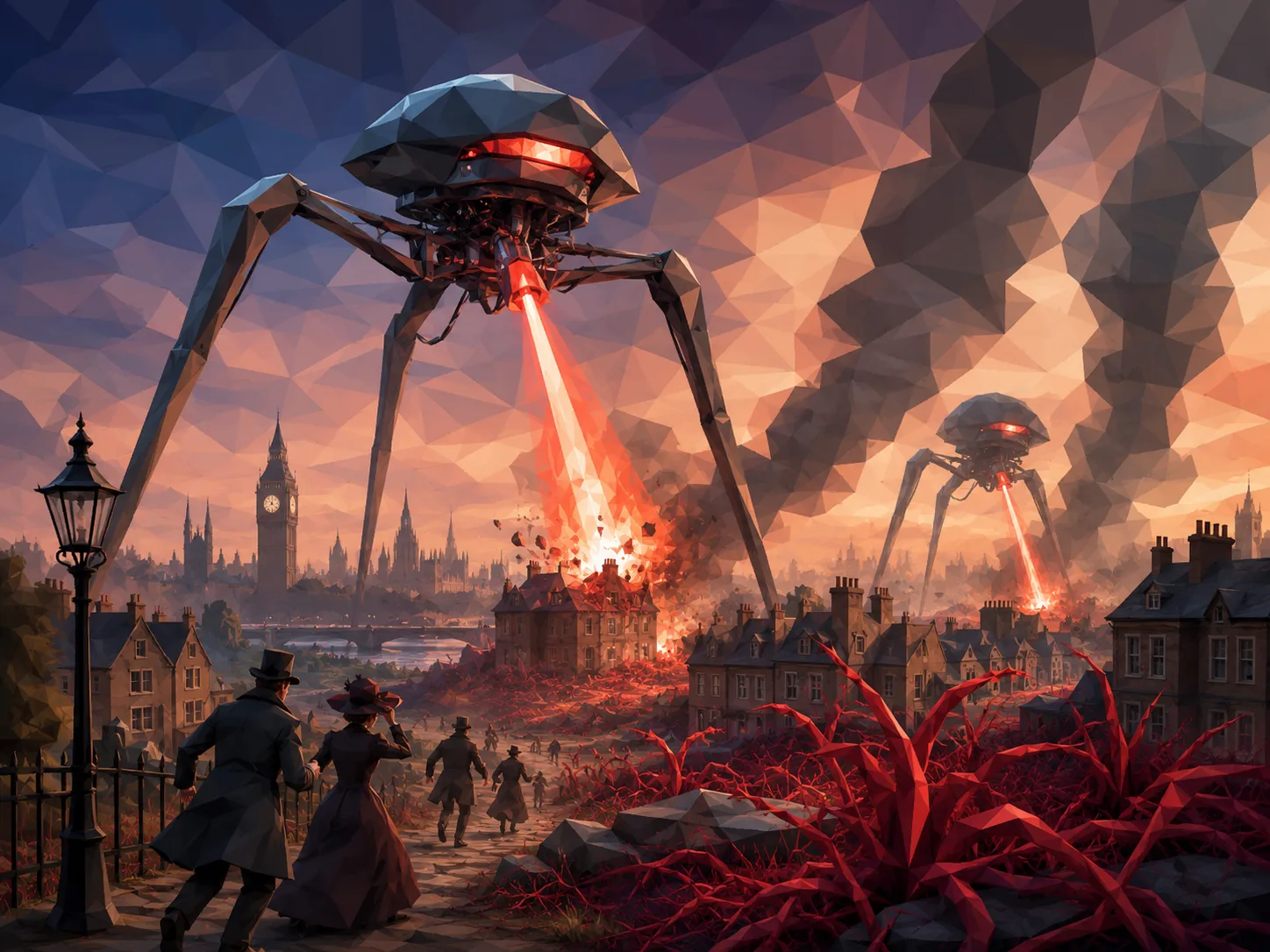
The ground shook. I jumped up and ran onto the lawn. The tops of the trees round the college were burning. Red flames rose through thick smoke.
As I watched, the little church tower fell.
Part of the college roof had gone. Then one of our own chimneys cracked. Bricks flew from it, struck the roof and fell into the flower bed below my study window.
For a moment, my wife and I could only stare.
Then I understood. The buildings and trees had stood between us and the Heat-Ray. Now they were falling, and the Martians could reach the top of Maybury Hill.
I caught my wife’s arm and ran with her into the road. Then I hurried back for our servant. She was calling for a box she had left upstairs.
“I’ll get it,” I told her. “Come out now!”
More shots came from the common.
“We can’t possibly stay here,” I said.
“But where are we to go?” my wife asked.
For a moment, I could think of nowhere. Then I remembered her cousins.
“Leatherhead!” I shouted.
Their house was twelve miles away. Surely my wife would be safe there.
I left the two women in the road below the top of the hill.
“Stay here,” I said. “You’re safe here.”
Then I ran to the Spotted Dog. I knew that the landlord had a horse and cart. Soon everyone on our side of the hill would want to escape, and I had to reach him first.
He was in the bar, talking to a man. He did not seem to know what was happening behind his house. I asked for his horse and cart.
“I must have a pound, and I’ve no one to drive it,” he said.
“I’ll give you two.”
“Two pounds? What for?”
“And I’ll bring it back by midnight.”
“Lord!” he said. “What’s the hurry?”
But there was no time for a long explanation. We agreed, and soon I had the cart.
I hurried home, put in a few things we wanted to save, and helped my wife and the servant into it. Then we drove away.
Ahead of us, the fields lay quiet in the evening sun. Behind us, people were running down the hill.
At the bottom, I looked back.
Thick black smoke rose above Maybury Hill. Red fire showed through it. The smoke stretched from the pine woods in the east towards Woking in the west.
Through the hot, still air came the sound of a machine gun.
It rattled for a little while.
Then it stopped.
I had to turn my attention to the horse. I was not a good driver, and the road needed all my care. When I looked back again, another hill had hidden the smoke.
I used the whip, and we hurried on towards Leatherhead.