


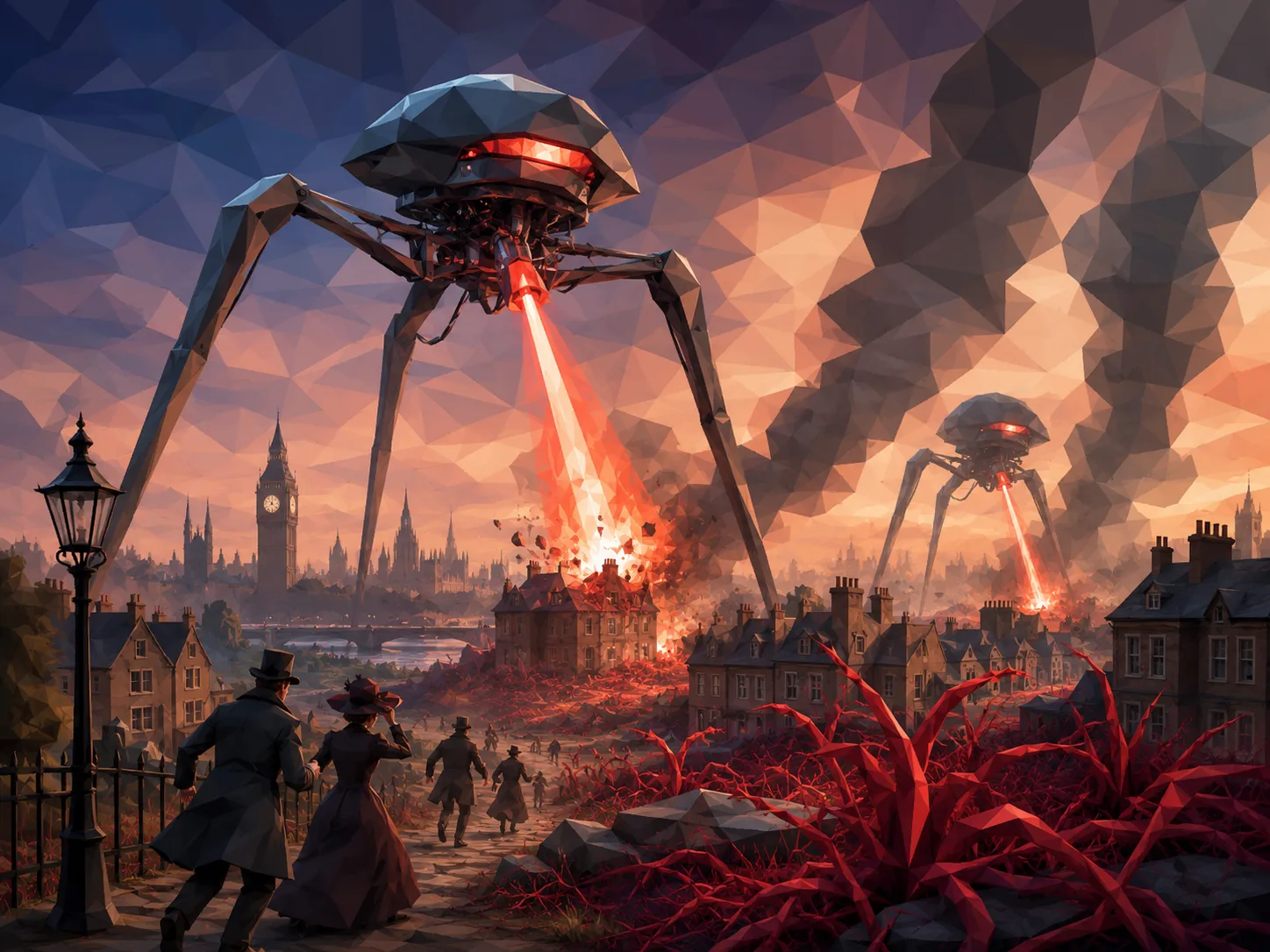
At last, I was able to get up. I went upstairs to my study and looked out of the window.
The country below Maybury Hill was burning.
Fires lit the roofs and trees. Farther away, a train stood on the railway, its carriages in flames. Smoke moved across the land and hid the familiar roads and houses.
Near the common, black shapes moved against the light. They bent down and rose again. They seemed very busy.
I watched them for a long time.
What were these walking machines? Could a machine think for itself? I could not believe that.
Perhaps a Martian sat inside each one. Perhaps it used the metal legs and tentacles as we use our arms and legs. The Martian could be like a brain inside a great metal body.
For the first time, I wondered how one of our warships or steam engines would look to an animal. Would it seem just as strange and terrible?
The storm had passed. The sky was clear above the smoke, and Mars was a small, fading light in the west.
Then I heard something at the garden fence.
A soldier was climbing over it.
At the sight of another person, I suddenly felt awake again. I leaned out and made a quiet sound to catch his attention.
He stopped, sitting across the top of the fence. Then he climbed down into the garden and came softly towards the house.
“Who’s there?” he whispered, looking up.
“Where are you going?” I asked.
“God knows.”
“Are you trying to hide?”
“That’s it.”
“Come into the house.”
I went downstairs and opened the door. As soon as he was inside, I locked it again.
He had no hat, and his coat was open. In the darkness, I could not see his face clearly.
“My God!” he said.
“What has happened?”
“What hasn’t?”
He moved his hand helplessly.
“They wiped us out. Simply wiped us out.”
He followed me into the dining room. I poured him some whisky.
He drank it, sat down at the table and put his head on his arms.
Then he began to cry.
I stood beside him. Only a short time before, I had been shaking with fear myself. Now, as I watched him, I almost forgot my own terror.
It was a long time before he could tell me his story. Even then, he stopped often and seemed unable to find the words.
He was a young artilleryman. He had driven one of the big guns to a place near Horsell at about seven.
Firing had already begun across the common. People were saying that the Martians were crawling towards their second cylinder. A great metal shield hid them from the soldiers.
The artilleryman’s gun was put into position, facing the sand pits.
Then, as he moved back with the horses, his horse stepped into a rabbit hole.
The horse fell and threw him into a hollow in the ground.
At the same moment, the gun exploded behind him.
The shells blew up. Fire flashed all round him.
When he understood where he was, dead men and horses lay on top of him.
“I lay still,” he said. “I was scared out of my wits. Part of a horse was across me. We’d been wiped out.”
He stopped and looked down at the table.
“And the smell—Good God! Like burned meat!”
His back had been hurt when the horse fell. For a long time, he could do nothing but lie there.
“A minute before, everything was in order,” he said. “Then the horse fell, there was a bang, and it was all over. Wiped out!”
He had hidden beneath the dead horse and watched the common.
Some soldiers had tried to rush towards the pit. The Heat-Ray had caught them. They had no chance to reach the Martians.
Then the great metal shield had risen from the ground.
Three long legs lifted it into the air.
It became one of the fighting machines I had seen in the storm.
The machine walked slowly across the common. Its hood turned like a head, looking for people who were trying to escape.
One metal arm held a box. Green lights flashed round it.
The Heat-Ray came from that box.
The artilleryman told me how Woking had burned. Men had run in every direction, but the machine could reach them wherever they went.
He had seen it pick up a man and strike his head against a tree.
At last, the artilleryman had crawled away from the dead horses. Somehow, he had escaped through the burning country and reached my garden.
We found some food and ate in the dark. Neither of us wanted to make a light.
When we had finished, we went quietly upstairs to the study.
Dawn was spreading across the sky.
In one night the valley had become a valley of ashes.
Most of the fires were lower now. Smoke rose where flames had been. In the growing light, I could see broken houses and black trees. The darkness had hidden much of the damage. Now the daylight showed everything.
Here and there, something had escaped the fire. A white railway signal still stood. Part of a greenhouse shone among the black ruins.
These small, ordinary things made the rest seem even more terrible.
Near the pit stood three great fighting machines.
The morning light shone on their metal bodies. Their hoods turned slowly, as if they were looking over the land they had destroyed.
The pit seemed larger than before. From time to time, bright green smoke rose from it. It curled into the clear morning air, broke apart and disappeared.