


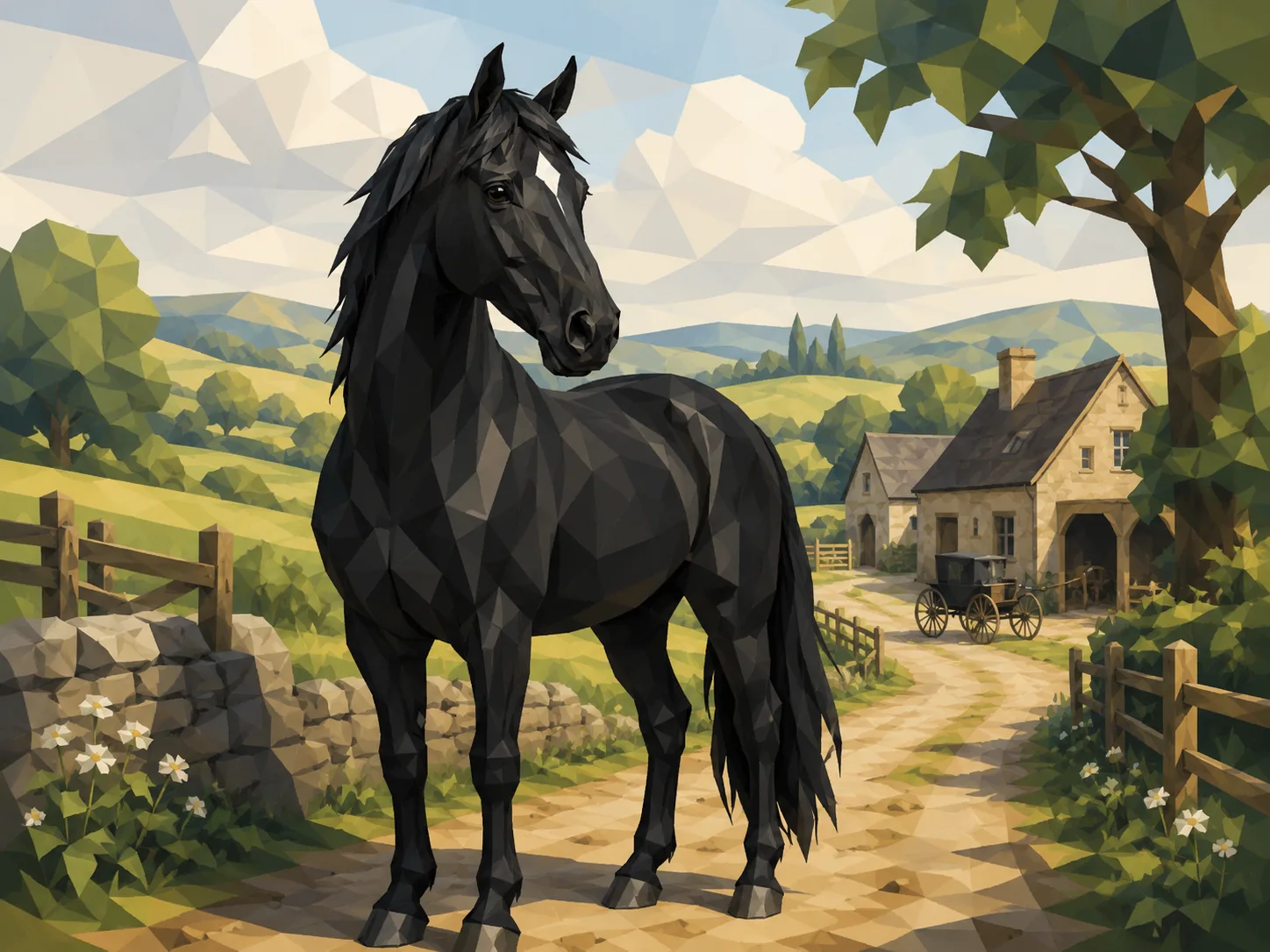
Early in the spring the Earl and part of his family went to London and took York with them. Lady Anne, the Earl’s daughter, stayed at home. She was a perfect horsewoman, as cheerful and gentle as she was beautiful. She chose me for her horse and named me Black Auster, and I loved our rides in the clear, cold air. Sometimes Lizzie came with us, a lively bay mare whom the gentlemen loved, but Ginger told me she was rather nervous.
Lady Anne’s cousin, Colonel Blantyre, was staying at the house. He always rode Lizzie and praised her so much that one day Lady Anne had her own saddle put on Lizzie and the other saddle on me.
“Please don’t ride her,” the colonel said. “She is a lovely creature, but she is too nervous for a lady.”
“My dear cousin,” she laughed, “don’t worry your head about me. I have ridden since I was a baby.”
So we rode to the village with a message for the doctor. At his gate the colonel got down, hung my rein on the gate and went up to the house, while Lady Anne waited on the road, singing softly to herself.
Just then some cart horses and young colts came trotting out of a field, with a boy behind them cracking a big whip. One wild colt ran across the road into Lizzie’s back legs. She gave a violent kick and galloped off, and Lady Anne was nearly thrown.
I neighed loudly for help, again and again. Colonel Blantyre came running, saw the figure flying far down the road and jumped into the saddle. I needed no whip; I was as eager as he was. Where the road divided, a woman at her garden gate pointed and cried, “To the right!” Further on, an old road-mender waved his arms. “To the common, sir!”
The common was rough ground full of hidden holes, the worst place for a wild gallop. There we saw them again. Lady Anne’s hat was gone, her long brown hair was flying, and she was pulling back with all the strength she had left. The rough ground had slowed Lizzie down, and the colonel guided me so well that we were gaining on them.
Halfway across there was a wide ditch with a bank of earth behind it. Lizzie jumped, stumbled and fell.
“Now, Auster, do your best!” cried the colonel. I gathered myself and cleared the ditch and the bank in one jump.
My poor young mistress lay without moving in the heather. The colonel knelt down and turned her face up. It was very white, and her eyes were closed. “Annie, dear Annie, do speak!” But there was no answer.
Two men cutting turf nearby came running. “Can you ride?” the colonel asked one of them.
“I’m not much of a horseman, sir, but I’d risk my neck for Lady Anne. She was very good to my wife last winter.”
“Then ride this horse to the doctor’s and ask him to come at once. Then go on to the house and tell them to send the carriage and help.”
He was no rider, but he held on, and I shook him as little as I could. He did his errand like a good, true man.
At home Lord George rode off on Ginger in a great hurry, and the carriage followed. Later Ginger told me what she had seen.
“We galloped nearly all the way,” she said. “A woman was sitting on the ground with the lady’s head in her lap. The doctor gave her something to drink, and all I heard was, ‘She is not dead.’ Then they took her home in the carriage.”
Lord George, a careless rider, often took Ginger hunting now. She enjoyed it, but sometimes she came back very tired and stiff, and now and then she gave a short cough. She had too much spirit to complain, but I could not help worrying about her.
Two days later Colonel Blantyre came to see me. He patted me and told Lord George that I knew Annie was in danger as well as he did. From their talk I learned that my young mistress was out of danger and would soon ride again. That was good news, and I looked forward to a happy life.