


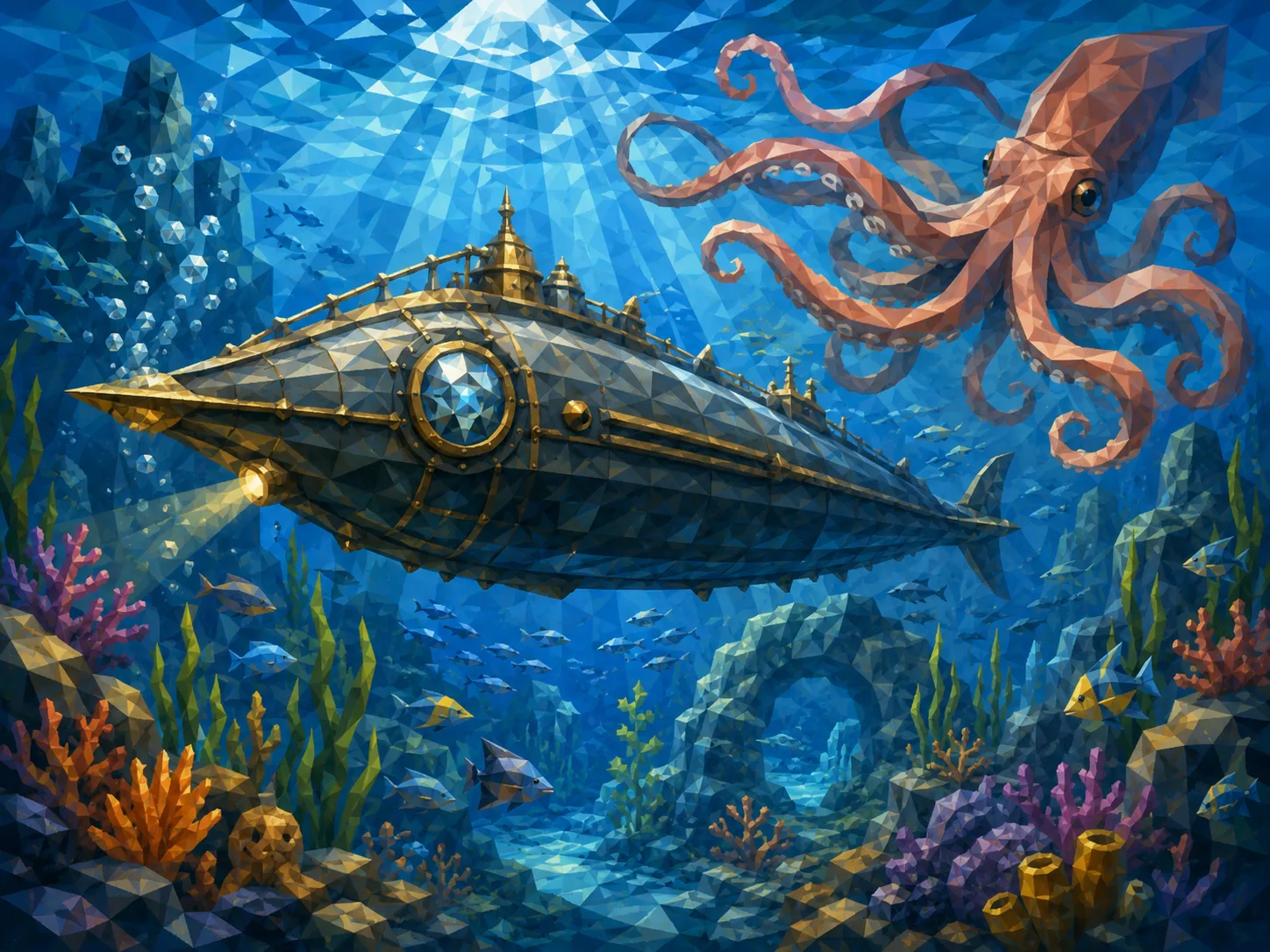
The next morning I went up to the platform just as the second officer was saying his daily words. Soon Captain Nemo appeared, and a number of sailors came up to pull in the nets. They were strong, healthy men who seemed to come from different nations: I thought I recognized Irishmen, Frenchmen, a few Slavs and a Greek. Among themselves they spoke only that strange language, and I could not ask them anything. The nets came up full of fish, some to eat fresh, others to keep.
Captain Nemo stood gazing at the ocean. Then he turned to me.
“Professor, is the ocean not truly alive? Last night it slept, as we did, and now it is waking up under the sun. I can imagine whole towns under the sea, which would rise every morning to breathe, like the Nautilus. Free towns, independent towns! And yet who knows whether some tyrant…”
He finished the sentence with a violent gesture and went below.
During the weeks that followed, I rarely saw him. The Nautilus crossed the Pacific toward the southeast, and almost every day the shutters of the salon opened. We never grew tired of the world under the sea.
On the 11th of December I was reading in the salon. The Nautilus lay still, deep below the surface, and Ned and Conseil were watching the lighted water.
“Will master come here a moment?” said Conseil in a strange voice. “I would like master to look.”
I went to the window. In the electric light a huge black mass hung motionless in the water.
“A ship!” I said.
“Yes,” said Ned. “A wrecked ship that sank straight down.”
It had sunk only a few hours before. Its masts were broken off just above the deck, and torn ropes still hung from them. On the deck were several bodies, tied there with ropes: four men, one of them standing at the wheel, and a young woman with a baby in her arms. In the bright light I could see her face clearly. In one last desperate effort she had lifted her child as high as she could, and the poor little thing still held its arms around its mother’s neck. Only the man at the wheel looked calm. With his gray hair stuck to his forehead and his hand on the wheel, he seemed still to be steering his ship through the depths of the ocean.
We could not speak. And already large sharks were coming toward the wreck.
The Nautilus circled the sunken ship, and I read the name on its stern: the Florida, Sunderland.
That terrible sight was only the first of many. Wherever many ships passed, we saw old wrecks rotting on the sea floor, with cannons, anchors and chains eaten by rust.
We sailed on among the coral islands of the Pacific, which tiny animals build very slowly from the bottom of the sea. One day I told Captain Nemo that these islands might one day join together and form a new continent.
“The earth does not need new continents,” he answered coldly, “but new men.”
Christmas Day came, and Ned was sad that there was no Christmas on board. I had not seen the captain for a week when, on the morning of the 27th of December, he came into the salon as if he had seen me five minutes before. I was following our route on the great map. He put his finger on one spot and said only one word:
“Vanikoro.”
I jumped to my feet. Vanikoro was the island where the great French explorer La Pérouse had been lost!
“When will we be there?” I asked.
“We are there now.”
I followed him up to the platform. Before us rose two green, mountainous islands inside a ring of coral reefs. Under the trees on the shore a few islanders watched us, astonished.
“What do you know about the loss of La Pérouse?” asked Captain Nemo.
“Only what everyone knows, Captain.”
“Then tell me what everyone knows,” he said, with a touch of irony.
So I told him. In 1785 the King of France sent La Pérouse to sail around the world with two ships. They were never heard of again. France sent ships to search for them, but they found nothing. Nearly forty years later, a sea captain named Dillon found the first remains here, and a French expedition came soon after him. The islanders took them to the place, and there, in a few meters of water among the reefs, they found anchors and cannons covered with coral. The islanders also said that the survivors had built a smaller boat from the remains of the two ships and sailed away in it. Where it was lost, nobody knew.
Captain Nemo said nothing, but signaled to me to follow him to the salon. The Nautilus went down a few meters, and the shutters opened. Under the coral, among bright fish, I saw what the searchers had left behind: iron, anchors, cannons and the front of a ship, all covered now with living flowers.
“The ships struck these reefs,” Captain Nemo said in a sad voice. “The first broke up almost at once; the second lasted a few days. The islanders welcomed the survivors, and they built a smaller boat. Some sailors chose to stay. The others, weak and ill, left with La Pérouse. They sailed toward the Solomon Islands and died there, on the coast of the main island.”
“How do you know that?”
“From this, which I found at the place of the last wreck.”
He showed me a tin box with the French royal arms on it, eaten by the salt water. Inside was a bundle of yellow papers that could still be read: the orders of the French navy to La Pérouse, with notes in the margins in the king’s own handwriting.
“Ah, it is a fine death for a sailor!” said Captain Nemo at last. “A coral grave is a quiet grave, and I hope that my companions and I will find no other.”