


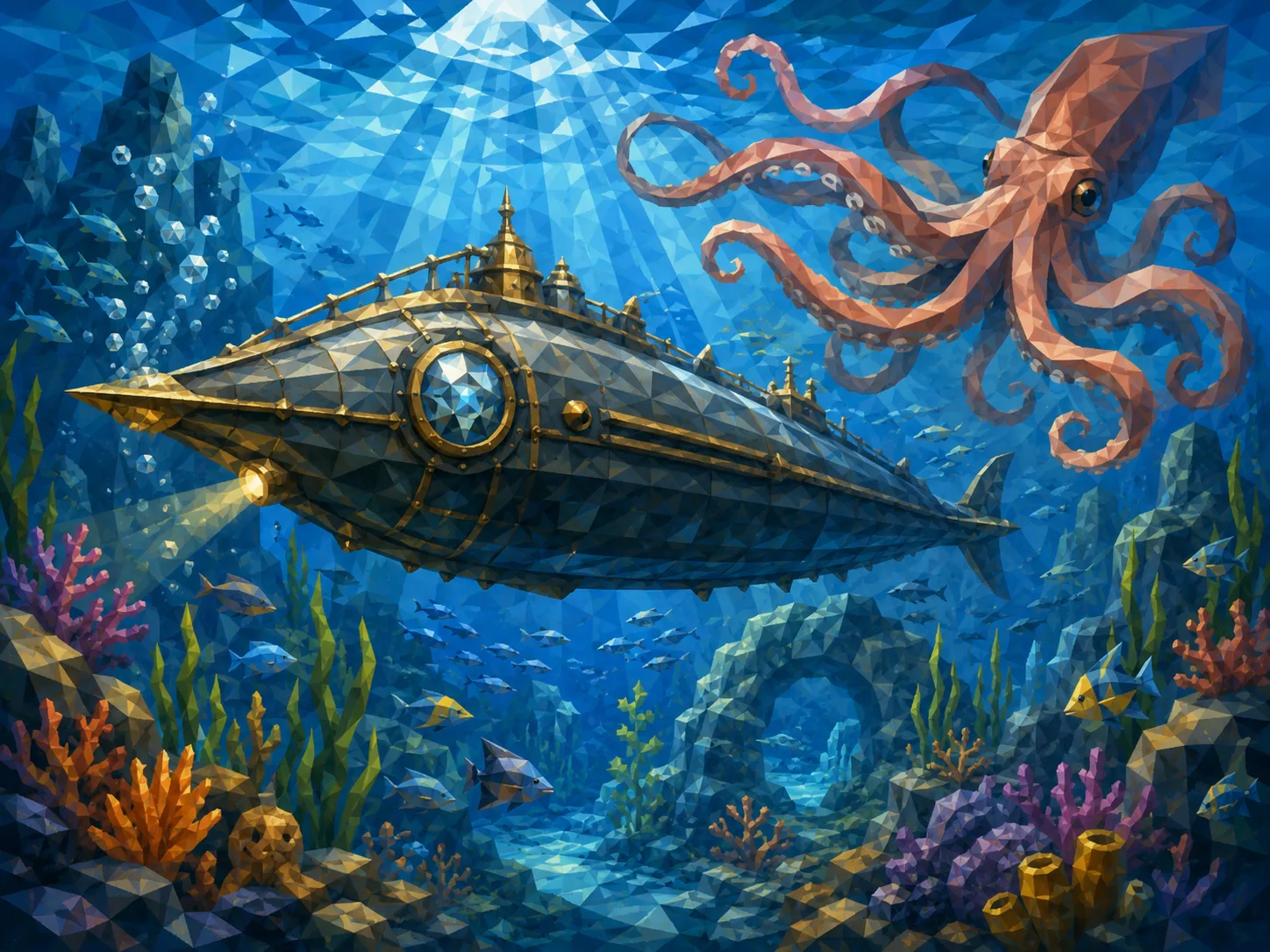
The Nautilus kept on toward the south at great speed. Did the captain really want to reach the Pole, where every explorer had failed?
On March 14 we met the first floating ice. Soon larger blocks appeared, some with green lines running through them, some shining like huge purple jewels, some like whole towns of white marble. Every day there were more of them. When every passage seemed closed, Captain Nemo always found a narrow opening and slipped boldly through it, though it closed behind us. On March 16 we crossed the Antarctic Circle. All around us we heard crashes as icebergs turned over, and when a field of ice blocked our way, the captain drove the Nautilus straight into it and split it like a wedge.
On March 18 we could go no farther. Ahead stood an endless wall of ice mountains frozen together.
“The ice barrier,” said Ned. “No ship can get past that.”
Behind us every passage had closed, and new ice was forming around the hull. I was on the platform when the captain turned to me.
“Well, Professor, what do you think?”
“I think we are caught, Captain.”
“You see nothing but difficulties, Professor. I tell you that the Nautilus will free itself and go farther still. It will go to the Pole.”
“To the Pole!” I could not hide my disbelief. “Then let us give the Nautilus wings and fly over the ice!”
“Over it?” said Captain Nemo quietly. “No, Professor. Not over it, but under it!”
Suddenly I understood, and I told him so. Most of an iceberg lies below the water, but under it the sea is free, and the Nautilus could travel there as easily as anywhere else. The only difficulty was air: we might be shut under the ice for several days. But the tanks could be filled with air, and if the sea at the Pole was frozen, the Nautilus could break through with its spur.
“Professor,” said the captain with a smile, “first you made so many objections, and now you are crushing me with arguments for my plan!”
The crew broke the new ice around the hull with picks, water poured into the tanks, and the Nautilus sank. Through the salon window Conseil and I watched the bottom of the ice pass above us.
“We will get through, master may be sure of it,” said Conseil.
We traveled south at the speed of an express train. Before midnight the Nautilus began to rise, and my heart beat fast. But a dull shock told me that we had struck the ice ceiling above us. All night the ship tried again and again, and the ice was always there. The air on board grew heavy, and I could not sleep. But little by little the ice was getting thinner.
At six in the morning on March 19 the door of the salon opened, and Captain Nemo appeared.
“The sea is open!” was all he said.
I rushed onto the platform. Before us lay open water, with only a few pieces of ice. Thousands of birds filled the air, and the sea was full of fish.
“Are we at the Pole?” I asked.
“I don’t know,” said the captain. “At noon I will find our position, if the sun shows itself through this fog.”
Ahead lay land, so large that we could not see its end. The boat took the captain, two of his men, Conseil and me to the shore. Ned did not come; I think he did not want to admit that the South Pole existed.
“Captain,” I said, “the honor of setting foot first on this land is yours.”
“Yes, Professor. And I do not hesitate to step on it, because no human being has ever left a trace here.”
He jumped onto the sand and climbed a rock, where he stood for five minutes, arms crossed, silent and still, as if he were taking possession of these southern lands.
The ground was dark volcanic rock, but the land was full of life. Birds flew around us with deafening cries, and penguins, so quick in the water and so clumsy on land, walked close to our feet without fear. But at noon the fog was still thick, and the sun did not appear. The captain watched the sky in silence, impatient and annoyed. This powerful man could command the sea, but not the sun.
The next day, March 20, Conseil and I went ashore again. In a wide bay the rocks were covered with seals, which looked at us with their soft eyes and did not run away; they had never met man. Farther on we heard loud bellowing.
“Bulls!” said Conseil.
“No, walruses.”
We climbed slippery black rocks to see them, and more than once I fell. Conseil helped me up.
“If master would kindly take longer steps,” he said, “master would keep his balance better.”
At noon I stood beside the captain on the shore, but again the sun did not come out. Tomorrow, March 21, was the equinox. After that the sun would disappear below the horizon for six months.
“If I cannot see the sun tomorrow,” said the captain, “I will not see it for six months. But tomorrow I will need only my clock. If the horizon cuts the sun exactly in half at twelve o’clock, we are at the South Pole.”
On the morning of March 21 the sky was clearing. Ned refused to come with us; he grew more silent and bad-tempered every day. The captain and I climbed a steep peak of black rock. Below us lay fields of dazzling white and the sea, where the Nautilus floated like a sleeping whale. To the north the sun hung low like a ball of fire, its lower edge already touching the line of the sea.
Captain Nemo watched it through his telescope as it sank slowly. I held the clock, and my heart was beating fast.
“Twelve!” I cried.
“The South Pole!” said Captain Nemo in a grave voice, and he handed me the telescope. The horizon cut the sun into two exactly equal halves.
Then he put his hand on my shoulder.
“I, Captain Nemo, on this 21st day of March 1868, have reached the South Pole, and I take possession of this part of the world.”
“In whose name, Captain?”
“In my own!”
And Captain Nemo unrolled a black flag with a gold N. Then he turned toward the sun, whose last rays lay on the sea, and cried:
“Goodbye, sun! Disappear, bright sun! Rest beneath this open sea, and let a night of six months spread its shadows over my new lands!”