


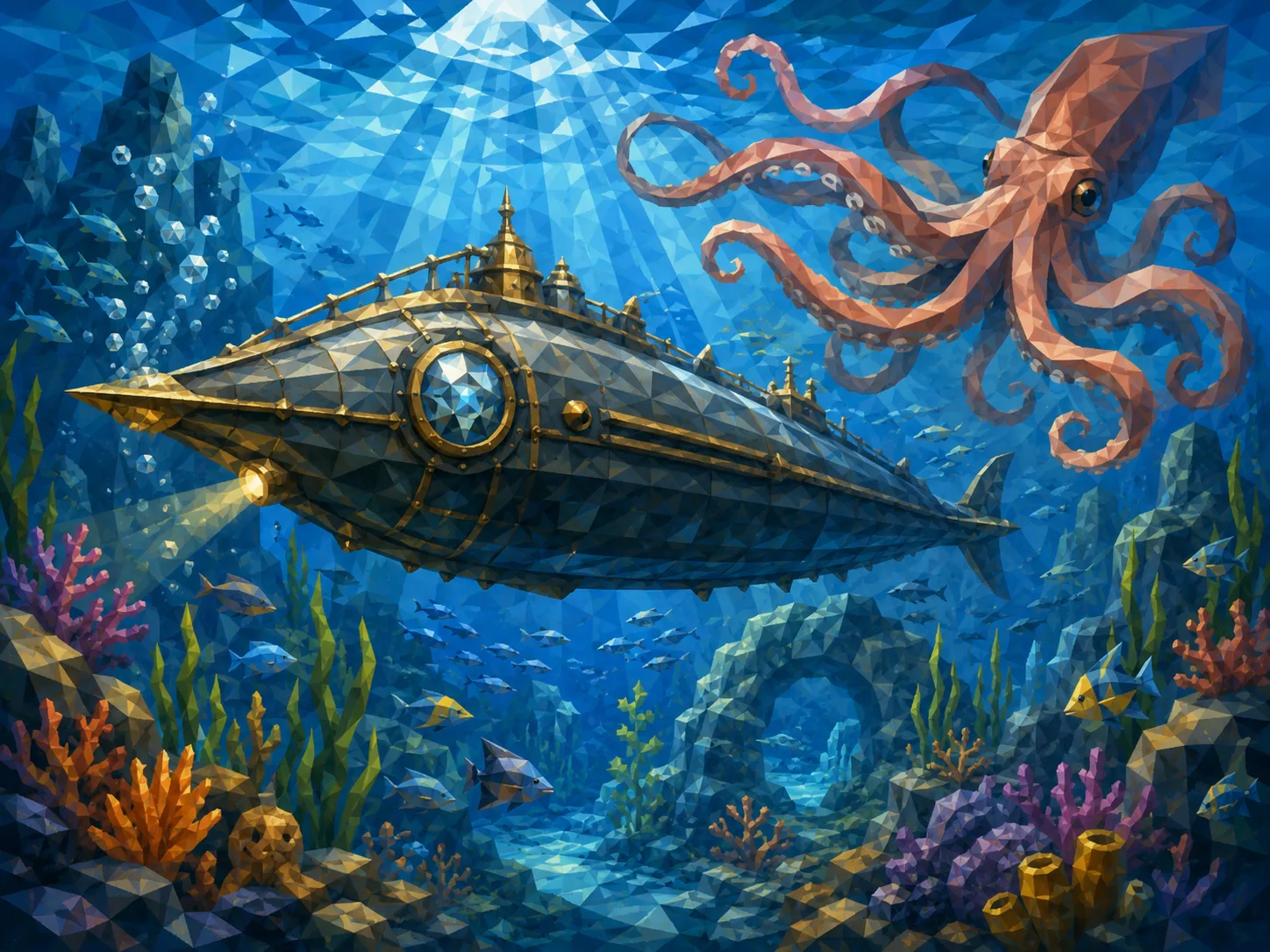
Captain Nemo had lost the second of his men since we came on board, and this one would not rest with his companions in the quiet coral cemetery. The Captain shut himself in his room, and for ten days the Nautilus drifted wherever the waves carried it, as if it could not leave the place where the sea had taken one of its men. Only at the beginning of May did it turn north again, into the Gulf Stream, that great warm river that flows through the middle of the sea.
We were following the coast of the United States now, where ships passed day and night, and nobody on board seemed to watch us any longer. But these are the waters of the worst storms in the Atlantic, and to go out in our small boat would have meant certain death. Ned knew it himself, and he suffered.
“Professor,” he said to me one day, “this has to end. The Captain is going north. I’ve had enough of the South Pole, and I won’t follow him to the North. Soon we’ll pass Nova Scotia and Newfoundland, and there the St. Lawrence flows into the sea. The St. Lawrence is my river, Professor, the river of Quebec, my hometown. When I think of it, I go mad. I’d rather throw myself into the sea than stay here! I can’t breathe!”
I understood him, for I was homesick myself. Nearly seven months had passed without any news from land.
“What do you want me to do, Ned?”
“Ask the Captain what he means to do with us. Speak in my name only, if you like.”
“But I hardly ever see him. He avoids me.”
“All the more reason to go and see him.”
I knocked at Captain Nemo’s door, and when no answer came, I went in. He was bent over his worktable and did not hear me. When I came closer, he raised his head and frowned.
“You here! What do you want?”
“To speak to you, Captain.”
“I am busy, sir. I never disturb you when you want to be alone; may I not have the same freedom?”
“I must speak to you about something that cannot wait.”
“Have you discovered something that I have missed?” he said with irony. “Has the sea told you a new secret?”
But before I could answer, he showed me an open manuscript on the table, and his voice became serious.
“Here, Professor Aronnax, is a manuscript written in several languages. It holds all my studies of the sea, and if God wills, it will not die with me. Once I have signed it and added the story of my life, it will be sealed in a small case that floats. The last of us alive on the Nautilus will throw this case into the sea, and it will go wherever the waves carry it.”
His name! His life, written by himself! So one day his secret would be known.
“Captain,” I said, “your studies must not be lost. But who knows into whose hands that case will fall? My companions and I would gladly keep the manuscript safe, if you would give us our freedom.”
“Your freedom?” said the Captain, rising.
“Yes, sir. That is what I came to ask you. We have been on board for seven months. I ask you today, in my companions’ name and in my own: do you mean to keep us here forever?”
“Professor Aronnax, I will answer you today as I answered you seven months ago: whoever enters the Nautilus must never leave it.”
“That is slavery!”
“Call it what you like.”
“But everywhere a slave has the right to win back his freedom.”
“Who denies you that right? Have I ever asked you to promise anything?”
He stood looking at me, his arms crossed.
“For me,” I said, “my studies are enough; they could make me forget everything. But Ned Land is different. A man like him, who loves freedom and hates slavery, might think of revenge; he might try…”
“Whatever Ned Land thinks or tries, what is that to me? I did not go looking for him! I do not keep him on board for my pleasure! As for you, Professor, you are one of those who can understand everything, even silence. I have nothing more to say to you. Let this first time be the last, for I will not listen a second time.”
I went out and told my companions everything.
“Now we know we can expect nothing from that man,” said Ned. “We’re near Long Island. We’ll escape, whatever the weather.”
But the sky grew more threatening every hour. The air turned white and misty, heavy clouds raced low over the water, and the waves rose higher and higher. The birds disappeared, except the petrels, those friends of the storm. Then, a few kilometers from New York, the hurricane broke.
Instead of escaping into the quiet depths, Captain Nemo chose to face it at the surface. He stood on the platform and tied himself to the rail so that the huge waves would not carry him away. I climbed up and tied myself near him. I did not know which I admired more, the storm or this extraordinary man who faced it. The Nautilus lay on its side, then stood up like a mast, but the waves could not hurt its steel body.
At ten o’clock the sky was on fire. Lightning flashed on every side, so bright that I could not look at it, but Captain Nemo looked at it calmly, as if he envied the storm its power. One might have thought he was looking for a death worthy of himself, a death by lightning. Sparks leaped from the spur of the Nautilus when it rose into the air.
I had no strength left. I untied myself, crawled to the hatch and went down to the salon. At midnight Captain Nemo came down too. I heard the tanks filling, and the Nautilus slowly sank. Even twenty meters down, the sea was still rough. We went deeper. And there, what quiet, what silence, what peace! Who could have believed that such a hurricane was raging above us?