


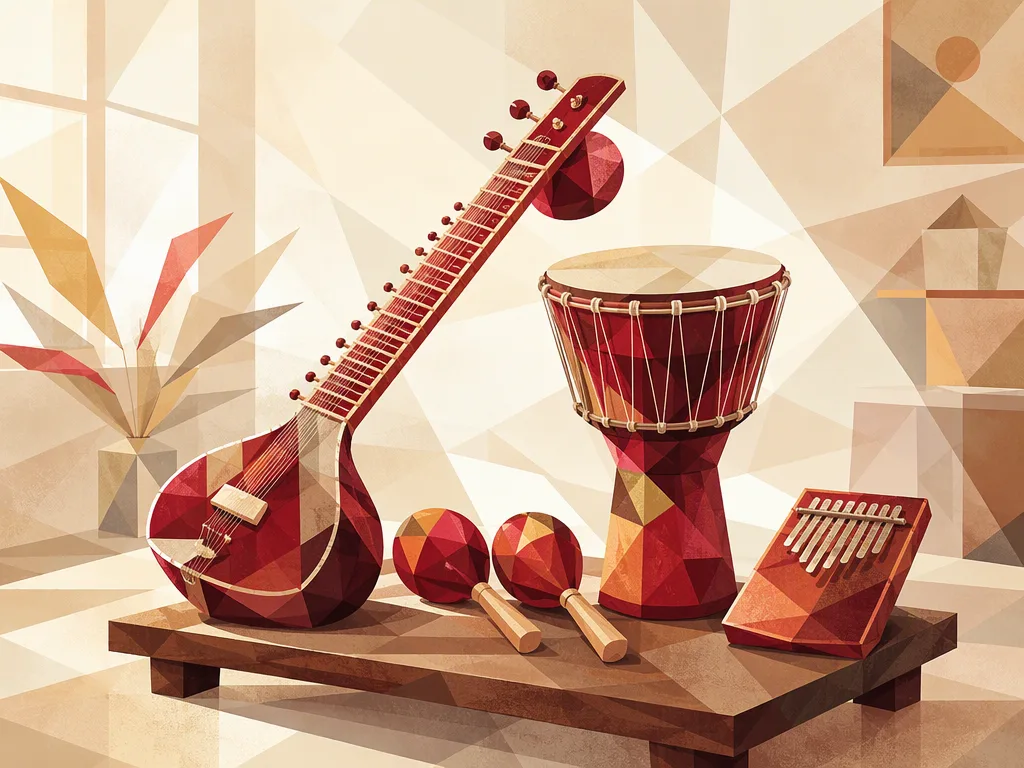
Musical Instruments Around the World
Explore how instruments are played, where they come from, and what makes their sounds special.
Preview
Questions with solutions-
1. Попълнете празното място.
A guitar player usually ___ the strings with their fingers or a small pick.
- plucks
- bows
- blows into
- shakes
Show solution
A guitar player usually plucks the strings with their fingers or a small pick.
A pick is a small tool used to catch and release the strings, making them move and produce sound.
-
2. Изберете верния отговор.
Which part of the violin does the bow touch?
A violin player holds the instrument under their chin and moves a bow to produce a note.
- The keys
- The strings
- The drumhead
- The mouthpiece
Show solution
- The strings
The hairs on the bow catch the strings as the bow moves across them, helping the player produce a long, steady note.
-
3. Изберете верния отговор.
Which instrument family does the flute belong to?
Most modern flutes are made of metal, but their sound comes from air moving inside a tube.
- Strings
- Brass
- Woodwinds
- Percussion
The material alone does not decide the family.
Show solution
- Woodwinds
A woodwind instrument does not have to be made of wood. How it produces sound is more important.
-
4. Попълнете празното място.
A drum belongs to the ___ family because it is usually played by hitting it.
- string
- woodwind
- brass
- percussion
Show solution
A drum belongs to the percussion family because it is usually played by hitting it.
Percussion instruments can be hit, shaken, or scraped. Drums are just one part of this large family.
-
5. Изберете верния отговор.
How are maracas usually played?
Maracas are common in Latin American music. Their hollow bodies contain small seeds or beads.
- By shaking them
- By blowing into them
- By drawing a bow across them
- By pressing keys on them
Show solution
- By shaking them
The seeds or beads strike the inside walls, creating a light, rattling sound.
-
6. Попълнете празното място.
The sitar is a string instrument strongly linked with classical music from ___.
- Japan
- India
- China
- Indonesia
Show solution
The sitar is a string instrument strongly linked with classical music from India.
A sitar has extra strings that can sound along with the main strings, even when the player does not touch them.
-
7. Изберете верния отговор.
Which instrument is being played?
A musician blows into a long wooden tube, producing a deep, steady sound. The instrument comes from Aboriginal traditions in Australia.
- A trumpet
- A clarinet
- A didgeridoo
- A flute
Show solution
- A didgeridoo
The didgeridoo is especially linked with Aboriginal peoples of northern Australia.
-
8. Изберете верния отговор.
Where should the player strike to get the deep sound described?
A djembe is a West African hand drum. A relaxed hand striking the center gives a deep sound; a strike near the edge can give a higher, sharper sound.
- Near the edge of the drumhead
- On the wooden side of the drum
- In the center of the drumhead
Show solution
- In the center of the drumhead
One djembe can produce several different sounds, allowing a player to create a varied rhythm with just one drum.
-
9. Попълнете празното място.
In Trinidad and Tobago, musicians developed the steelpan from large ___ barrels.
- wooden
- plastic
- clay
- metal
The instrument's name gives a clue about its material.
Show solution
In Trinidad and Tobago, musicians developed the steelpan from large metal barrels.
Differently shaped areas of a steelpan produce different notes when hit, so it can play a melody.
-
10. Изберете верния отговор.
Why does the accordion player keep pushing and pulling the middle section?
An accordion needs flowing air to make sound. Its middle section opens and closes like a folding fan.
- To move air through the instrument
- To tighten and loosen its strings
- To strike a stretched drumhead
- To shake loose beads inside it
Show solution
- To move air through the instrument
The air makes small metal parts called reeds vibrate. The keys and buttons control which notes sound.
-
11. Изберете верния отговор.
How does a kalimba player usually produce notes?
A kalimba is an African instrument with thin metal strips fixed to a wooden board or box. The player holds it in both hands.
- By blowing across the metal strips
- By plucking the metal strips with the thumbs
- By moving a bow across the wooden body
- By pressing foot pedals below the box
The player's fingers support the instrument, leaving the thumbs free.
Show solution
- By plucking the metal strips with the thumbs
The kalimba is often called a thumb piano, although it has metal strips rather than piano keys.
-
12. Изберете верния отговор.
What would most likely happen if the gourds were removed?
A West African balafon has wooden bars above hollow, dried gourds. The bars make sound when hit, and air moving inside the gourds adds to that sound.
- The bars would make no sound at all.
- The sound would become louder.
- The sound would become quieter.
The bars produce the notes; the gourds support the sound.
Show solution
- The sound would become quieter.
The gourds act like small sound boxes, helping the notes carry farther.
-
13. Изберете верния отговор.
What allows the notes to continue while the player takes a breath?
A bagpipe player blows air into a bag, then squeezes the bag to push air through the pipes.
- Air drawn in through the finger holes
- Air already stored in the bag
- Air stored in the player's mouth
Show solution
- Air already stored in the bag
Bagpipes are strongly linked with Scotland, but different kinds are played in many other regions too.
-
14. Изберете верния отговор.
What kind of tube would add a lower note?
Panpipes are played in the Andes. In a set of tubes with the same width, shorter tubes make higher notes and longer tubes make lower notes.
- A tube longer than the others
- A tube shorter than the others
- A tube the same length as an existing tube
Show solution
- A tube longer than the others
Each tube produces its own note, so players move their mouths from tube to tube to play a melody.
-
15. Изберете верния отговор.
Which description explains the piano's link to both string and percussion instruments?
Inside a piano, pressing a key makes a small hammer hit a string. The string then vibrates and produces the note.
- Its notes come from strings that are plucked.
- Its notes come from stretched skin that is struck.
- Its notes come from strings that are struck.
Think about both the part that sounds and the action that starts it.
Show solution
- Its notes come from strings that are struck.
The keyboard is the player's control system. Hidden inside, hammers and strings do the sound-making work.