


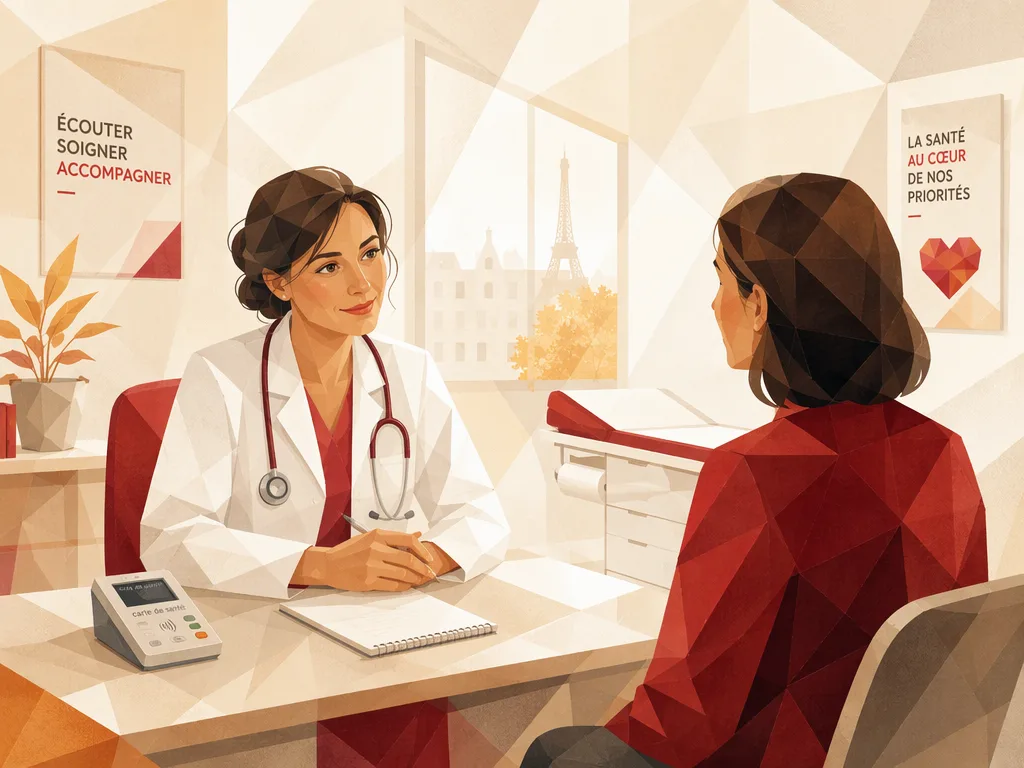
Seeing a Doctor Without an Appointment

Публичен
•
4 ноември 2026 г.
Генерира се аудио за произношение...
Може да отнеме малко. Междувременно разгледайте и останалите части на сета.
0
Слушане и преговор
Добавете поне 2 Voca карти, за да отключите „Слушане и преговор“ и да се упражнявате с аудио.
Go beyond basic pain statements to handle an urgent visit to a doctor's office in France. This set follows a walk-in consultation from the reception desk to the examination and final prescription.
- At reception: ask for an available slot, show your insurance card, and handle waiting times.
- With the doctor: describe how your symptoms have changed over several days and what you have already tried.
- Before leaving: understand examination instructions, ask about follow-up care, and get paperwork for reimbursement.
Pay attention to how depuis with the present tense expresses ongoing symptoms, and how formal vous is used by both patient and staff.
Картички Voca
1.
la consultation sans rendez-vous
walk-in visit, walk-in consultation
Bonjour, est-ce que le médecin assure des consultations sans rendez-vous aujourd'hui ?
Hello, does the doctor take walk-in visits today?
2.
le créneau
time slot, opening
Il me reste un petit créneau en fin de matinée si vous pouvez rester sur place.
I have a short time slot left late this morning if you can stay here.
In medical and professional contexts, 'un créneau' is an available time slot.
3.
la carte d'assurance maladie
health insurance card
Voici ma pièce d'identité et ma carte d'assurance maladie.
Here are my ID and my health insurance card.
Residents in France use 'la carte Vitale', while visitors from Europe show 'la carte européenne d'assurance maladie'.
4.
patienter
to wait
Le médecin a un peu de retard, il faudra patienter une demi-heure dans la salle d'attente.
The doctor is running a little late; you'll need to wait half an hour in the waiting room.
A polite verb often used by receptionists and medical staff instead of 'attendre'.
5.
Qu'est-ce qui vous amène ?
What brings you in?
Entrez, asseyez-vous. Dites-moi, qu'est-ce qui vous amène aujourd'hui ?
Come in, have a seat. Tell me, what brings you in today?
The standard question doctors in France ask at the start of an appointment to mean "What brings you in?"
6.
tousser
to cough
Je tousse beaucoup depuis trois jours, surtout la nuit.
I've been coughing a lot for three days, especially at night.
French uses the present tense with 'depuis' to say how long a current symptom has been going on.
7.
le symptôme
symptom
Les premiers symptômes sont apparus dimanche soir d'un seul coup.
The first symptoms came on all of a sudden Sunday night.
8.
avoir du mal à avaler
to have trouble swallowing, to have difficulty swallowing
J'ai la gorge très irritée et j'ai du mal à avaler depuis hier.
My throat is really irritated and I've had trouble swallowing since yesterday.
'Avoir du mal à' followed by an infinitive is the natural way to say you have difficulty doing something.
9.
s'aggraver
to get worse, to worsen
Au début c'était supportable, mais la douleur s'aggrave d'heure en heure.
At first it was bearable, but the pain is getting worse by the hour.
10.
avoir des frissons
to have chills
Je n'ai pas beaucoup de fièvre, mais j'ai des frissons depuis ce matin.
I don't have much of a fever, but I've had chills since this morning.
11.
avoir des vertiges
to feel dizzy, to get dizzy
Dès que je me lève un peu trop vite, j'ai des vertiges.
As soon as I stand up a little too fast, I get dizzy.
French uses the plural 'des vertiges' for feeling dizzy or lightheaded.
12.
gonflé
swollen
J'ai l'impression que ma cheville est encore plus gonflée qu'hier.
I feel like my ankle is even more swollen than yesterday.
13.
faire effet
to work, to take effect
J'ai pris du paracétamol ce matin, mais ça ne fait plus effet.
I took some acetaminophen this morning, but it's not working anymore.
Used to say whether a medication is working or taking effect.
14.
allergique
allergic
Est-ce que vous êtes allergique à certains médicaments, comme la pénicilline ?
Are you allergic to any medications, like penicillin?
15.
ausculter
to examine, to listen to someone's chest
Enlevez votre pull, s'il vous plaît, je vais vous ausculter.
Take off your sweater, please. I'm going to examine you.
Specifically refers to a doctor examining a patient, especially listening to the chest with a stethoscope.
16.
respirer profondément
to breathe deeply, to take a deep breath
Respirez profondément par la bouche, puis bloquez votre respiration.
Breathe deeply through your mouth, then hold your breath.
17.
prendre la tension
to take someone's blood pressure
Détendez votre bras, je vais vous prendre la tension.
Relax your arm; I'm going to take your blood pressure.
'La tension' (short for 'la tension artérielle') means blood pressure.
18.
prescrire
to prescribe
Ce n'est rien de grave, je vais vous prescrire un traitement pour cinq jours.
It's nothing serious. I'm going to prescribe you a five-day treatment.
19.
l'ordonnance
prescription
Voici votre ordonnance, vous pourrez chercher les médicaments directement à la pharmacie.
Here is your prescription. You can pick up the medication directly at the pharmacy.
20.
l'arrêt de travail
doctor's note, sick leave
Vous avez besoin de repos, je vous fais un arrêt de travail jusqu'à vendredi.
You need rest. I'm writing you a doctor's note until Friday.
An official medical certificate excusing an employee from work due to illness.
21.
Est-ce que je dois revenir si ça continue ?
Should I come back if it continues?
Est-ce que je dois revenir vous voir si ça continue après la fin du traitement ?
Should I come back to see you if it continues after I finish the treatment?
22.
la feuille de soins
medical claim form, treatment form
Gardez bien cette feuille de soins pour vous faire rembourser par votre assurance.
Be sure to keep this medical claim form so you can get reimbursed by your insurance.
A paper form given by the doctor when you do not have a French 'carte Vitale', used to claim reimbursement.