


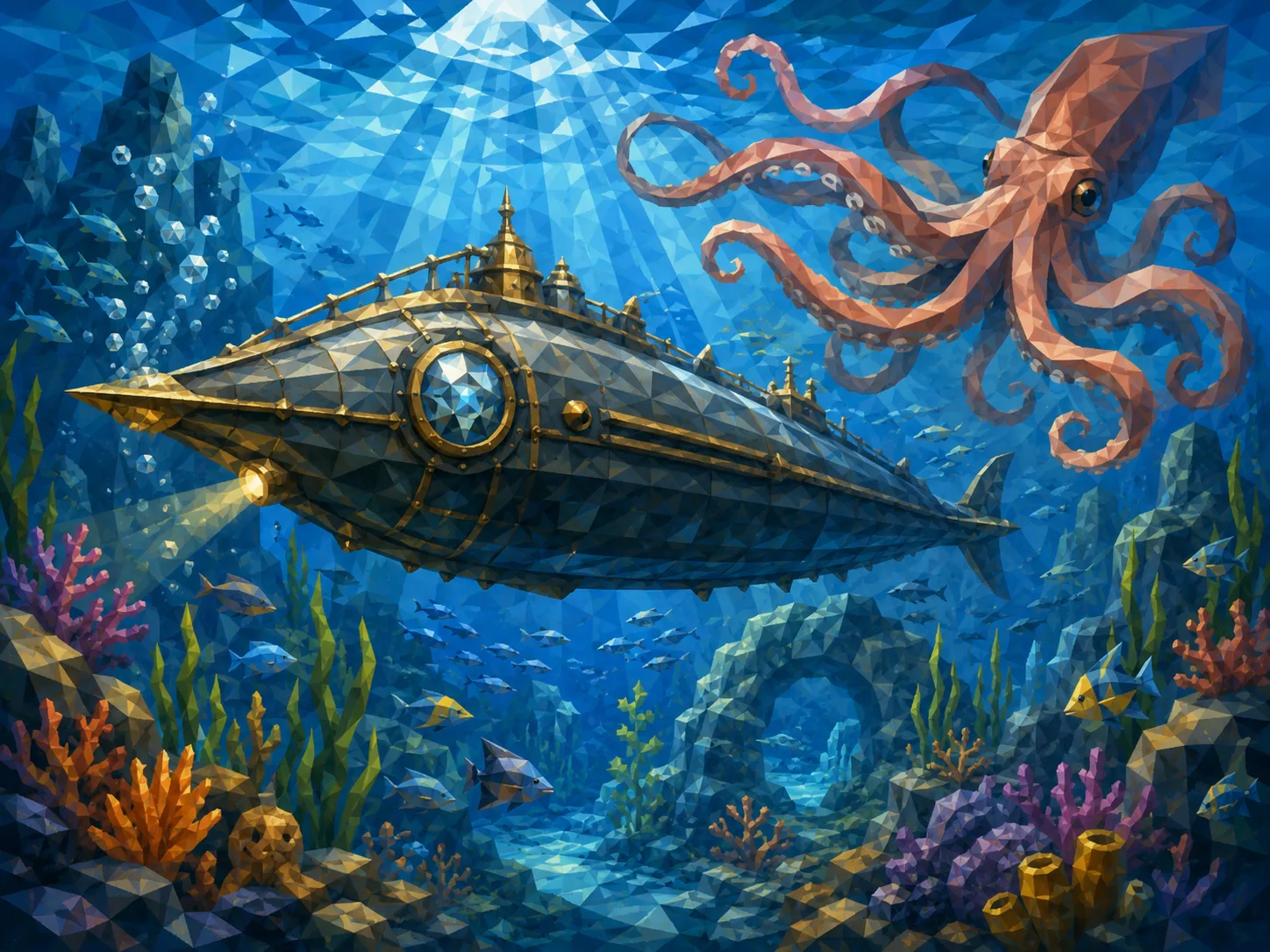
“It is a quarter to twelve,” said Captain Nemo. “We will go up and mark the starting point of our voyage.”
He pressed a button, the pumps drove the water out of the tanks, and we rose to the surface. I climbed the central staircase and came out onto the platform, less than a meter above the waves. Its iron plates lay slightly over one another, like the scales of a great reptile. No wonder, I thought, that everyone had taken this boat for a sea animal.
The sea was beautiful and the sky clear. There was nothing in sight, no island, no ship: only an empty desert of water. Captain Nemo measured the height of the sun with his instrument. Not one of his muscles moved; a hand of marble could not have held it more still.
“Noon,” he said.
I took a last look at the sea near the coast of Japan, and we went down. The captain showed me the maps on which I could follow our course, bowed, and left me alone in the salon. Who was this man? What country did he come from? Why did he hate the world so much? I found no answers.
Then Ned and Conseil appeared at the door and stopped, amazed.
“Where are we?” cried Ned. “In the museum in Quebec?”
“On board the Nautilus, fifty meters below the surface of the sea.”
“But Professor, how many men are there on board? Ten, twenty, a hundred?”
“I don’t know, Ned. And I advise you to forget, for now, any idea of escaping. This ship is a masterpiece, and many people would accept our position just to live among such wonders.”
“Wonders!” cried the harpooner. “We can’t see anything in this iron prison! We’re sailing blind.”
Just as he said this, the room went completely dark. We heard a sliding sound, as if panels were moving in the sides of the ship.
“This is the end!” said Ned.
Suddenly light appeared on both sides of the salon. The iron shutters had slid back, and behind two large, thick windows lay the sea, brilliantly lit by the ship’s electric light. It was no longer water full of light; it was liquid light. We looked out as if through the glass of an enormous aquarium.
“You wanted to see, Ned. Well, now you can.”
“It’s strange!” murmured the Canadian, forgetting his bad temper. “A man would travel a long way for a sight like this!”
“Now I understand this man’s life,” I thought. “He has made a world of his own, and he keeps its greatest wonders for himself.”
For two whole hours an army of fish swam beside us, racing and shining in the light: mackerel with blue bodies and silver heads, long eels with huge mouths full of teeth. Ned named the fish, Conseil classified them, and I was delighted. I had never seen these animals alive and free in their own home.
Then the shutters closed, and the vision was gone. I waited for Captain Nemo, but he did not come. He did not come the next day, or the day after.
“After all,” said Conseil, “as master sees, we are free and very well fed. Our host is keeping his promise. We cannot complain.”
That day I began the journal of our adventures. I wrote it on paper made from sea grass.
On the morning of the 11th of November, fresh air filled the ship, and I climbed up to the platform. The sun was rising. I hoped to see Captain Nemo, but another man came up: his second officer, the short, strong man who had come into our cell with him. He did not seem to notice me. He looked carefully around the horizon through his telescope, then went to the hatch and said these words:
“Nautron respoc lorni virch.”
I never learned what they meant, but I remember them well, because the same man said them every morning in exactly the same way.
Five days passed like this, and Captain Nemo did not appear. Then, on the 16th of November, I found a note on the table in my room:
To Professor Aronnax, on board the Nautilus.
Captain Nemo invites Professor Aronnax to a hunt, which will take place tomorrow morning in the forests of Crespo Island. He hopes that nothing will prevent the Professor from coming, and he will be pleased if his companions come too.
Captain Nemo, Commander of the Nautilus.
“A hunt!” cried Ned. “So he does go on land after all! Once we’re on dry ground, we’ll know what to do. And I wouldn’t mind a piece of fresh meat.”
I found Crespo Island on the map: a small rock in the middle of the North Pacific.
“If Captain Nemo goes on land at all,” I said, “at least he chooses desert islands.”
The next morning Captain Nemo was waiting for me at breakfast. He said nothing about his long absence, so I did not mention it either.
“Professor,” he said, “when I invited you to hunt in my forest under the sea, you thought I was mad. You should never judge a man too quickly. A man can live under the water if he carries enough air with him. My men wear a strong suit and a copper helmet, with a tank of air on their backs that lasts nine or ten hours, and an electric lamp at the belt. And we hunt with air guns that shoot small glass bullets with an electric charge. However lightly an animal is touched, it falls as if struck by lightning.”
“I will argue no longer,” I said. “I will go wherever you go.”
I called Ned and Conseil, and the captain led us to a room near the engine room. A dozen diving suits hung on the wall.
Ned looked at them, and his face changed. “What’s this?”
“My good Ned,” I said, “the forests of Crespo Island are under the sea.”