


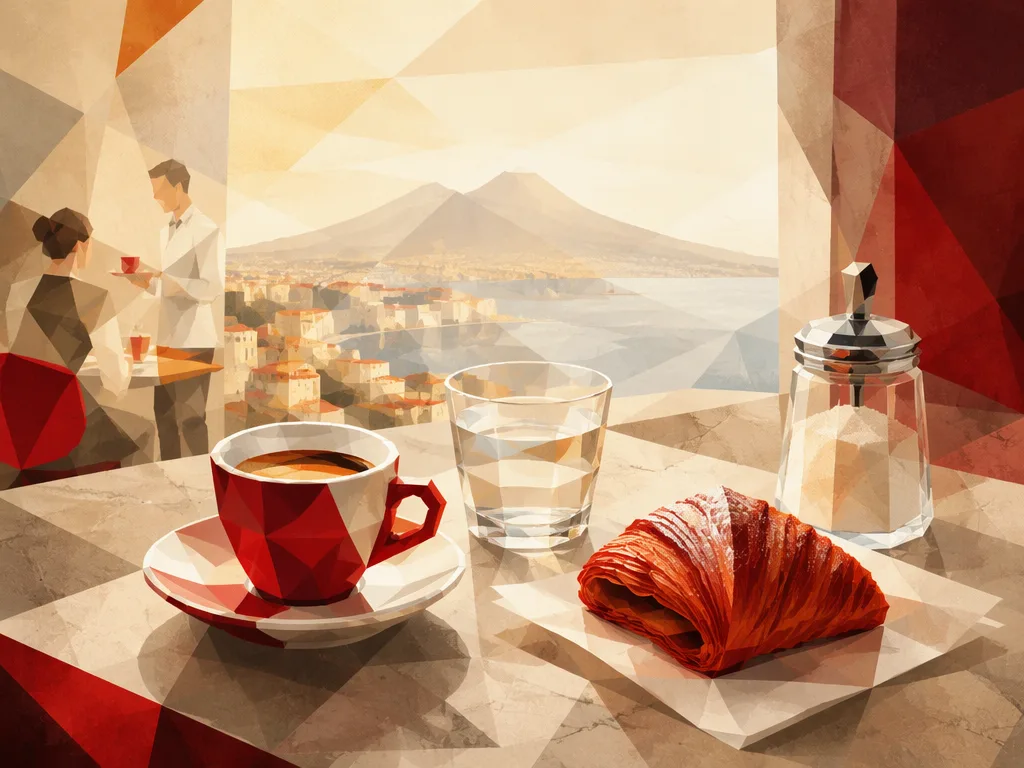
At the Italian Bar: Coffee, Cornetto and the Cassa
Practice ordering at an Italian bar: ask for un caffè, un cappuccino, un cornetto and a glass of water, pay at the cassa first, and ask "Quant'è?". Along the way you'll find out how to say two coffees and two cappuccinos.
Preview
Questions with solutions-
1. Kies het juiste antwoord.
You want to know the price. What do you ask at the cassa?
- Quant'è?
- Che cos'è?
- Dov'è?
- Com'è?
Look for the word quanto (how much) inside the question.
Show solution
- Quant'è?
"Quant'è?" is short for "quanto è?" and means "How much is it?". "Che cos'è?" means "What is it?", "Dov'è?" means "Where is it?" and "Com'è?" means "What is it like?".
-
2. Kies het juiste antwoord.
Read the sentence about Italian bars. What do you do first?
Prima si paga alla cassa, poi si ordina al banco.
- Si paga alla cassa.
- Si ordina al banco.
- Si beve il caffè.
- Si mangia il cornetto.
Prima means "first" and poi means "then".
Show solution
- Si paga alla cassa.
In many Italian bars you pay at the cassa (till) first, then you order at the banco (counter) and show your receipt.
-
3. Zet de woorden in de juiste volgorde.
Ask where the till is.
- dov'è
- Scusi,
- cassa?
- la
Start politely with "Excuse me".
Show solution
Scusi, dov'è la cassa?
"Scusi" is the polite way to say "excuse me" to a stranger, and "dov'è" means "where is".
-
4. Vul het ontbrekende woord in.
Order a cornetto.
Vorrei ___ cornetto, per favore.
- un
- una
- uno
- un'
Cornetto is a masculine word and starts with a normal consonant.
Show solution
Vorrei un cornetto, per favore.
Most masculine words use "un": un cornetto, un caffè, un cappuccino. "Uno" is for masculine words starting with z or s + consonant (uno scontrino), "una" is for feminine words and "un'" for feminine words starting with a vowel.
-
5. Vul de ontbrekende woorden in.
Order politely at the counter.
Buongiorno, ___ un cappuccino e un cornetto, ___ favore.
- vorrei
- per
- volere
- di
- con
- a
You need "I would like" and the word that goes with favore to make "please".
Show solution
Buongiorno, vorrei un cappuccino e un cornetto, per favore.
"Vorrei" means "I would like", the polite way to order. "Per favore" means "please". "Volere" is the infinitive (to want), so it doesn't fit after "Buongiorno" here.
-
6. Kies het juiste antwoord.
The barista asks you: "Cosa prende?" What is a good answer?
- Un caffè, grazie.
- Sono le dieci.
- Mi chiamo Luca.
- Sto bene, grazie.
Prendere means "to take" or "to have" when you talk about food and drinks.
Show solution
- Un caffè, grazie.
"Cosa prende?" means "What will you have?". You simply answer with what you want: "Un caffè, grazie."
-
7. Vul het ontbrekende woord in.
You want a glass of water.
Vorrei un ___ d'acqua.
- bicchiere
- piatto
- cucchiaio
- scontrino
You drink water from it.
Show solution
Vorrei un bicchiere d'acqua.
"Un bicchiere d'acqua" is a glass of water. "Piatto" is a plate, "cucchiaio" a spoon and "scontrino" a receipt.
-
8. Kies het juiste antwoord.
The barista asks about your water: "Naturale o frizzante?" You want sparkling water.
- Frizzante, grazie.
- Naturale, grazie.
- Calda, grazie.
- Grande, grazie.
Think of the bubbles: fizzy sounds a bit like this word.
Show solution
- Frizzante, grazie.
"Acqua frizzante" is sparkling water and "acqua naturale" is still water. "Calda" means hot and "grande" means big.
-
9. Zet de woorden in de juiste volgorde.
Ask for a glass of water.
- un bicchiere
- avere
- d'acqua?
- Posso
Start with "Can I...".
Show solution
Posso avere un bicchiere d'acqua?
"Posso avere...?" means "Can I have...?" and is a friendly, polite way to ask for something.
-
10. Vul het ontbrekende woord in.
You pay at the cassa and hand the receipt to the barista.
Ecco lo ___.
- scontrino
- banco
- conto
- cornetto
It's the little paper you get at the till.
Show solution
Ecco lo scontrino.
"Lo scontrino" is the receipt. It takes "lo" because it starts with s + consonant. "Ecco" means "here is".
-
11. Vul het ontbrekende woord in.
You are ordering for yourself and a friend: two coffees.
Due ___ e due cornetti, per favore.
- caffè
- caffi
- caffèe
- caffès
Look at the accent on the last letter of caffè.
Show solution
Due caffè e due cornetti, per favore.
Words that end with a stressed vowel, like caffè, don't change in the plural: un caffè, due caffè. Cornetto changes normally: due cornetti.
-
12. Vul het ontbrekende woord in.
Now order two cappuccinos.
Per noi due ___, per favore.
- cappuccini
- cappuccino
- cappuccine
- cappuccinos
Masculine words ending in -o usually change the -o to -i in the plural.
Show solution
Per noi due cappuccini, per favore.
Un cappuccino, due cappuccini. Italian plurals don't use -s, so "cappuccinos" is only English.
-
13. Luister en typ het antwoord.
Remember the accent on caffè.
Show solution
- Vorrei un caffè e un cornetto.
"Vorrei un caffè e un cornetto" means "I would like a coffee and a cornetto."