


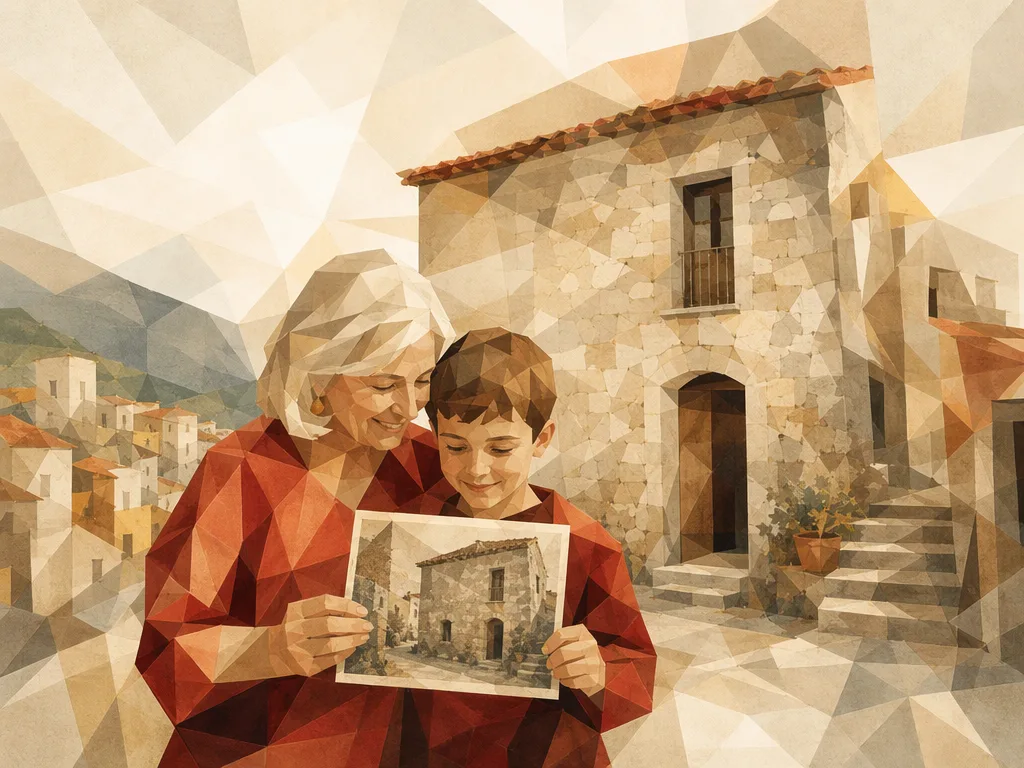
Tracing Your Italian Family Roots
Practice the Italian you need to ask relatives and the comune about your ancestors: family words like bisnonno and prozio, emigration verbs with essere, polite requests for an atto di nascita, and questions about your paese d'origine.
Preview
Questions with solutions-
1. Vul het ontbrekende woord in.
Describe a family relationship.
Il padre di mia nonna era il mio ___.
- bisnonno
- prozio
- nipote
- suocero
The prefix bis- means "twice": one generation above your grandparents.
Show solution
Il padre di mia nonna era il mio bisnonno.
Your grandparent's father is your "bisnonno" (great-grandfather); his wife is your "bisnonna". A "prozio" is a great-uncle, a "nipote" is a grandchild, niece or nephew, and a "suocero" is a father-in-law.
-
2. Kies het juiste antwoord.
Which document records when and where a person was born?
- l'atto di nascita
- l'atto di matrimonio
- l'atto di morte
- il certificato di residenza
"Nascere" means to be born.
Show solution
- l'atto di nascita
"Nascita" means birth, so "l'atto di nascita" is the birth record. The "atto di matrimonio" records a marriage, the "atto di morte" a death, and the "certificato di residenza" shows where someone lives.
-
3. Vul het ontbrekende woord in.
Tell a relative when your great-grandparents left Italy.
I miei bisnonni ___ emigrati in Argentina nel 1910.
- sono
- hanno
- avevano
- ha
Verbs of movement from one place to another usually take essere in the passato prossimo.
Show solution
I miei bisnonni sono emigrati in Argentina nel 1910.
"Emigrare" takes "essere", so it is "sono emigrati". With essere the participle agrees with the subject: "emigrati" is masculine plural to match "i miei bisnonni".
-
4. Kies het juiste antwoord.
Which question asks a relative where the family originally came from?
- Qual è il paese d'origine della nostra famiglia?
- Dove abita adesso la nostra famiglia?
- Quanti paesi ha visitato la nostra famiglia?
- Quando si è trasferita la nostra famiglia?
"Origine" points to where something began.
Show solution
- Qual è il paese d'origine della nostra famiglia?
"Il paese d'origine" is the place a family comes from. Here "paese" often means a small town or village, not only a country, which is why Italians talk about "il mio paese" when they mean their home town.
-
5. Vul de ontbrekende woorden in.
Complete your email to the comune's registry office.
Buongiorno, vorrei ___ una copia dell'atto di ___ del mio bisnonno, ___ in questo comune nel 1885.
- richiedere
- nascita
- nato
- richiesto
- nata
- nati
After "vorrei" you need an infinitive; the last gap must agree with "bisnonno".
Show solution
Buongiorno, vorrei richiedere una copia dell'atto di nascita del mio bisnonno, nato in questo comune nel 1885.
"Vorrei richiedere" means "I would like to request"; "vorrei" is followed by an infinitive. "L'atto di nascita" is the birth record, and "nato" is masculine singular to agree with "bisnonno".
-
6. Zet de woorden in de juiste volgorde.
Tell someone what you are doing.
- antenati.
- informazioni
- sui
- miei
- cercando
- Sto
Start with "stare + gerundio" for something you are doing right now.
Show solution
Sto cercando informazioni sui miei antenati.
"Sto cercando" means "I am looking for". "Gli antenati" are your ancestors, and "sui" = "su + i" ("about the").
-
7. Typ het antwoord.
Type the Italian word for great-uncle.
Il fratello di mio nonno è il mio ___.
It starts with pro-, like the word for great-grandchild, "pronipote".
Show solution
- prozio
- zio nonno
Your grandfather's brother is your "prozio"; his wife is your "prozia". In some regions people also say "zio nonno".
-
8. Luister en typ het antwoord.
Listen for the past tense of "nascere" and the feminine ending.
Show solution
- Mia bisnonna è nata in un piccolo paese vicino a Napoli.
"È nata" uses "essere", and the participle ends in -a because "bisnonna" is feminine. Notice "mia bisnonna" without an article, as in "mia madre": singular family words usually drop it after a possessive. With longer family words like "bisnonno" and "prozio", you also hear it: "il mio bisnonno".
-
9. Kies het juiste antwoord.
You phone the comune's registry office. Which question sounds properly polite to a clerk you don't know?
- Potrebbe dirmi come richiedere un atto di nascita?
- Puoi dirmi come richiedere un atto di nascita?
- Mi dici come richiedere un atto di nascita?
- Dimmi come richiedere un atto di nascita.
With officials, Italians use the formal "Lei" form.
Show solution
- Potrebbe dirmi come richiedere un atto di nascita?
"Potrebbe" is the conditional of "potere" in the formal "Lei" form, which is both polite and respectful. "Puoi", "mi dici" and "dimmi" use "tu", which suits relatives and friends, not a public office.
-
10. Vul het ontbrekende woord in.
A cousin shares a childhood memory.
Quando ero piccola, la nonna mi ___ sempre storie sul suo paese.
- raccontava
- racconterà
- racconti
- raccontasse
"Quando ero piccola" and "sempre" describe a habit in the past.
Show solution
Quando ero piccola, la nonna mi raccontava sempre storie sul suo paese.
The imperfetto "raccontava" describes something that happened regularly in the past: "she always used to tell me stories". This tense is very useful when relatives talk about the old days.
-
11. Kies het juiste antwoord.
Read the reply from the comune. What do they need from you?
Buongiorno, per richiedere l'atto di nascita del Suo bisnonno deve indicare nome, cognome e data di nascita. Il documento sarà inviato per posta elettronica entro trenta giorni.
- Nome, cognome e data di nascita del bisnonno
- Una fotografia del bisnonno
- Il passaporto del bisnonno
- Una visita di persona all'ufficio
Look at what comes after "deve indicare".
Show solution
- Nome, cognome e data di nascita del bisnonno
"Deve indicare nome, cognome e data di nascita" means you must give his first name, surname and date of birth. Note the capital S in "Suo": formal letters often capitalize the polite form. "Entro trenta giorni" means "within thirty days".
-
12. Vul het ontbrekende woord in.
Ask a relative about your great-grandmother's maiden name.
Qual era il cognome da ___ della bisnonna?
- nubile
- celibe
- vedova
- sposata
Which word describes an unmarried woman?
Show solution
Qual era il cognome da nubile della bisnonna?
"Nubile" means unmarried (for a woman), so "il cognome da nubile" is the maiden name. "Celibe" is the word for an unmarried man, and "vedova" means widow. Italian records usually list women under their maiden name, which is very helpful in family research.
-
13. Vul de ontbrekende woorden in.
Tell the story of your great-grandfather's journey.
Nel 1920 il mio bisnonno è ___ dall'Italia ed è ___ a New York in nave.
- partito
- arrivato
- partita
- arrivata
- partiti
- arrivati
Both verbs use "essere", so both participles must agree with "il mio bisnonno".
Show solution
Nel 1920 il mio bisnonno è partito dall'Italia ed è arrivato a New York in nave.
"Partire" (to leave) and "arrivare" (to arrive) take "essere", so their participles agree with the subject: masculine singular "partito" and "arrivato". Note "partire da" (leave from) and "arrivare a" (arrive in a city).
-
14. Typ het antwoord.
Type one word for a person who leaves their own country to live abroad.
Una persona che lascia il proprio paese per vivere all'estero è un ___.
It comes from the verb "emigrare".
Show solution
- emigrante
- emigrato
- espatriato
"Un emigrante" or "un emigrato" is someone who has left their country. From the point of view of the new country, the same person is "un immigrato".
-
15. Zet de woorden in de juiste volgorde.
Ask an older relative if they remember your great-grandfather's name.
- si chiamava
- Ti ricordi
- come
- il bisnonno?
Start with "Do you remember…", using the informal "tu" you would use with family.
Show solution
Ti ricordi come si chiamava il bisnonno?
"Ti ricordi…?" means "Do you remember…?" and "come si chiamava" means "what his name was". The imperfetto "si chiamava" is used because it describes a past state.
-
16. Vul het ontbrekende woord in.
A relative suggests where to look for very old birth records.
Per le nascite più antiche, prova a cercare nei registri della ___.
- parrocchia
- farmacia
- questura
- stazione
Before town halls kept records, baptisms were written down by the local church.
Show solution
Per le nascite più antiche, prova a cercare nei registri della parrocchia.
"La parrocchia" is the parish. Parish registers of baptisms, marriages and burials often go back further than the comune's civil records. "Prova a cercare" means "try looking".
-
17. Kies het juiste antwoord.
Your cousin writes: "I miei parenti vivono ancora in Sicilia." Who are "i parenti"?
- tutti i familiari, come zii, cugini e nonni
- solo la madre e il padre
- gli amici più stretti
- i vicini di casa
Careful: this word looks like an English word but doesn't mean the same thing.
Show solution
- tutti i familiari, come zii, cugini e nonni
"I parenti" are relatives in general. Mother and father together are "i genitori". This false friend matters a lot when you ask about family.