


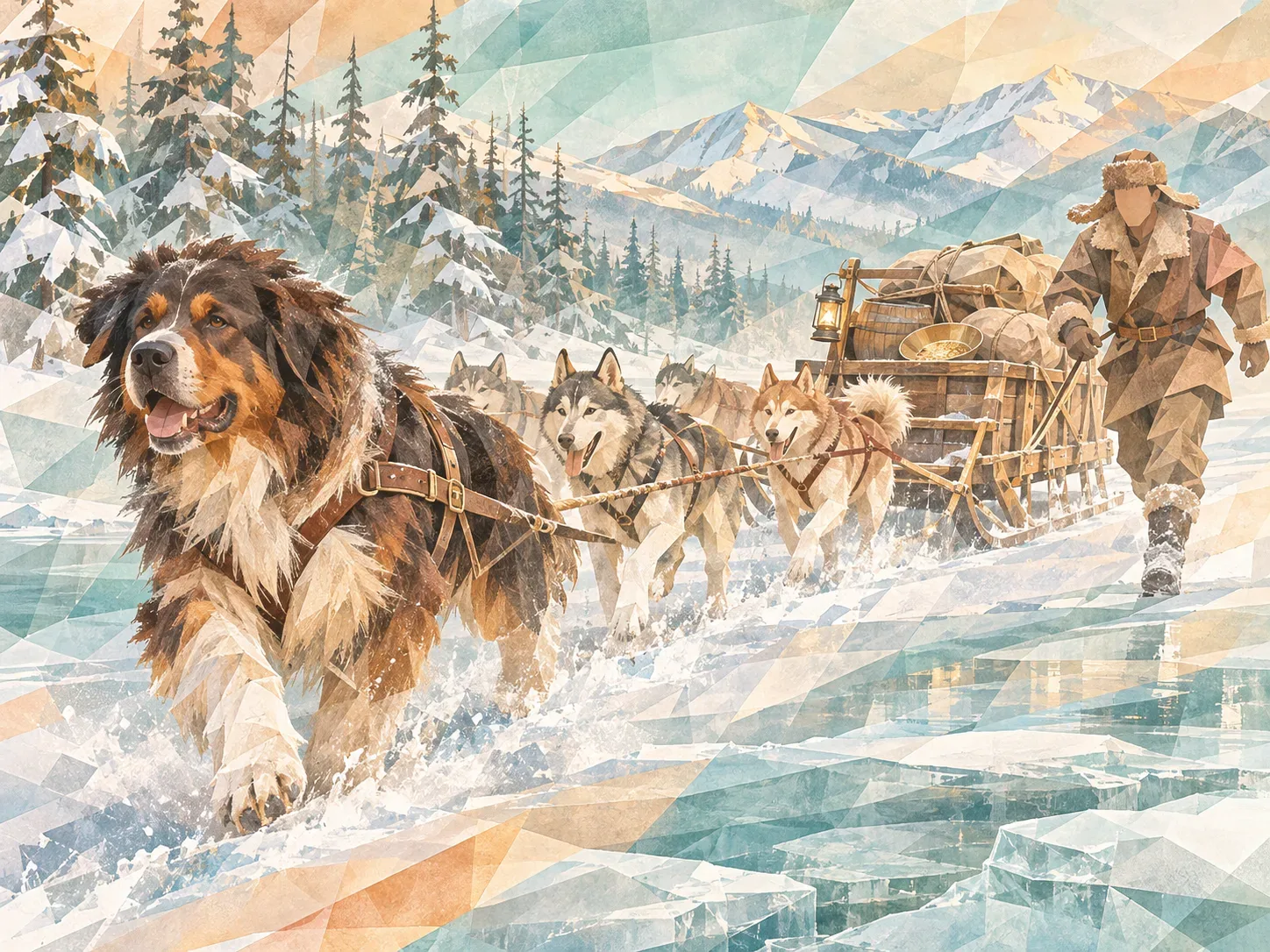
With the sixteen hundred dollars Buck had won, John Thornton paid off his debts. Soon after, he and his partners, Pete and Hans, set off into the wild country to the east. They were looking for the Lost Cabin, an old gold mine. Many men had hunted for it, and few had ever found it; many more had never come back. Dying men had told of it and shown strange pieces of gold to prove their words, yet no living man had ever brought out its treasure.
Thornton, Pete, and Hans took Buck and six other dogs to try where others had failed. They drove their sled seventy miles up the Yukon, turned left onto the Stewart River, and kept going until the river became a small stream high among the mountains.
John Thornton asked little of nature and feared nothing in the wild. With just a handful of salt and his rifle, he could travel anywhere and stay as long as he pleased. He was never in a hurry. He hunted for dinner during the day's march, and if he found nothing, he simply kept walking until he found meat. Their sled carried mainly tools and bullets, and they had no fixed time to return.
To Buck, this wandering life of hunting and fishing was pure joy. For weeks they pushed steadily on, and for weeks they camped while the dogs rested and the men burned holes in frozen ground and washed pans of gravel by the fire. Sometimes they went hungry, and sometimes they ate huge meals, depending on the hunt. When summer came, men and dogs carried packs on their backs, crossed blue mountain lakes on rafts, and built thin boats from forest trees to travel unknown rivers.
Months passed as they twisted through empty country where no people lived. They crossed high mountain ridges in summer snowstorms, shivered under the midnight sun on bare mountains above the trees, walked through valleys thick with flies, and picked ripe strawberries beside great walls of ice. In the fall they reached a cold, lonely lake country where the birds had gone and thin ice was forming along silent shores.
Through another winter they followed the faded trails of men long dead. Once they found an old path cut through the forest, and the Lost Cabin seemed very near. Yet the path began nowhere and ended nowhere, and stayed a mystery. Another time they found the broken ruins of an old hunting hut. Inside, among rotted blankets, Thornton picked up an old gun with a long barrel from the earliest days of the North. Nothing else remained to show who had left it there.
Spring came again, and at last their wandering ended. They did not find the Lost Cabin, but in a wide valley they found shallow gold in the gravel. Gold showed like yellow butter across the bottom of the washing pan. They stopped searching and went to work. Every day earned them thousands of dollars in clean gold dust and pieces of gold. They packed it into bags made of moose skin, fifty pounds to a bag, and stacked the bags like firewood outside their hut of green branches.
Now the dogs had nothing to do except haul in meat when Thornton killed an animal. Buck spent long hours resting by the fire, and the vision of the hairy man came to him more often than before.
Fear filled that other world. When the hairy man slept by the fire, with his head between his knees and his arms over his head, he woke again and again in sudden fright. Then he looked into the dark and threw more wood on the fire. When they walked by the sea to gather shellfish, his eyes watched everywhere for hidden danger, and his legs were ready to run like the wind. Through the forest they crept without a sound, Buck at his heels, both with twitching ears and noses. The hairy man could leap into the trees and swing fast from branch to branch, never slipping or falling. Buck remembered nights spent watching beneath a tree while the hairy man slept high above, holding tightly to a branch.
Close to those visions was the call still sounding deep in the forest. It filled Buck with strange restlessness and a sweet, wild gladness. Often he dozed in camp, then suddenly lifted his head, pricked up his ears, and ran for hours through the woods and across grassy open spaces. He pushed his nose into cool green moss and black earth, snorting with joy at the rich smells, or kept low behind fallen logs to watch and listen. Most of all, he loved to run in the dim light of summer midnights, reading every sign in the quiet forest and searching for whatever called him—awake or asleep—to come.
One night Buck jumped up from sleep, eager and alert, his nose quivering and his neck hair rising. Out of the forest came one clear note of the call—a long, deep howl. It was like a husky's howl, yet different, and he knew it at once from long ago.
He slipped past the sleeping camp and ran swiftly through the dark trees. Drawing closer to the cry, he slowed down and crept carefully forward until he reached an open space in the woods. Looking out, he saw a long, thin timber wolf sitting with its nose pointed to the sky.
Buck had made no noise, yet the wolf stopped howling and tried to sense where he was. Buck stepped into the open, holding his body low, tail straight and stiff, placing each foot with care. His look showed both warning and an offer of friendship.
At the sight of him, the wolf fled. Buck leaped after him, eager to catch up, and chased him into a dead-end stream bed blocked by fallen logs. The wolf spun around on his back legs, just as Joe and other cornered huskies did, snarling and snapping his teeth fast.
Buck did not attack, but walked slowly around him in friendly circles. The wolf was afraid and did not trust him, for Buck was three times his weight, and the wolf's head barely reached Buck's shoulder. Watching his chance, the wolf dashed away, and the chase began again. Time after time Buck cornered him, and time after time the wolf snapped and ran off. He was thin and weak, or Buck could not have caught him so easily.
At last the wolf saw that Buck meant no harm, and they touched noses. They became friends and jumped around each other in a nervous, playful way. After a while, the wolf set off at an easy trot, clearly going somewhere, and made it clear that Buck should follow.
Side by side they ran through the dim light, straight up the stream bed, through a narrow rocky valley, and across the bare mountain ridge at its top. On the other side they ran down into a flat land of deep forests and many streams. Hour after hour they ran steadily while the sun climbed higher and the day grew warm. Buck was wildly happy. He was answering the call at last, running beside his wild brother toward the place where it came from. Old memories rushed over him. He had done this before in that other world, and now he was doing it again—running free over soft earth under the wide sky.
They stopped at a stream to drink, and as he stopped, Buck remembered John Thornton. He sat down. The wolf started forward again, then came back and sniffed Buck's nose to urge him on. But Buck turned around and began walking slowly back along their trail. For nearly an hour the wild brother trotted beside him, whining softly. Then the wolf sat down, pointed his nose upward, and howled. It was a sad, lonely howl, and as Buck kept steadily on his way, he heard it grow fainter and fainter until it vanished in the distance.
John Thornton was eating dinner when Buck burst into camp and threw himself upon his master in a storm of joy. He knocked Thornton over, scrambled on top of him, licked his face, and chewed gently at his hand, while Thornton shook him back and forth and cursed him lovingly.
For two days and nights Buck never left camp and never let Thornton out of his sight. He followed him at work, watched him eat, and saw him into his blankets at night and out of them in the morning. Yet after two days, the call in the forest grew stronger than ever. Restlessness returned to Buck, bringing memories of his wild brother and the green land beyond the ridge. Once again he wandered in the woods, listening. Still, the wild brother did not come back, and the sad howl was never heard again.