


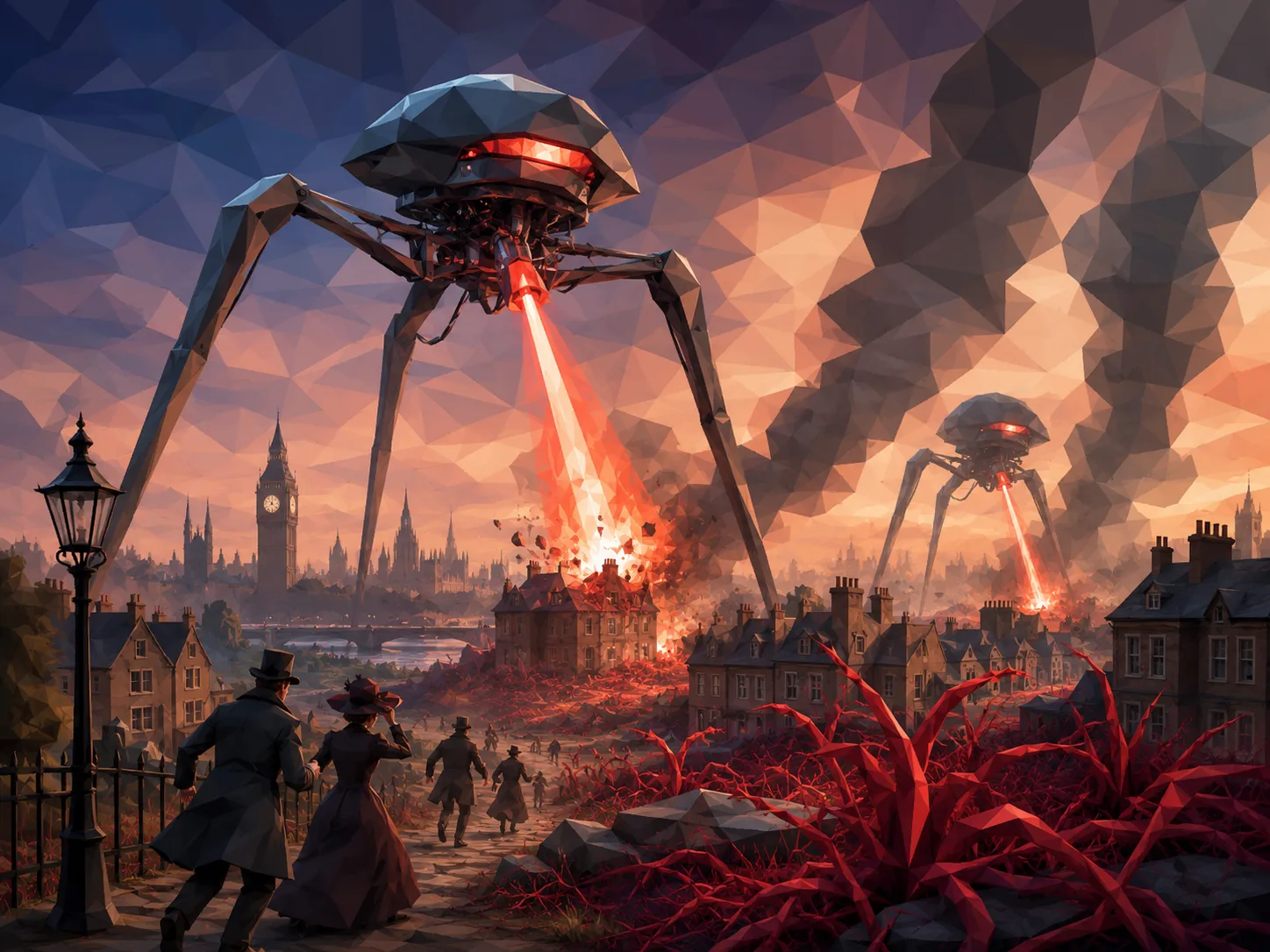
I spent that night in an empty inn on Putney Hill.
For a long time, I could not sleep. Whenever I closed my eyes, I saw the curate lying on the kitchen floor.
When I had raised the meat chopper, I had not known what would follow. But I had struck him. I have written down what happened as I remember it.
At last, I pushed that picture from my mind and thought of my wife.
Was she still alive? Was she waiting for me at Leatherhead? Had she escaped, or had the Martians caught her?
The darkness seemed full of terrible answers.
I sat up in bed. I even found myself praying that the Heat-Ray had killed her quickly, without pain.
Since I had left her, I had cried out to God many times in fear. But that night, I truly prayed.
Then morning came, and I crept out of the inn like a rat leaving its hole.
On Wimbledon Common, I saw a man.
His clothes were as dirty as mine. There was green mud on them, mixed with dry clay and black marks. His hair hung over his eyes, and a red cut crossed the lower part of his face. A sword hung at his side.
I went towards him.
“Stop! Where do you come from?”
His voice was rough. I stopped about ten yards away.
“From Mortlake,” I said. “I was buried in a house beside the Martians’ pit. I have escaped.”
“There isn’t much food here,” he said. “This is my country. There is only food for one. Where are you going?”
“I don’t know. I’ve been under the ruins for nearly two weeks. I don’t know what has happened.”
He watched me without speaking.
“I don’t want to stay here,” I added. “I think I shall go to Leatherhead. My wife was there.”
He suddenly pointed at me.
“It is you, the man from Woking! You weren’t killed at Weybridge!”
Then I recognised him.
“You are the artilleryman who came into my garden.”
“We are lucky ones! Fancy you!”
He held out his hand, and I took it.
“I crawled up a drain,” he said. “After they went away, I got across the fields towards Walton. But look at you—your hair is grey.”
A shadow passed over us. He turned sharply and looked up.
“Only a bird,” he said. “You learn to watch every shadow now. Come under these bushes. We’re too easy to see here.”
We crawled into their shelter.
“Have you seen any Martians?” I asked.
“They’ve gone across London. I think they’ve got a great camp there. At night, the sky is full of their lights. You can see them moving.”
He paused and looked at me.
“And the night before last, I saw lights up in the air. I believe they’ve built a flying machine. They’re learning to fly.”
“Fly!”
“Yes. Fly.”
For a moment, neither of us spoke.
“It’s all over,” he said at last. “We killed one at Weybridge. One! And look what they’ve done to us. They’ve walked over us. We’re beat.”
“Can nothing be done?”
“This isn’t a war. It never was a war, any more than there’s war between men and ants.”
His words brought back my feelings among the ruins.
“Ants build their homes,” he continued. “They live their lives. Then a man wants the ground, and he clears them away. That’s what we are now. Ants. Only there’s one difference.”
He looked straight at me.
“We’re eatable ants.”
I said nothing.
“After Weybridge, I saw everyone running south,” he said. “They were shouting and pushing, but I kept thinking. Food wouldn’t last with all those people together. So I turned back.”
“And what will you do now?”
“Live. I mean to go on living. But I won’t let them catch me and keep me like a farm animal. I won’t sit in a cage and grow fat for them.”
He leaned closer.
“Some people will be glad of cages. Think of those men who ran for their trains every morning. Afraid of being late, afraid of losing their jobs. Work all day, hurry home at night. Give them food and safety, and they won’t care who their masters are.”
“But surely—”
“They’ll get used to it. Some may even become pets. Perhaps the Martians will teach them tricks. Perhaps they’ll train some to hunt the rest of us.”
“And you?”
“I’m going to live under their feet. We don’t know enough to fight them yet. We’ve got to learn. But we’ve got to stay free while we learn.”
For the first time in many days, I felt hope.
“But you are a man indeed!” I cried, and seized his hand.
“I’ve thought it all out,” he said. “We’ll live underground. London’s full of drains. There’s room down there for plenty of people.”
He spoke faster now.
“We’ll gather strong men and women. People who can work and keep quiet. We can’t have any weak or silly ones.”
“What if someone cannot manage it?”
“Weak people go out again.”
He said it without a pause.
“We’ll take food down, and tools. Then books. Not stories—books of science. We must save what people have learned. We’ll watch the Martians and find out how their machines work.”
His eyes grew bright.
“Just imagine four or five fighting machines moving across London. Heat-Rays everywhere. And not a Martian inside them! Men who’ve learned how to use them! Fancy their surprise when we turn their own weapons against them!”
As he talked, I almost saw it. After the fear and darkness of the ruined house, his plan seemed like a road back to life.
He took me to a house where he had found food and shelter. In the cellar, he had begun a tunnel. He meant to dig through to one of the great drains under the hill.
We took spades and began to work.
At first, I dug eagerly. Then I looked more carefully at the tunnel.
He said he had been there for a week. Yet he had moved very little earth.
“We’re working well,” he said, putting down his spade. “Let’s stop a bit. We ought to look from the roof.”
I wanted to continue, so after a moment he began digging again.
Then a question came to me.
“Why were you walking about the common instead of working here?”
“Taking the air. I was coming back. It’s safer by night.”
“But the work?”
“Oh, one can’t always work,” he said.
In a flash, I saw the man as he was.
He stood holding his spade, then pointed upwards.
“We really ought to look from the roof. If a Martian comes near, it may hear us digging.”
We went upstairs.
From the roof, we could see no fighting machines nearby. He began to tell me stories of the last few days.
“One night last week, some fools got the electric lights working in Regent Street,” he said. “People filled the street, drinking and dancing till morning. A man who was there told me.”
“What happened?”
“When daylight came, they saw a fighting machine standing there, looking down at them. Who knows how long it had been watching? It came along the road and picked up nearly a hundred. Too drunk or too frightened to run.”
I looked out over the silent houses.
Below us, there was plenty of food. The artilleryman also had champagne and cigars, and he wanted us to enjoy them.
He called the rest of the day a holiday.
After we had eaten and drunk, he brought out cards. He taught me a game. We divided London between us and played for its different parts.
It sounds foolish now, but I became deeply interested. For hours, we ate, drank and played cards while the unfinished tunnel waited below.
At night, I went onto the roof alone.
Mars shone above me. Far away, great masses of red weed glowed in the dark.
I thought of the strange changes in that single day. In the darkness before dawn, I had prayed for my wife. Now I had spent hours drinking and playing for parts of a dead city.
I felt that I had betrayed her. I had almost forgotten why I needed to go on.
The artilleryman’s plans were only dreams. He loved talking about work, but he did not want to do it. I could not stay there and share his food while the days passed.
I threw away my cigar.
In London, I might learn what the Martians were doing. I might find other people. I had to try.
I left the artilleryman and went on alone.