


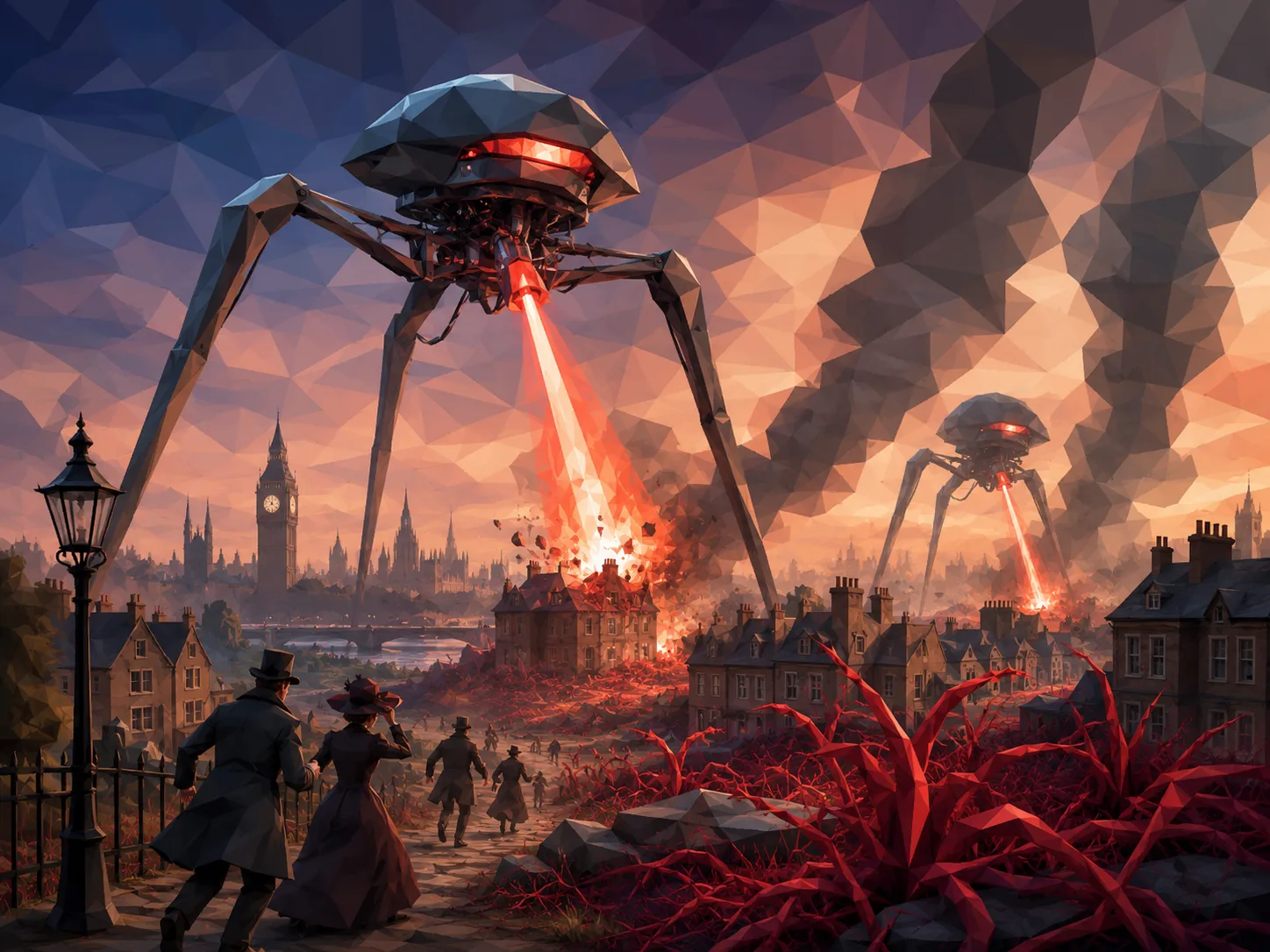
Black dust covered the streets again as I walked into London. Along the Fulham Road, I passed about a dozen bodies. They had lain there for many days. The dust covered their clothes and faces, and dogs had pulled at some of them. I hurried past.
The shops were closed. Here and there, people had broken windows and taken things, but much was still untouched. Money lay in the street. Once, people had worked all day for a few coins. Now there was no one to pick them up.
The farther I went, the quieter London became. But it did not seem like the quiet of a place where everything was over. It seemed to be waiting. At any moment, a fighting machine might appear above the roofs. These streets, too, might become lines of burning houses.
In South Kensington, there were no bodies or black dust. Sunlight lay across the empty roads.
It was there that I first heard the cry.
“Ulla, ulla, ulla, ulla.”
At first it was so faint that I hardly noticed it. Then I stopped and listened. The sound rose and fell, again and again. It seemed to come from somewhere far to the north.
I passed a street that led in that direction, and the cry grew louder. Beyond the next row of houses, it became faint again.
“Ulla, ulla, ulla, ulla.”
It was like a great voice crying over the empty city.
For a moment, I thought of climbing one of the towers of the Natural History Museum. From there, I might see where the sound came from. But on the ground I could hide quickly. I stayed in the street and went towards Hyde Park.
My footsteps sounded strangely loud between the empty houses.
Near the park gate, a bus lay on its side. Beside it were the bones of a horse. I stopped to look, then went into the park, towards the bridge over the lake.
The cry grew louder, but I could see no fighting machine above the buildings. Only a little smoke rose in the distance.
I crossed the park and continued north. The sun was going down. Long shadows filled the streets, and the red weed climbed over walls and broken windows.
At last, near Regent’s Park, I saw it.
Above the trees stood a fighting machine. Its three long legs were still. Its hood rose high against the evening sky.
“Ulla, ulla, ulla, ulla.”
The sound came from that motionless shape. Nothing answered it. I watched, waiting for the hood to turn or a tentacle to move. But the machine stood exactly where it was.
Farther on, I saw a handling machine lying smashed among broken buildings. Then I saw another fighting machine. That one, too, stood still, but it made no sound.
I went on through the gathering darkness. The great cry followed me between the houses.
Then, as I crossed a bridge, it stopped.
The silence came like a thunderclap.
I stood still. Dark houses rose on either side of me. The trees were almost black now, and the red weed covered the ruins. A moment before, that terrible voice had made London seem alive. Now there was nothing.
What had happened? Why had it stopped?
I could not bear that silence. I began to run. At last, I found a small, empty hut and hid inside it. There I stayed through the night, afraid to go out again.
At dawn, I left my hiding place. The streets were grey and quiet. Ahead of me, on Primrose Hill, stood a third fighting machine.
I walked straight towards it because I no longer cared whether I lived or died.
As the light grew stronger, I noticed black shapes moving round its hood.
Birds.
They circled above it and settled on the metal. More birds were already there, pulling at something that hung from the hood.
My heart began to beat faster.
I ran.
The red weed filled the road. Water rushed down from higher ground, and in one place it came up to my chest as I pushed through it. Then I reached the grass below the hill.
Great heaps of earth stood round the top. Behind them, a thin line of smoke rose into the morning sky. A dog ran along the top of one heap and disappeared.
A wild hope was growing in my mind. I was no longer afraid. Shaking, I ran up towards the fighting machine.
Something brown hung from its hood. The birds were pulling it apart.
I climbed the bank of earth and looked down.
Below me was the greatest pit the Martians had made. Huge machines stood among piles of metal and strange shelters. Some fighting machines had fallen on their sides. The arms of the handling machines were still.
And everywhere there were Martians.
Some lay inside their machines. Others lay on the ground. About a dozen had been placed in a row. There were perhaps fifty of them in all.
They were dead!
Killed by the germs of disease, against which their bodies had no defence; killed, after all man’s weapons had failed, by the humblest things that God, in his wisdom, has put upon this earth.
I did not understand it all at that moment. Later, the reason became clear.
Germs had lived on the earth for longer than people had. They had killed many of us, but over time our bodies had become able to fight them. There were no germs on Mars. The Martians had no defence against them.
From the moment they arrived, from the moment they began to drink and feed, the germs were working against them. Even while I watched them from the ruined house, they were already dying.
Our guns had failed. The smallest living things on earth had won.
The sun rose as I stood above the pit. Its light touched the tops of the great machines, but the ground below was still dark. I could hear dogs fighting over the bodies.
On the far side lay something broad and flat. It was the flying machine the Martians had been building. They had almost learned to fly through our air.
Death had stopped them just in time.
I turned and looked across London. Roofs and towers came into the morning light. There were blackened walls and long lines of ruined houses, but the city was still there.
The people who had run away could return. Ships would bring back those who had crossed the sea. Fires would burn in kitchens again. Workers would repair the broken houses, and voices would fill the streets.
The terrible days were over.
I began to cry. I lifted my hands towards the sky and thanked God.
“In a year,” I thought, “in a year...”
Then the thought of my wife came back with terrible force.
The city could live again. But what was left of my own life?