


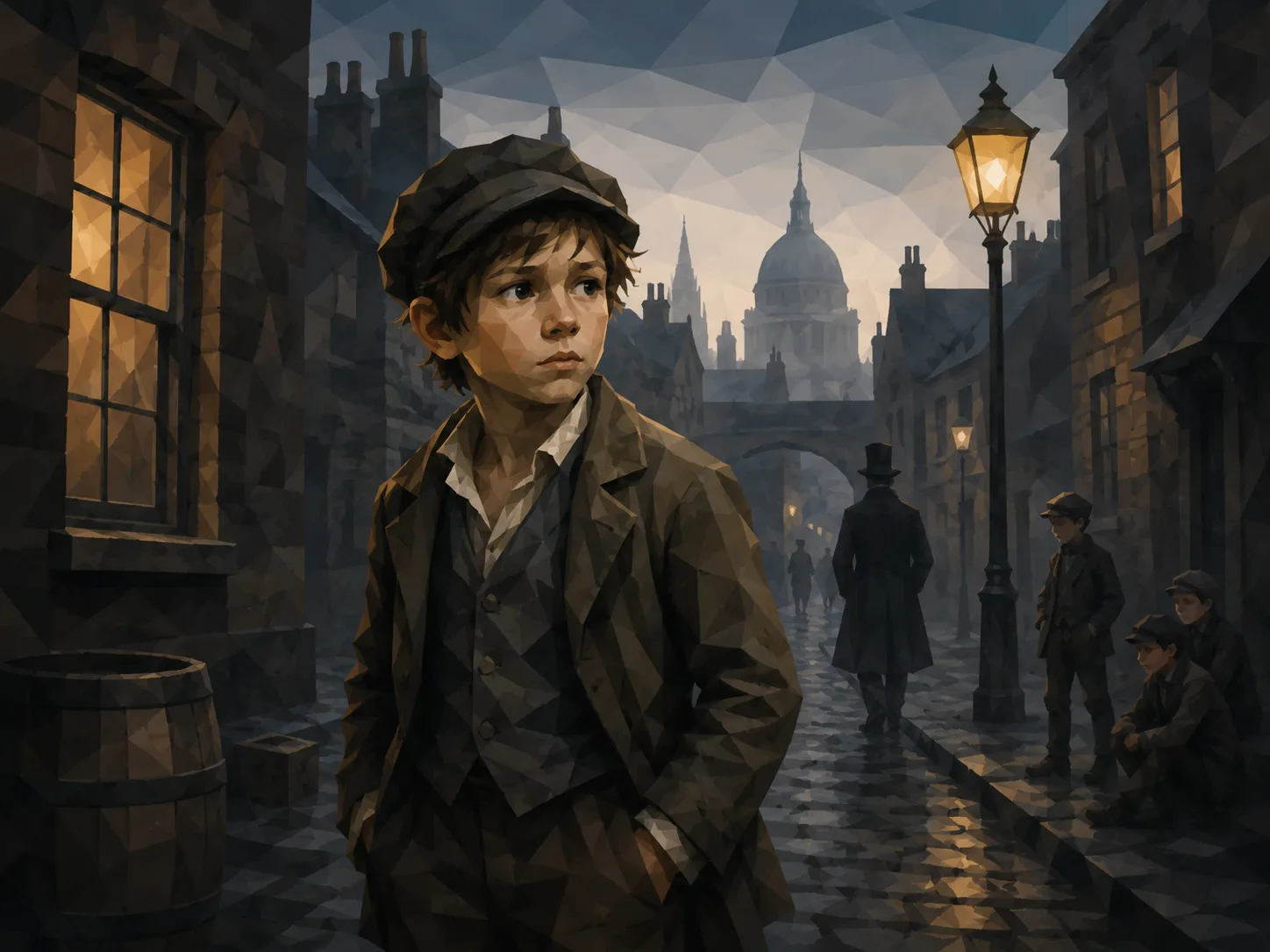
For the next eight or ten months, Oliver fell victim to a systematic pattern of deception. He was "brought up by hand," as the saying goes. The hungry and destitute state of the infant orphan was duly reported by the workhouse authorities to the parish officials. These officials inquired with great dignity whether there was any woman currently living in "the house" who could provide Oliver Twist with the nourishment and care he desperately needed. The workhouse authorities humbly replied that there was not. Consequently, the parish authorities magnanimously—and, in their own eyes, humanely—resolved that Oliver should be "farmed." In other words, he was sent to a branch-workhouse some three miles away. There, twenty or thirty other young offenders against the poor laws rolled about the floor all day without being inconvenienced by too much food or clothing. They were under the "parental" care of an elderly woman who looked after these young culprits for the sum of sevenpence-halfpenny per head, per week.
Now, sevenpence-halfpenny’s worth of food per week is quite a substantial diet for a small child; one could certainly buy enough to overload a stomach and make a child feel quite uncomfortable. However, the elderly woman was a person of great wisdom and experience; she knew what was good for children, and she had an even clearer understanding of what was good for herself. Consequently, she kept the greater part of the weekly allowance for her own use, providing the growing children with even less than the tiny amount originally intended for them. In doing so, she discovered a way to make a desperate situation even worse, proving herself to be a very skilled experimental philosopher.
Everyone knows the story of another philosopher who had a theory that a horse could live without eating. He demonstrated this so well that he had successfully reduced his own horse’s diet to a single straw a day. He would undoubtedly have turned the animal into a very energetic creature on a diet of nothing at all, had the horse not died exactly twenty-four hours before it was due to have its first meal of pure air. Unfortunately for the philosophy of the woman in charge of Oliver Twist, a similar result usually followed her methods. Just at the moment when a child had managed to exist on the smallest possible portion of the weakest possible food, it perversely happened that the child either fell ill from cold, was injured due to neglect, or was accidentally smothered. In any of these cases, the miserable little being was usually summoned to another world, joining the parents it had never known in this one.
Occasionally, when there was a particularly interesting legal inquiry into the death of a parish child, the jury would ask troublesome questions. Sometimes the local citizens would even sign a formal protest against the treatment of the orphans. However, these complaints were quickly dismissed by the evidence of the surgeon and the testimony of the beadle. The surgeon would always claim to have performed an autopsy and found "nothing inside" the body (which was likely true, given the lack of food), and the beadle would invariably swear to whatever the parish wanted him to say. Furthermore, the board of directors made regular visits to the farm, but they always sent the beadle a day in advance to announce their arrival. Naturally, the children were always neat and clean when the directors arrived—and what more could anyone ask for!
It could not be expected that this system would produce a very healthy result. On his ninth birthday, Oliver Twist was a pale, thin child, somewhat small for his age and undeniably fragile. But nature, or perhaps his inheritance, had planted a sturdy spirit in Oliver’s chest. It had plenty of room to expand, thanks to the very limited diet of the establishment. Perhaps it was this spirit that allowed him to reach his ninth birthday at all. Be that as it may, it was his ninth birthday, and he was spending it in the coal-cellar with two other young gentlemen. After being soundly beaten, they had been locked up for the crime of being hungry. It was then that Mrs. Mann, the lady of the house, was startled by the sudden appearance of Mr. Bumble, the beadle, who was struggling to open the garden gate.
"Goodness gracious! Is that you, Mr. Bumble, sir?" cried Mrs. Mann, sticking her head out of the window with an expression of fake delight. "(Susan, take Oliver and those two brats upstairs and wash them immediately!)—My goodness, Mr. Bumble, how glad I am to see you!"
Now, Mr. Bumble was a fat man with a short temper. Instead of responding kindly to this greeting, he gave the little gate a tremendous shake and then kicked it with a force that only a beadle’s leg could manage.
"Just think of that!" said Mrs. Mann, running out—the three boys having been removed by now. "I completely forgot that the gate was bolted on the inside because of those dear children! Walk in, sir; please walk in, Mr. Bumble."
Although this invitation was accompanied by a polite bow that might have softened the heart of any official, it did not satisfy the beadle.
"Do you think this is respectful conduct, Mrs. Mann?" inquired Mr. Bumble, gripping his cane. "To keep the parish officers waiting at your gate when they come here on official business with the parish orphans? Are you aware, Mrs. Mann, that you are a paid representative of the parish?"
"I’m sure, Mr. Bumble, that I was only telling the children, who are so fond of you, that you were coming," replied Mrs. Mann humbly.
Mr. Bumble had a very high opinion of his own speaking skills and his importance. Having displayed both, he finally relaxed.
"Well, well, Mrs. Mann," he replied in a calmer tone. "It may be as you say. Lead the way, for I have come on business."
Mrs. Mann led the beadle into a small parlor, offered him a seat, and carefully placed his hat and cane on the table. Mr. Bumble wiped the sweat from his forehead, glanced proudly at his hat, and smiled. Even a beadle is only human, and Mr. Bumble smiled.
"Now, don't be offended by what I'm about to say," Mrs. Mann said with a sweet smile. "You've had a long walk, so would you like a little drop of something, Mr. Bumble?"
"Not a drop. Not a single drop," said Mr. Bumble, waving his hand in a dignified yet calm manner.
"I think you will," said Mrs. Mann, who had noticed his tone and the way he moved his hand. "Just a tiny drop, with a little cold water and a lump of sugar."
Mr. Bumble coughed.
"Now, just a tiny drop," Mrs. Mann persuaded him.
"What is it?" the beadle asked.
"Well, it's something I’m forced to keep in the house to give the blessed infants when they aren't well," replied Mrs. Mann as she opened a cupboard. "It’s gin. I won't lie to you, Mr. B. It’s gin."
"Do you give the children gin, Mrs. Mann?" Bumble asked, watching her mix the drink with interest.
"Ah, bless them, I do, even though it's expensive," she replied. "I couldn't bear to see them suffer."
"No," said Mr. Bumble approvingly. "You are a compassionate woman, Mrs. Mann. I shall take the first opportunity to mention it to the board. You have the heart of a mother. I drink to your health!" And he swallowed half the glass.
"And now to business," the beadle said, taking out a leather notebook. "The child named Oliver Twist is nine years old today."
"Bless him!" interrupted Mrs. Mann, pretending to wipe a tear from her eye with her apron.
"And despite a reward of ten pounds, which was later increased to twenty, and despite the incredible efforts of this parish," said Bumble, "we have never been able to discover who his father is, or his mother's name or social standing."
Mrs. Mann raised her hands in surprise, then asked, "How does he have a name at all, then?"
The beadle straightened up with great pride. "I invented it."
"You, Mr. Bumble?"
"I, Mrs. Mann. We name our foundlings in alphabetical order. The last one was an S—Swubble, I named him. This one was a T—Twist. The next one will be Unwin, and after that Vilkins. I have names ready all the way to Z."
"Why, you’re quite a literary man, sir!" said Mrs. Mann.
"Well, perhaps I am," said the beadle, clearly pleased with the compliment. He finished his drink and added, "Oliver is now too old to stay here. The board has decided to bring him back to the workhouse. I have come to take him myself, so let me see him at once."
Mrs. Mann left the room and soon returned with Oliver. His face and hands had been scrubbed just enough to remove the thickest layer of dirt.
"Bow to the gentleman, Oliver," said Mrs. Mann.
Oliver made a bow, uncertain whether he was bowing to the beadle or the impressive hat on the table.
"Will you come with me, Oliver?" Mr. Bumble asked in a majestic voice.
Oliver was about to say he would go with anyone quite happily, but he saw Mrs. Mann standing behind the beadle, shaking her fist at him with a furious look. He understood the hint immediately, as her fist had often left a physical impression on him.
"Will she go with me?" poor Oliver asked.
"No, she can't," replied Mr. Bumble. "But she’ll come to see you sometimes."
This was not much comfort to the child. However, despite his age, he was smart enough to pretend he was sad to leave. It wasn't hard for him to cry; hunger and recent mistreatment are very helpful if you need to produce tears. Mrs. Mann gave him many hugs and—what Oliver wanted much more—a piece of bread and butter, so he wouldn't look too hungry when he arrived at the workhouse. With the bread in his hand and a small parish cap on his head, Oliver was led away from the wretched home where not a single kind word had ever brightened his childhood. Yet, he burst into tears as the gate closed behind him. Miserable as his companions were, they were the only friends he had ever known, and a deep sense of loneliness sank into his heart for the first time.
Mr. Bumble walked with long strides, while little Oliver trotted beside him, asking every few minutes if they were "nearly there." Mr. Bumble gave short, grumpy replies; the temporary kindness brought on by the gin had worn off, and he was once again a stern beadle.
Oliver had not been in the workhouse for even fifteen minutes when Mr. Bumble returned. He informed Oliver that the board was meeting and that he must appear before them immediately.
Not knowing what a "board" was, Oliver was quite confused and wasn't sure if he should laugh or cry. He had no time to decide, however, as Mr. Bumble gave him a tap on the head with his cane to wake him up and led him into a large, white room. Eight or ten fat gentlemen were sitting around a table. At the top sat a particularly fat gentleman with a very round, red face.
"Bow to the board," said Bumble. Oliver brushed away his tears and, seeing no board but the wooden table, bowed to that.
"What’s your name, boy?" asked the gentleman in the high chair.
Oliver was so terrified that he began to tremble. When the beadle tapped him again, he started to cry. He answered in such a low, hesitant voice that a gentleman in a white waistcoat called him a fool—which was a wonderful way to make the boy feel at ease.
"Boy," said the red-faced gentleman, "listen to me. You know you’re an orphan, don’t you?"
"What’s that, sir?" inquired poor Oliver.
"The boy is a fool—I knew it," said the gentleman in the white waistcoat.
"Hush!" said the first gentleman. "You know you have no father or mother, and that you were raised by the parish, right?"
"Yes, sir," Oliver replied, crying bitterly.
"What are you crying for?" asked the man in the white waistcoat. Indeed, it was very strange! What could the boy possibly have to cry about?
"I hope you say your prayers every night," said another gentleman in a deep voice, "and pray for the people who feed you and take care of you—like a good Christian."
"Yes, sir," stammered the boy. The gentleman was accidentally right; it would have taken a remarkably good Christian to pray for the people who "cared" for Oliver. But he hadn't, because nobody had ever taught him how.
"Well! You have come here to be educated and taught a useful trade," said the red-faced gentleman.
"So you’ll begin to pick oakum tomorrow morning at six o'clock," added the grumpy man in the white waistcoat.
Oliver bowed low as instructed and was hurried away to a large room where, on a hard bed, he sobbed himself to sleep.
Poor Oliver! He had no idea that the board had made a decision that day which would change his entire life. The members of this board were very "wise" men. When they looked at the workhouse, they concluded that poor people actually liked it! They saw it as a place of entertainment for the poor—a tavern where everything was free, a "paradise" where there was all play and no work.
"We’ll stop this at once," said the board. They established a new rule: the poor could choose to be starved slowly inside the workhouse, or starve quickly outside of it. They arranged for an unlimited supply of water and small amounts of oatmeal. They decided to provide three meals of thin gruel a day, with an onion twice a week and half a roll on Sundays. They also decided to separate married couples to save money, effectively turning husbands into bachelors.
For the first six months, the system worked perfectly. It was expensive at first because of the increased number of funerals and the cost of taking in the clothes of the paupers, which now hung loosely on their shrunken bodies. But soon, the number of inmates began to decrease, and the board was delighted.
The room where the boys ate was a large stone hall. At mealtimes, the master, wearing an apron, would ladle out a single bowl of gruel for each boy. On special occasions, they also received two ounces of bread. The bowls never needed washing; the boys polished them with their spoons until they shone. When they finished—which took no time at all—they would sit staring at the large copper pot with hungry eyes, as if they wanted to eat the very bricks of the building.
Oliver Twist and his companions suffered the pain of slow starvation for three months. Eventually, they became so desperate that one boy, who was tall for his age, hinted that if he didn't get another basin of gruel every day, he might be forced to eat the boy sleeping next to him. The others believed him. A meeting was held, and they drew straws to decide who should walk up to the master after supper and ask for more. The lot fell to Oliver Twist.
The evening arrived. The master stood at the pot; the gruel was served. The gruel disappeared quickly. The boys whispered and nudged Oliver. Though he was just a child, he was desperate with hunger and reckless with misery. He rose from the table, walked up to the master with his bowl and spoon in hand, and said, terrified by his own boldness:
"Please, sir, I want some more."
The master was a fat, healthy man, but he turned incredibly pale. He stared at the small rebel in shock for several seconds, clinging to the pot for support. The assistants were paralyzed with wonder, and the boys with fear.
"What!" said the master at last, in a faint voice.
"Please, sir," Oliver repeated, "I want some more."
The master hit Oliver on the head with the ladle, grabbed him, and screamed for the beadle.
The board was in the middle of a meeting when Mr. Bumble rushed in. "Mr. Limbkins!" he cried. "I beg your pardon, sir! Oliver Twist has asked for more!"
Everyone started in horror.
"For more!" said Mr. Limbkins. "Answer me clearly, Bumble. Do I understand that he asked for more after he had eaten his full allowance?"
"He did, sir," replied Bumble.
"That boy will be hanged," said the gentleman in the white waistcoat. "I know that boy will be hanged."
Nobody disagreed with him. Oliver was immediately locked away. The next morning, a notice was posted on the gate offering a reward of five pounds to anyone who would take Oliver Twist as an apprentice. In other words, the parish was offering five pounds to anyone willing to take the boy off their hands.
"I have never been more convinced of anything in my life," said the gentleman in the white waistcoat as he read the notice the next morning. "I am certain that boy will end up on the gallows."