


Theme & Story
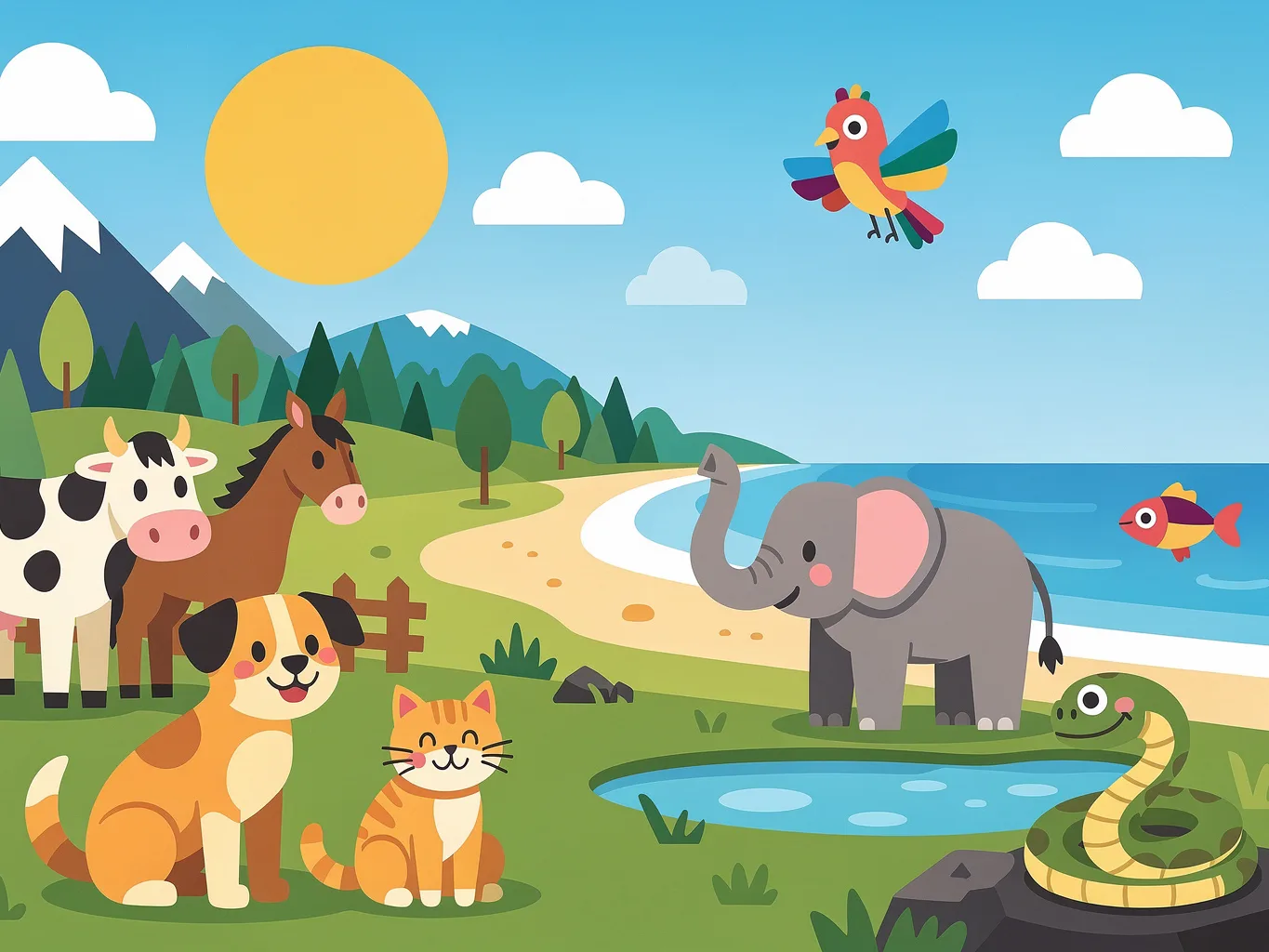
“Big and Small Animals” is a simple, cheerful educational song about animals in many places: home, farm, forest, mountains, lake, sky, and sea. It begins with familiar pets like a dog and a cat, then moves to farm animals, wild animals, birds, fish, and a snake. The song teaches that nature is shared by humans and animals, and it ends with a gentle message: we should love and protect animals.
The repeated chorus — “Animals, animals, big and small” — makes the song easy to remember. It also helps learners practice animal names, adjectives, places in nature, and simple present-tense verbs.
Metaphors & Meaning
The song is mostly literal, meaning it says things directly rather than using many metaphors. However, a few lines have broader meaning:
- “Nature is a home for you and me” means the natural world belongs to all living things, not only humans. It suggests respect, sharing, and environmental care.
- “Side by side” means animals live together in the same world. It can also suggest harmony and peaceful coexistence.
- “The lion, full of pride” has two meanings. Literally, lions are often seen as proud, strong animals. Also, a group of lions is called a pride, so this line has a small wordplay.
- pet: an animal that lives with people, like a dog or cat.
- farm: a place where people grow food and raise animals.
- wild animals: animals that live in nature, not in people’s homes.
- creatures: living animals; a general word for animals.
- protect: to keep someone or something safe.
- huge: very big.
- heavy: having a lot of weight.
- clear blue sky: a sky without many clouds.
- ocean wide: a poetic way to say “wide ocean.”
- full of pride: very proud; here, used to describe a lion.
- big and small
- fast and slow
- high and deep
- dark and clear
- strong and brown
- huge and gray
- Simple present tense
- “He likes to run.”
- “The horses run.”
- “The colorful fish swim.”
- “The little birds fly.”
- Third-person singular -s
- “My little cat sleeps.”
- “The pig is pink.”
- “He walks for miles.”
- Plural nouns
- “cows,” “horses,” “sheep,” “animals,” “creatures,” “birds.”
- Prepositions of place
- “in the sun”
- “on the farm”
- “in the lake”
- “in the sky”
- “in the dark forest”
- Modal phrase: “have to”
- “We have to protect them.”
- Imperatives and polite instructions
- “Look at the earth.”
- “Listen to the sounds.”
- “Please do not feed the wild animals.”
- Conversation practice The dialogue section gives useful question-and-answer patterns:
- “Do you have a pet?” / “Yes, I have a dog and a cat.”
- “What is your favorite animal?” / “I really like horses.”
- “What kind of bird is it?” / “It is an eagle.”
There is also a cultural and educational message in the spoken dialogue: “Please do not feed the wild animals.” This is common advice in parks, zoos, and nature reserves because feeding wild animals can be dangerous for both people and animals.
Vocabulary & Slang
There is no slang in the song; the language is clear and beginner-friendly. Useful vocabulary includes:
Important adjective pairs:
These pairs are useful for learning opposites and descriptive language.
Grammar Notes
The song uses simple grammar that is excellent for English learners.
This tense describes habits, facts, and general truths.
When the subject is he, she, it, or one animal, English often adds -s to the verb.
Note: sheep is irregular. One sheep and many sheep use the same form.
These phrases help learners describe where things are.
Have to means something is necessary or important.
These are commands or instructions. Adding please makes the command polite.