


Theme & Story
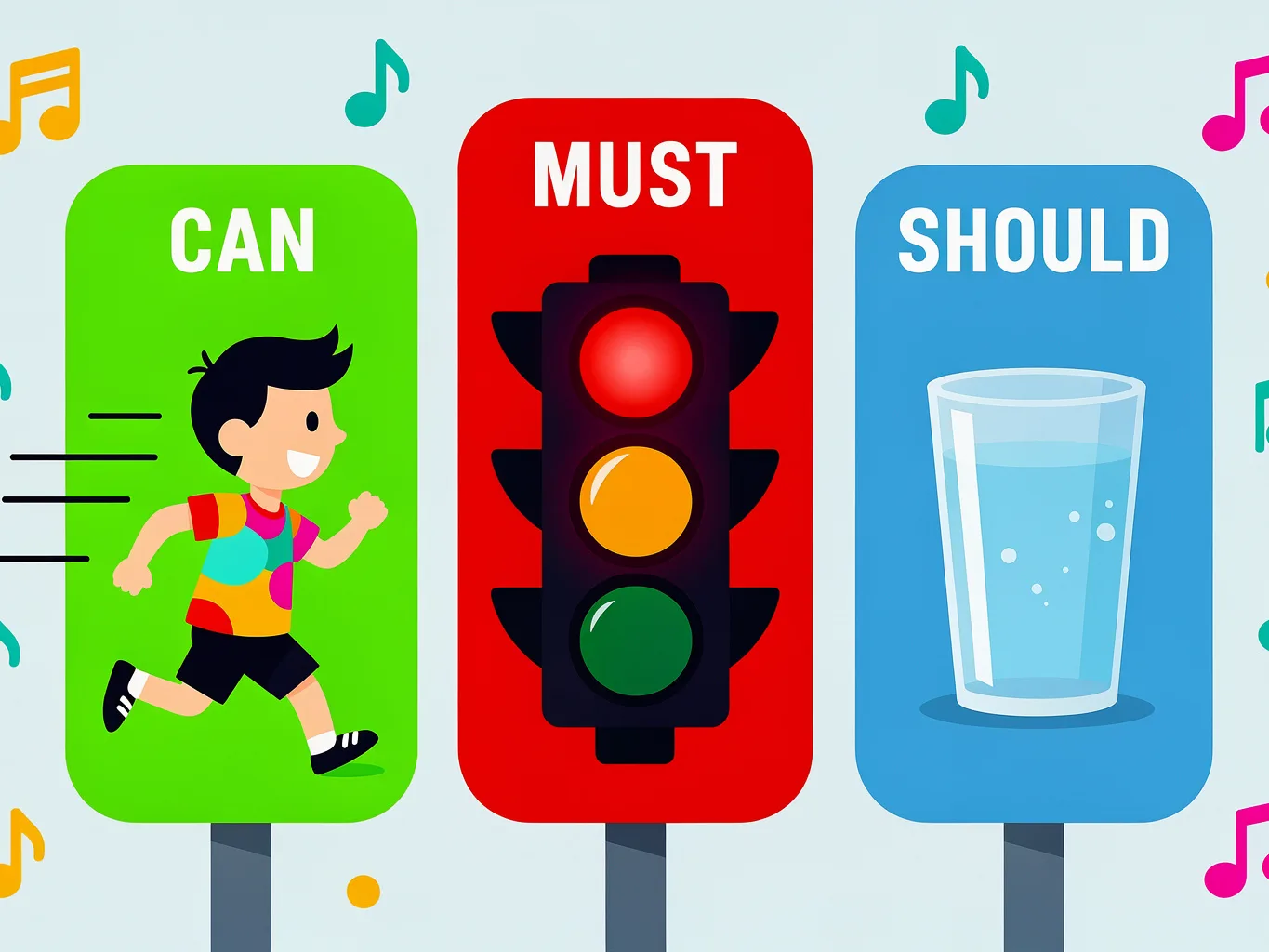
This song is a simple, classroom-style lesson about three important English modal verbs: can, must, and should. It teaches learners how each word expresses a different kind of meaning:
- Can = ability or possibility: “I can run,” “I can swim.”
- Must = strong obligation or rule: “You must stop at the red light.”
- Should = advice or recommendation: “You should rest.”
- “Keep your both feet on the ground” means to stay practical and realistic. In the song, it also connects to the earlier idea that people cannot fly. It reminds learners to focus on real abilities and real rules.
- “The strongest word you ever saw” describes must as a very powerful modal verb. It is not literally strong like a person; it means the word carries strong force because it expresses rules, duties, or laws.
- “The open sky” creates an image of freedom and possibility, but the line “I cannot touch the open sky” shows limits. This helps explain the difference between what we can do and what we cannot do.
- be able to: This explains the meaning of can. Example: “Can means I am able to.”
- follow the sound: Listen to the music and move or sing with it.
- sing along: Sing together with the song.
- red light: A traffic signal where cars and people must stop.
- steal or lie: To take something that is not yours, or to say something untrue.
- good advice: A helpful suggestion, not a strict rule.
- good mood: A happy or positive emotional state.
- cannot = not able to
- must not = not allowed to; forbidden
- shouldn’t = should not; advice against doing something
- I can swim.
- You can swim.
- He can swim.
- I can run.
- You must stop.
- You should rest.
- Can you do it?
- Must I do it?
- Should I do it?
- Cannot / can’t: lack of ability — “I cannot fly.”
- Must not / mustn’t: prohibition — “You must not steal.”
- Shouldn’t: advice not to do something — “You shouldn’t eat too much sweet food.”
- Keep both feet on the ground.
- Keep your feet on the ground.
The “story” is not a dramatic narrative; instead, it works like a musical grammar lesson. The singer introduces rules, gives examples from daily life, and repeats a catchy chorus so learners can remember the modal verbs easily.
Metaphors & Meaning
The lyrics are mostly direct and educational, but a few lines have deeper or figurative meaning:
There are also everyday cultural references, such as stopping at a red light, sleeping enough, listening to your mom, and not stealing or lying. These examples connect grammar to common social rules and good behavior.
Vocabulary & Slang
There is no slang in the song; the language is clear and learner-friendly. Key phrases include:
The song also contrasts negative forms:
Grammar Notes
1. Modal verbs do not change form
Modal verbs like can, must, and should stay the same for all subjects:
Not: “He cans swim.”
2. Use the base verb after a modal
After can, must, and should, use the base form of the verb:
Not: “I can running” or “You must to stop.”
3. Questions use modal + subject + base verb
The chorus shows the question pattern clearly:
This is useful because English modal questions do not need “do/does.”
4. Negative forms have different strength
The song teaches three important negatives:
5. A small grammar correction
The line “Keep your both feet on the ground” sounds a little unnatural in standard English. More natural options are:
Overall, the song is excellent for beginners because it repeats useful grammar patterns and connects them to everyday actions, rules, and advice.