


Theme & Story
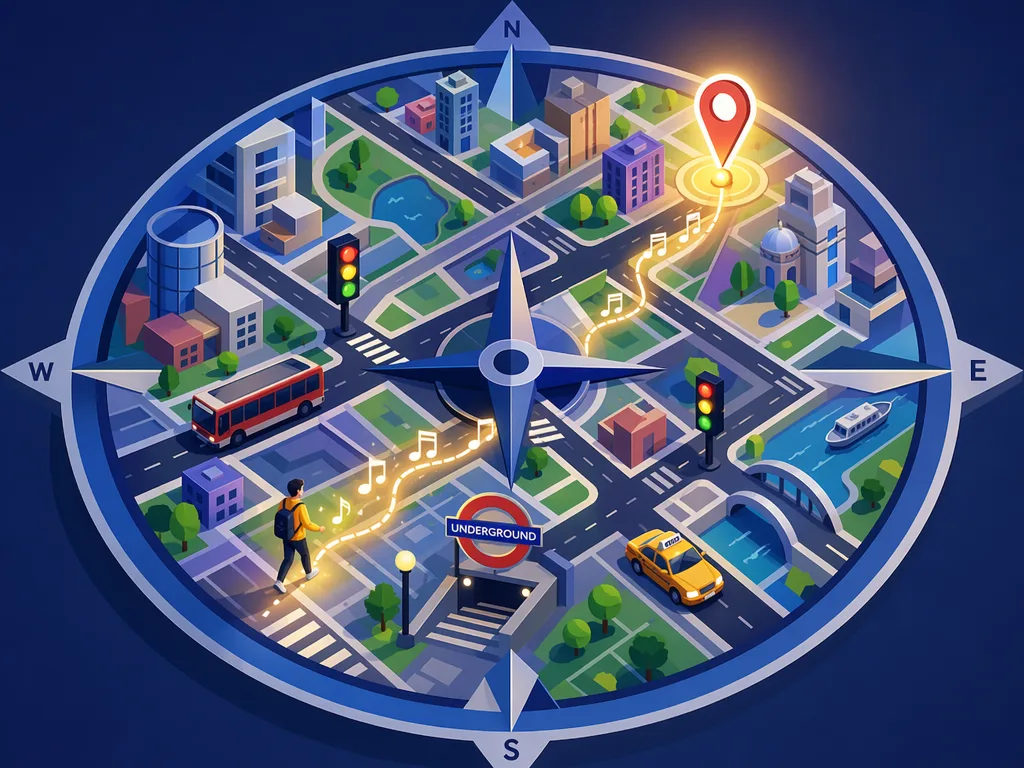
“Concrete Compass (City Navigation)” is a practical, upbeat song about moving through a city and learning how to ask for and follow directions. The speaker walks around town, looking for everyday places like a bank, petrol station, post office, and hospital. The song then becomes a guide to city movement: going straight, turning left or right, crossing roads safely, using public transport, and arriving at a destination.
For language learners, the song is especially useful because it repeats common direction phrases in a memorable rhythm.
Metaphors & Meaning
The title “Concrete Compass” is a metaphor. A compass helps you find direction, while concrete suggests the city environment—streets, sidewalks, buildings, and roads. Together, the phrase means “a way to navigate the city.”
The line “The city is a puzzle, let the music be your guide” compares the city to a puzzle. This suggests that cities can feel confusing, with many roads, signs, and choices. But the music makes the learning process fun and helps the listener remember directions.
The phrase “to the city beat” connects walking through the city with music. It gives the feeling that urban life has its own rhythm: traffic, footsteps, buses, sirens, and movement.
There is also a cultural reference in “boom-bap track.” Boom-bap is a classic hip-hop beat style, especially associated with 1980s and 1990s East Coast rap. It usually has strong drum sounds: a deep “boom” from the bass drum and a sharp “bap” from the snare.
Vocabulary & Slang
- Step into the city: Enter or begin exploring the city.
- Find our way around: Learn how to navigate a place.
- Looking at the map: Using a map to understand where to go.
- Boom-bap track: A hip-hop song or beat with a classic drum style.
- Cash: Money, usually physical money like banknotes or coins.
- Gotta: Informal form of “got to” or “have to.” Example: “I gotta find the bank” means “I have to find the bank.”
- Petrol: Fuel for a car. This is more common in British English; in American English, people usually say gas.
- Fill the tank: Put fuel into a vehicle.
- Around the corner: Very nearby, usually after turning at the next corner.
- Show me the way: Tell me how to get there.
- Go straight ahead: Continue forward without turning.
- Crossroads: A place where roads meet or cross.
- Traffic lights: Lights that control vehicles and pedestrians: red, yellow/amber, and green.
- Pedestrian: A person walking, especially near roads or traffic.
- Roundabout: A circular road junction where traffic moves around a central island.
- Destination: The place you want to reach.
- Without any fuss: Easily, without problems or stress.
- Get off at the station: Leave a bus, train, or underground/subway at a stop.
- Imperatives for directions: The song uses many command forms, which are very common when giving directions: Go straight ahead, Turn left, Turn right, Stop, Follow the signs. In English, imperatives usually start with the base verb and do not need a subject.
- “Gotta” in informal speech: Lines like “I gotta find the bank” and “gotta fill the tank” use casual spoken English. In formal English, you would say “I have to find the bank” or “I need to fill the tank.”
- Present continuous for actions happening now: Phrases like “Walking down the street”, “looking at the map”, and “Navigating the city” describe ongoing actions. In full grammar, they could be: “I am walking down the street” or “We are navigating the city.” Lyrics often shorten sentences to fit the rhythm.
- Modal question for polite requests: “Can you show me the way?” is a useful polite question. It asks for help with directions.
- Prepositions of place and movement: The song teaches important prepositions and direction words: at the corner, through the gate, at the sign, on the crossing, at the station, around the corner.
- Simple rules with “means”: The traffic light lines use a clear structure: Red means stop, green means go, yellow means wait. This is a helpful pattern for explaining symbols, signs, and meanings.