


Theme & Story
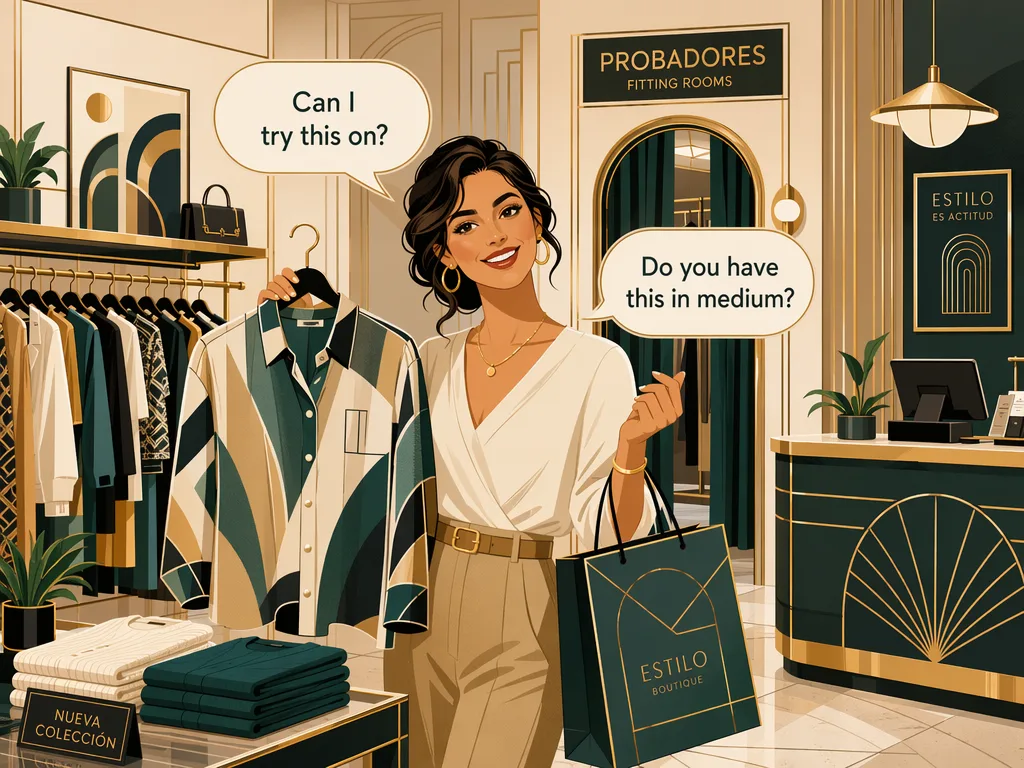
This song is a practical, learner-friendly story about shopping for clothes in English. The speaker enters a clothing store, talks with a shop worker, asks about size, uses the fitting room, checks the price, pays by card, asks for a receipt, and leaves politely.The main theme is confidence in everyday communication. The song teaches common phrases you can use in a real store, especially when you need help from staff.
Metaphors & Meaning
The lyrics are mostly literal and educational, but there are a few playful expressions:- “Finding my style” means discovering what clothes suit your personality and taste. It can also suggest becoming more confident in who you are.
- “To win this fashion prize” is not a real prize. It is a fun way to say the speaker wants to succeed at shopping and choose the right item.
- “She answers with a breeze” suggests the worker answers easily, calmly, and helpfully. The more natural phrase would be “with ease,” so this line is likely chosen for rhyme and rhythm.
- “I’m just looking, thank you” — A polite way to say you are browsing and do not need help.
- “Do you have this in a medium?” — Used to ask for a different size. You can replace “medium” with “small,” “large,” “extra large,” etc.
- “Let me check the back” — The worker will look in the storage area, not the public part of the store.
- “Fitting room” — The place where customers try on clothes. In some places, people may also say “changing room.”
- “Does this look good on me?” — A common question when asking for an opinion about clothing.
- “Can I try this on?” — Used before putting on clothes in a fitting room.
- “Cash desk” — The place where you pay. Also called “checkout,” “cash register,” or “counter.”
- “Is this on sale?” — Asks if the item has a reduced price.
- “Twenty percent off” — The price is reduced by 20%.
- “I’ll take it” / “I will take it” — Means “I want to buy this.”
- “Receipt” — The paper or digital proof of purchase.
- “Here you go” — A friendly phrase used when giving something to someone.
- Present simple for routines and dialogue: The song uses simple, clear sentences like “I walk,” “I find,” “I need,” “I take.” This makes it easy for learners to follow the action.
- Polite questions: Many questions use polite modal verbs:
- “Can I try this on?”
- “Can I get a receipt?”
- “Do you have this in a medium, please?”
- Preposition pattern: “look good on me” — We say clothes look good on a person, not “in” a person.
- Phrasal verb: “try on” — This means to put on clothing to see if it fits or looks good. Example: “I want to try on this jacket.”
- “This in a medium” — Here, “this” means “this shirt/item,” and “in a medium” means “in medium size.”
- Lyrics may bend natural phrasing for rhyme: For example, “she answers with a breeze” is understandable, but “she answers with ease” sounds more natural.
Culturally, the song reflects a common shopping experience in English-speaking countries: store staff may greet you and ask, “Are you looking for something?” or “Can I help you?” A polite response like “I’m just looking, thank you” is very common if you do not need help yet.