


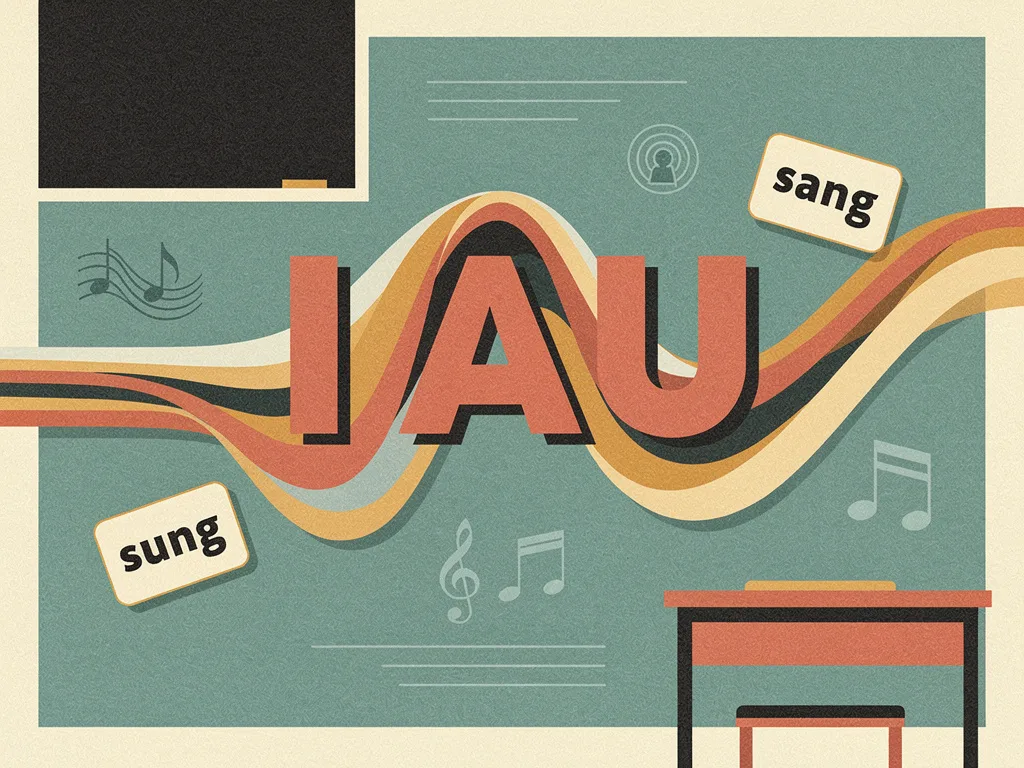
Theme & Story
This song is a fun grammar chant about a common pattern in English irregular verbs: I → A → U. It teaches learners to notice how the vowel sound changes across three forms:
- base form: sing
- past tense: sang
- past participle: sung
- “Keep it on the beat” suggests that rhythm can help memory.
- “Let the rhythm flow” makes grammar feel natural, like music.
- “Keep it in your head” means remember it, especially through repetition.
- vowels: The letters/sounds a, e, i, o, u.
- base form: The basic dictionary form of a verb, such as sing or drink.
- past tense: The form used for completed past actions, such as sang or drank.
- past participle: The form used with perfect tenses and passive voice, such as sung or drunk.
- “Let’s go”: A common energetic phrase meaning “start now” or “come on.” It gives the song a motivational feeling.
- “Keep it in your head”: An informal way to say “remember it.”
- I sing today.
- I sang yesterday.
- I have sung before.
The song turns grammar practice into rhythm and repetition. Instead of memorizing a dry list, the learner is invited to listen, watch, and feel the beat as the verbs change.
Metaphors & Meaning
There is no deep hidden story here; the meaning is mostly educational. However, the lyrics use music as a metaphor for learning language:
The title, “The Vowel Shift,” refers to the way the middle vowel changes in these verbs. It is not about the historical “Great Vowel Shift” in English, but about a practical learner-friendly pattern: i → a → u.
Vocabulary & Slang
Grammar Notes
The song focuses on irregular verbs, especially verbs that follow the vowel pattern:
| Base Form | Past Tense | Past Participle |
|---|---|---|
| sing | sang | sung |
| ring | rang | rung |
| drink | drank | drunk |
| shrink | shrank | shrunk |
| swim | swam | swum |
| begin | began | begun |
| spring | sprang | sprung |
| stink | stank | stunk |
A useful pattern is:
i sound → a sound → u sound
Examples:
The lyrics use short fragments like “Sing. Sang. Sung.” These are not full sentences, but they work well in a song because they are meant as rhythmic grammar examples.